
Gaia20ehk Reveals Evidence of Planet Collision Resembling Moon's Origin
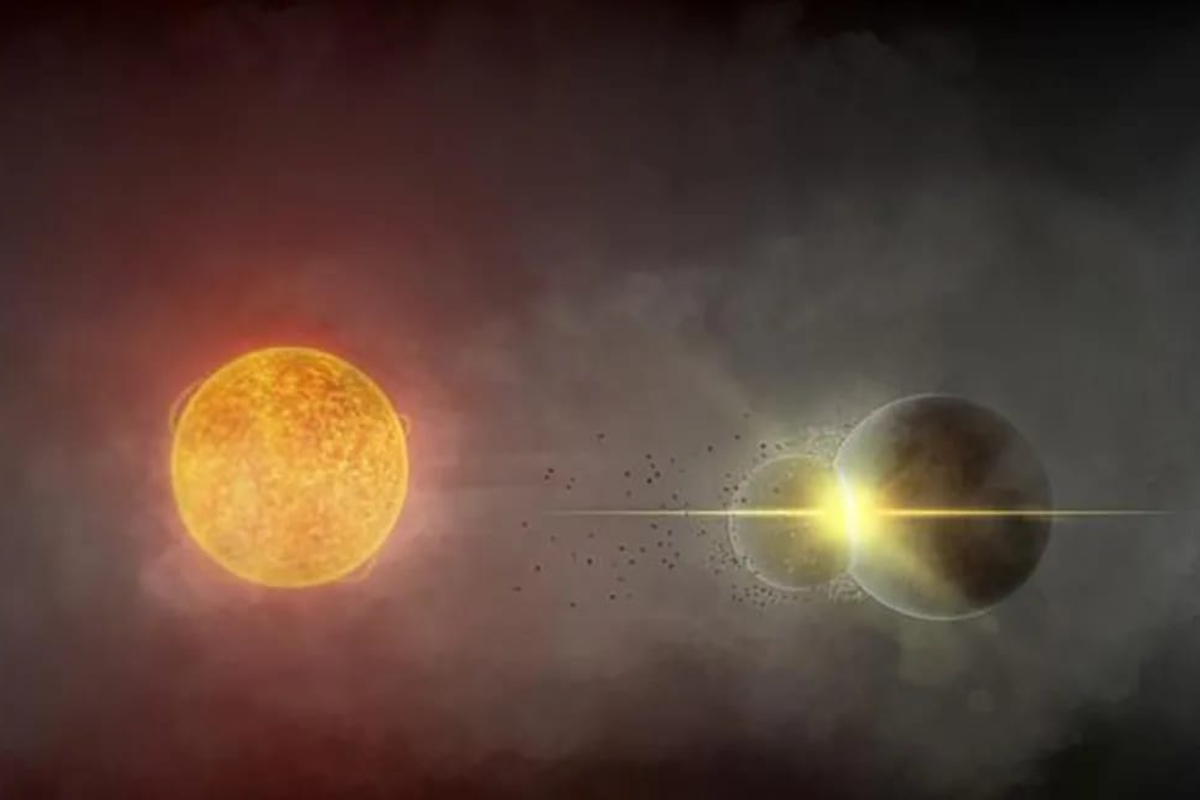
Astronomers believe they have witnessed a collision between two planets orbiting a distant star named Gaia20ehk, which is located about 11,000 light-years from Earth. The discovery is significant because the event is thought to resemble the giant impact that formed the Earth-Moon system around 4.5 billion years ago.
Gaia20ehk is a main sequence star similar to the Sun and should emit stable light. However, while examining archival telescope data from 2020, astronomer Anastasios “Andy” Tzanidakis from the University of Washington found an unusual pattern in the star’s light. “The light output of this star was initially very stable. But since 2016, there have been several dips in brightness, and then around 2021 its behaviour became truly unusual,” Tzanidakis said.
After further analysis, the research team concluded that the flickering light was likely caused by dust and rock fragments passing in front of the star. This material is thought to originate from a catastrophic collision between two planets. To confirm the finding, the astronomers conducted observations using an infrared telescope. The results showed a sharp increase in infrared light as the star’s visible light began to dim.
According to the researchers, this phenomenon indicates the presence of material superheated by a massive impact. They suspect the two planets initially experienced several smaller collisions before finally crashing together catastrophically. “When the visible light started to dim, the infrared light increased dramatically. This indicates the presence of hot material glowing brightly in the infrared spectrum,” Tzanidakis explained.
Scientists say this event bears similarities to the theory of the Moon’s formation. In that theory, a young Mars-sized planet known as Theia struck the early Earth, producing material that later formed the Moon. Interestingly, the dust cloud resulting from the collision around Gaia20ehk is located at a distance of about one astronomical unit (AU) from its star, nearly the same as the average distance from the Earth to the Sun. In the coming millions of years, this material could potentially cool and form a new planet-moon system.
Senior researcher James Davenport said such observations are invaluable for understanding how planets form and evolve. “If we can observe more events like this in the galaxy, we will learn a great deal about how our own world was formed,” he stated. Astronomers consider the chance of directly witnessing a planetary collision to be very small, as it requires precise positioning and long-term observation. Therefore, the Gaia20ehk discovery represents one of the rarest and most important pieces of evidence regarding the planet formation process ever observed in real time.