
Gadi Eisenkot’s Bloody Record in Palestine: More Ruthless than Netanyahu?
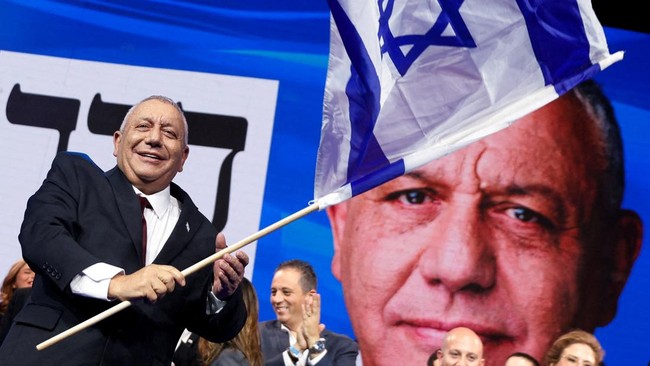
Israel is considering a change of prime minister after President Isaac Herzog chose Gadi Eisenkot to have the first opportunity to form a new government, potentially bringing Benjamin Netanyahu’s leadership to an end.
However, the prospective new Israeli leader has a controversial military record, particularly in relation to operations against Palestinians that killed large numbers of civilians.
Eisenkot is a former chief of staff of the Israel Defense Forces (IDF) who led various military operations, including during the 2018 demonstrations in the Gaza Strip in which hundreds of Palestinians were killed.
According to Al Jazeera, Israeli President Isaac Herzog announced on Saturday (7 November 2026) that he would give Eisenkot the first chance to form a new government after the 27 October 2026 election failed to produce an outright majority winner.
The decision followed recommendations from 67 of the 120 members of Israel’s parliament, the Knesset, for Eisenkot to be the government-former. Netanyahu received the support of 46 members, while seven gave no recommendation.
Herzog is scheduled to formally give Eisenkot the mandate on Sunday (8 November 2026). He will then have 28 days to form a government, with a possible extension of up to 14 days.
Despite receiving more recommendations, Eisenkot’s path to the premiership is far from certain.
His four-party coalition holds only 48 seats, while Netanyahu’s bloc has 53. Eisenkot needs additional support to reach the minimum majority of 61 seats.
Amid the political contest, Eisenkot’s long career in the Israeli military is also worth examining.
Before entering politics, he commanded Israeli forces in the West Bank, advocated a doctrine of using overwhelming military force and deployed snipers against Palestinian demonstrations in Gaza.
From ordinary soldier to Israel’s military chief
Gadi Eisenkot was born on 19 May 1960 in Tiberias, Israel, to a Jewish family of Moroccan descent. His father was from Marrakesh and his mother from Casablanca.
He spent much of his childhood in Eilat, a port city in southern Israel.
His military career began in 1978, when he joined the Golani Brigade, an IDF infantry unit.
Eisenkot spent decades in the military, rising from the ranks to command the Golani Brigade in 1997–98.
From 2003 to 2005, he served as commander of the Judea and Samaria Division, the name Israel uses for much of the West Bank, Palestinian territory occupied since the 1967 war.
The Second Intifada was under way at the time. The West Bank was the scene of Israeli military operations, clashes with armed groups and crackdowns on Palestinians.
His career continued to advance: he became head of the IDF Operations Directorate from 2005 to 2006 and then commander of the Northern Command from 2006 to 2011.
In February 2015, Eisenkot reached the peak of his military career when he was appointed the IDF’s 21st chief of staff.
He led the Israeli armed forces until January 2019, ending a military career of about 41 years.
Throughout that period, Eisenkot was part of the command structure for various Israeli operations. Some of his policies and statements also prompted controversy, particularly over the use of military force in ways that risked causing heavy civilian casualties.
Eisenkot’s dark record towards Palestinians
Gadi Eisenkot’s military career has included a number of controversial episodes, particularly concerning Israel’s use of force against Palestinians.
One of the most notable occurred while he was IDF chief of staff in 2018, when hundreds of Palestinians were killed during protests along the Gaza border in a crackdown by Israeli forces.
That was not the only controversy associated with him. The following are some of the key episodes in his military career.
1. Snipers deployed and hundreds killed in Gaza
In March 2018, thousands of Palestinians began the Great March of Return demonstrations, demanding the right of return for Palestinian refugees and protesting against the blockade of Gaza.
Ahead of the demonstrations, Eisenkot said the Israeli military had deployed more than 100 snipers along the border.
Reuters reported that Eisenkot said his forces would not allow demonstrators to breach the border fence. He also authorised the use of live fire if Israeli soldiers’ lives were threatened.
The demonstrations continued for months and resulted in heavy casualties.
According to findings published in February 2019 by the UN Independent Commission of Inquiry, between 30 March and 31 December 2018:
189 Palestinians were killed, 183 of them by Israeli forces’ live fire.
Those killed by live fire included 35 children, three medical workers and two journalists.
A further 6,106 Palestinians were injured by live fire.
The UN also found reasonable grounds to believe that Israeli forces had shot some demonstrators who posed no direct threat to the lives of others.
The commission said some of the actions by Israeli forces may have constituted war crimes or crimes against humanity and warranted further investigation.
Israel rejected the findings, saying its forces faced security threats along the Gaza border.
The events took place while Eisenkot was the IDF’s top commander. However, the UN findings did not, by themselves, establish his personal criminal responsibility.
2. The Dahiya doctrine: a strategy of large-scale destruction
Another controversy dates from before Eisenkot became IDF chief of staff, when he advanced a military approach known as the Dahiya doctrine.
The doctrine refers to the use of overwhelming military force to inflict extensive damage on areas used by armed groups to launch attacks.
Its name comes from the Dahiya district of Beirut, Lebanon, which suffered extensive damage during Israel’s 2006 Lebanon war.
In October 2008, Eisenkot warned that Lebanese villages used by Hezbollah to attack Israel could face similar destruction.
He said Israel would use disproportionate force to cause extensive damage to areas regarded as Hezbollah military bases.
Although the statement was initially directed at Hezbollah in Lebanon, the approach raised questions about the protection of civilians in Israeli military operations, including in conflicts in Gaza.
International humanitarian law requires parties to a conflict to distinguish between military targets and civilians, and prohibits attacks expected to cause excessive civilian harm.
3. Proposal to restrict humanitarian aid to Gaza
Controversy surrounding Eisenkot continued after he left the military and joined Netanyahu’s emergency government following Hamas’s 7 October 2023 attack.
Eisenkot served as a minister without portfolio — a ministerial-level official who sits in the cabinet but does not head a specific ministry — and was also an observer on Israel’s war cabinet.
In January 2024, Israeli broadcaster Channel 12 reported that Eisenkot and Benny Gantz had considered temporarily restricting the entry of humanitarian aid into the Gaza Strip.
The measure was considered as a way to increase pressure on Hamas, change the aid distribution mechanism and encourage the release of Israeli hostages.
The reported proposal prompted concern because Gaza’s population was heavily dependent on humanitarian aid during the war. The report did not say that the restriction had been approved or implemented.
Eisenkot left Netanyahu’s emergency government in June 2024, criticising the war strategy and the prime minister’s leadership.
However, his departure did not mean that he opposed all Israeli military operations against Hamas.
Netanyahu goes, but are Palestinians still at risk?
After retiring from the military, Eisenkot entered politics through the National Unity Party in 2022, before founding the Yashar Party in September 2025.
Although he is challenging Netanyahu, Eisenkot’s views on Palestine have several points in common with the prime minister’s. Both oppose the establishment of an independent Palestinian state. Eisenkot has also left open the possibility of Israel resuming military operations in Gaza if Hamas does not disarm.
Eisenkot differs on Israeli settlements in the West Bank. He opposes settler violence against Palestinians and has criticised plans to build settlements in the E1 area, while continuing to support Israeli settlements under certain conditions.
After decades in military leadership and involvement in military operations, Eisenkot now has the opportunity to become Israel’s prime minister.
But his record and political positions suggest that replacing Netanyahu with Eisenkot may not bring major change for Palestinians, particularly in Israeli security policy or the prospects for an independent Palestinian state.
Source: jawawa.id (https://jawawa.id/newsitem/gadi-eisenkots-bloody-record-in-palestine-more-ruthless-than-netanyahu-1794181840)
Originally published by CNBC Indonesia (https://www.cnbcindonesia.com/research/20261108183710-128-783312/jejak-berdarah-gadi-eisenkot-di-palestina-lebih-kejam-dari-netanyahu), translated from Indonesian