
Furniture Industry Starts to Gasp for Air, Business Leaders Urge Indonesia Not to Be Complacent
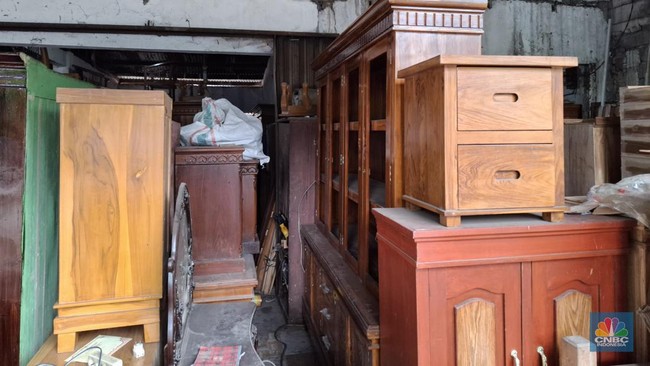
Geopolitical tensions worldwide, especially the conflict in the Middle East, are now being directly felt by national industry players. Furniture businesspeople assess that this situation is pressuring business activities, particularly those reliant on export markets.
The impact of supply chain disruptions is now increasingly evident in the field. The distribution of goods has become slower, while payments from foreign buyers tend to be delayed due to heightened caution.
“What is happening in the field right now is that goods are often held up, shipments are no longer smooth, and payments from buyers are also proceeding more slowly. This is the real condition we are facing,” said the General Chairman of the Indonesian Furniture and Handicraft Industry Association (HIMKI), Abdul Sobur, to CNBC Indonesia on Monday (6/4/2026).
The furniture and handicraft sector, which absorbs a lot of labour, is very vulnerable to global changes. Increases in logistics and energy costs, as well as disruptions to distribution routes, are seen to directly strike production sustainability.
“Now we are facing major changes in the global landscape. Geopolitics is already greatly influencing market directions, costs, and business risks,” he said.
In this situation, industry resilience cannot rely solely on production capacity. Adaptation to uncertainty becomes a key factor for business players to remain viable.
“The future resilience of the industry will be greatly determined by the ability to adapt to uncertain conditions like now,” he explained.
One way to survive is by expanding export markets. Diversification is considered important so that business players do not depend on a single region. In addition, strengthening alternative distribution routes and logistics efficiency are also primary concerns.
“This step is what we are promoting as a medium-term strategy, by building distribution centres in Europe, America, and Canada so that our marketing system becomes more stable,” he said.
Such efforts cannot proceed alone without government support. The role of the state is considered important, both through policies, financing, and trade diplomacy.
“We hope the government can see this as part of the national strategy, so that the association’s movements can be strengthened with state support,” he stated.
According to him, the presence of international hubs will not only expand market access but also sustainably enhance the competitiveness of the national industry.
On the other hand, he views the current global situation as an opportunity for Indonesia to carry out structural improvements. Dependence on old patterns is seen to need reduction by building a more resilient and flexible industrial system.
“Going forward, we need to build an industry that is not easily shaken by crises, with more diverse markets and a more adaptive distribution system,” he said.
Source: jawawa.id (https://jawawa.id/newsitem/furniture-industry-starts-to-gasp-for-air-business-leaders-urge-indonesia-not-to-be-complacent-1775638358)
Originally published by CNBC Indonesia (https://www.cnbcindonesia.com/news/20260406123045-4-724146/industri-mebel-mulai-megap-megap-bos-pengusaha-desak-ri-jangan-lengah), translated from Indonesian