
Full Story: Purbaya Rejects IMF Emergency Financing Offer
Jakarta, CNBC Indonesia - The Ministry of Finance has detailed the reasons Finance Minister Purbaya Yudhi Sadewa rejected an offer of funding assistance from the International Monetary Fund (IMF).
Plt. Director General of Financial Sector Stability and Development Herman Saheruddin stated that Purbaya refused the IMF’s offer because Indonesia’s economic conditions remain sufficiently strong.
“Mr. Minister Purbaya rejected the IMF’s offer because it depends on the nature of the financing and our economic conditions are still quite good. They lowered our economic growth projection, but the fact is our economy is still growing above 5%,” Herman said when met by journalists at his office on Thursday (26/6/2026).
Herman continued that the IMF lowered Indonesia’s economic growth projection based on existing risks, as the IMF views things from a risk perspective, meaning its financing is intended to face risk.
“So if they lower the economic growth projection, there’s no need to be surprised. Because their nature is to look at it from the risk side. Their main product is financing to face risk,” he explained.
“So at that time, Mr. Purbaya said, we can grow higher, and we are committed to keeping our deficit below 3%. If we accept that financing, it means financing to face high-risk conditions,” he added.
He further explained that the Finance Minister refused because the government is still capable of safeguarding the Indonesian economy.
“It was indeed offered by the IMF, but the Minister refused and said, ‘we shouldn’t give up yet, because we have plenty of money’,” he stated.
Previously, Purbaya rejected the offer of debt funding assistance from the International Monetary Fund amidst global economic turmoil that is currently pressuring many countries.
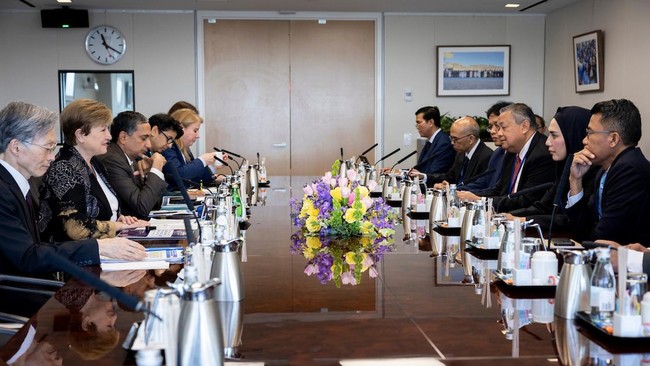
The assistance offer was conveyed during a meeting between the government and IMF Managing Director Kristalina Georgieva in Washington DC, United States, on 14 June.
To the IMF, Purbaya stated that the State Budget (APBN) remains quite strong. This strength is partly supported by a Budget Surplus Balance (SAL) reaching Rp420 trillion.
“I asked them if there was any specific policy from the IMF to help reduce uncertainty. He said the IMF does not have the authority to do that, but they provide aid funds for countries in need. Of course, Indonesia does not need it because our budget is quite good and we still have a large cushion of Rp420 trillion,” Purbaya said.
The IMF also questioned how Indonesia could remain solid amidst such challenging circumstances. Purbaya answered that this resilience is the result of policy changes implemented by the government since last year.
These policy reforms have made the Indonesian economy more prepared to absorb external shocks.
“Why can we survive amidst this global situation? I explained that we have already changed our policies since last year, and it seems clear. So we are experiencing an acceleration when shocks from global uncertainty, from high oil prices, occur. Thus, we can absorb the shocks that happen,” he said.