
Full Details of Jambean, Bantul’s Rule Requiring New Residents to Contribute Up to Rp1 Million
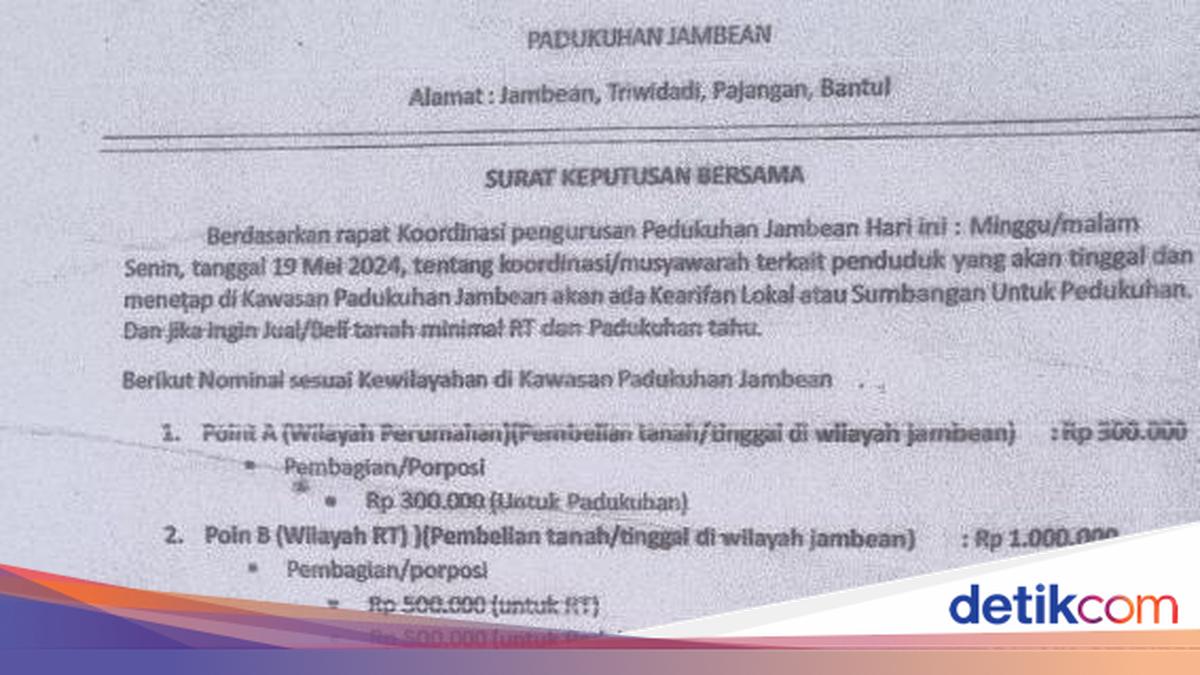
An agreement requiring new residents in Padukuhan Jambean, Bantul, to contribute up to Rp1 million was signed in 2024.
DetikJogja obtained a copy of the agreement from Triwidadi Village Head Slamet Riyanto. The letter, bearing the Padukuhan Jambean letterhead, is dated 14 May 2024.
It states that contributions are requested from people who plan to live or settle in Padukuhan Jambean. The amounts are set out in two categories.
Under point A, residents in the housing area are asked to contribute Rp300,000 to the hamlet. Under point B, residents in the RT areas are asked to pay Rp500,000 to their RT and Rp500,000 to the hamlet, bringing the total to Rp1 million.
The contributions apply to people buying land or planning to settle in Padukuhan Jambean. The letter also refers to other contributions or local customs that may be agreed at a later date. The amounts listed are payable only once by people moving into the hamlet.
The letter was signed by the Jambean hamlet head, the Jambean Village Community Resilience Institution (LKMD), the chair of the Bukit Tentrem Housing Association and all RT heads.
Hamlet head says contributions are voluntary
Jambean Hamlet Head Hendi said the letter was a joint agreement and that contributions were voluntary.
“The joint agreement dates from 2024, so it has been in place for quite a long time. It was agreed with all local stakeholders, including the RTs and the housing area,” he said when met at his home in Jambean, Triwidadi, Bantul, on Tuesday (13 October 2026).
Hendi said the agreement sets out contribution amounts for new residents in the housing area and in Jambean’s seven RTs. However, in the two years since it was issued, only four people had paid.
“In practice, not everyone contributes, and we do not force anyone. From 2024 to 2026, only four people have contributed, and they were all from the housing area,” he said.
He said the contributions were intended solely to support the hamlet, particularly its operating costs. These include funding for integrated health posts (Posyandu), road repairs, RT events, Independence Day celebrations and some activities for Jambean’s young people.
Hendi said officials did not pursue or pressure residents who chose not to contribute.
“Many people do not contribute, and in practice we do not chase them or ask them to pay. Why? It is the people’s right, and we do not force them,” he said.
Residents who do not contribute still receive administrative services. For example, the hamlet will process a certificate of domicile without charging a fee.
“We still provide services. The claim being circulated that a domicile certificate costs Rp300,000 is simply not true,” he said.
After the contributions became controversial, Hendi said the hamlet planned to hold another meeting to decide whether the agreement should remain in force.
“We will discuss it with all residents first, because a decision has to be made through deliberation,” he said.
“If the Inspectorate wants it withdrawn and residents want that too, we will withdraw it. But we must discuss it together first,” he added.
Bantul Inspectorate says no extortion took place
The Bantul Regency Inspectorate also commented, saying it had found no element of extortion in the contributions.
“We have concluded our review and have summoned the complainant, the hamlet head, the RT heads, the association chair and the village head. Based on the facts we examined, the accounts we heard and the evidence, we did not conclude that this was extortion,” Bantul Regional Inspector Trisna Manurung told reporters at the Inspectorate office on Tuesday (13 October 2026).
Trisna said extortion involved a charge imposed without a regulatory basis and under coercion. It could also involve denying services or forcing someone to leave their home if they refused to pay.
“After looking into it, we found there was no coercion, and the person who reported it did not pay. We can debate the regulatory basis, even though an agreement exists, but clearly there was no compulsion: only a few people paid,” he said.
He added that payment was not linked to services provided by the RT or hamlet officials, as the complainant had still received a certificate of domicile. There was also no discrimination or attempt to prevent the person from living there.
Inspectorate recommends reviewing the contributions
Nevertheless, Trisna recommended reviewing the contributions and ensuring they had a stronger legal basis, such as a village regulation (Perdes).
“Given the circumstances, my first recommendation is, as far as possible, to put this under a higher-level regulation, such as a village regulation,” he said.
His second recommendation was that officials prepare and share an accountability report (SPJ) with residents to demonstrate that the money was being used for the community’s benefit.
“Another important point is a review of the joint agreement. If it is not suitable as a regulation, raise it to a higher level, such as a village regulation. Otherwise, residents can discuss whether it should continue or be discontinued,” he said.
Source: jawawa.id (https://jawawa.id/newsitem/full-details-of-jambean-bantuls-rule-requiring-new-residents-to-contribute-up-to-rp1-million-1791942626)
Originally published by detikJogja (https://www.detik.com/jogja/berita/d-8705671/isi-lengkap-aturan-jambean-bantul-soal-warga-baru-harus-nyumbang-rp-1-juta), translated from Indonesian