
Full Details: Bank Indonesia Maintains Benchmark Interest Rate at 5.75% to Stabilise Rupiah
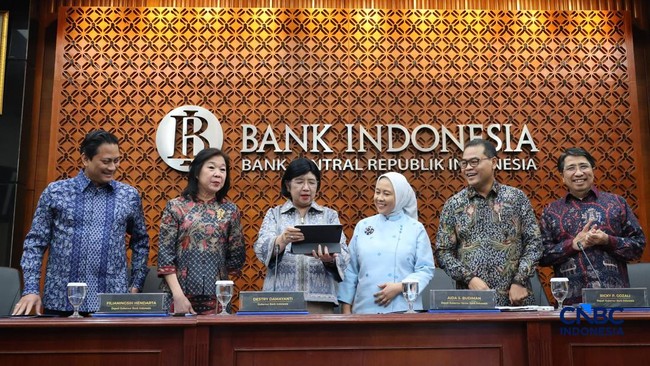
The Board of Governors of Bank Indonesia (BI) has maintained the BI-Rate benchmark at 5.75% for September 2026. This decision marks the fourth consecutive month that the benchmark rate has remained unchanged since the board of governors’ meeting in June 2026.
“The Bank Indonesia Board of Governors’ Meeting on 22-23 September 2026 decided to maintain the BI-Rate at 5.75%, the Deposit Facility interest rate at 4.75%, and the Lending Facility interest rate at 6.50%,” stated BI Governor Destry Damayanti during a press conference at the Bank Indonesia Office, Jakarta, on Wednesday (23/9/2026).
Damayanti noted that this decision remains consistent with the strategy to stabilise the Rupiah exchange rate amidst strong external pressures, aiming to support the inflation target of 2.5±1% for 2026 and 2/27, while encouraging sustainable economic growth. Bank Indonesia also continues to strengthen incentive policies to attract foreign capital inflows, maintain Rupiah stability, and accelerate the deepening of money and foreign exchange markets (PUVA).
Meanwhile, macroprudential and payment system policies remain directed towards supporting economic growth. Loose macroprudential policies are being strengthened to increase credit and financing to the real sector while maintaining financial system stability. Payment system policies are focused on supporting economic activities through the expansion of digital payment acceptance, strengthening the payment system industry structure, and enhancing the reliability and resilience of payment infrastructure.
The direction of the monetary, macroprudential, and payment system policy mix to strengthen stability and promote sustainable economic growth is supported by the following policy measures:
Strengthening the effectiveness of monetary policy implementation to stabilise the Rupiah, maintain 2026 and 2027 inflation within the 2.5±1% target, and ensure Rupiah liquidity adequacy, by:
Optimising foreign exchange intervention strategies to strengthen Rupiah stability through Non-Deliverable Forward (NDF) transactions in overseas markets as well as spot and Domestic Non-Deliverable Forward (DNDF) transactions in the domestic market;
Managing the interest rate structure in the money market in line with the BI-Rate policy and pro-market monetary operation instruments, accompanied by the strengthening of pro-market monetary operation strategies.
Strengthening the effectiveness of Rupiah exchange rate stabilisation while supporting efforts to maintain Rupiah liquidity adequacy, by:
Increasing incentives for Conventional Hedging Buy Swap instruments to Bank Indonesia for underlying foreign funding transactions, including portfolio inflows, foreign loans by banks, and foreign direct investment, by reducing premiums from 12.5% for all tenors to 15% for 3-month tenors, 20% for 6-month tenors, and 25% for 12-month tenors;
Increasing incentives for Domestic Non-Deliverable Forward (DNDF) Hedging instruments to Bank Indonesia for underlying foreign funding transactions, including portfolio inflows, foreign loans by banks, and foreign direct investment, by reducing premiums from 15% to 25% for 6-month tenors and 30% for 12-month tenors;
Continuing the provision of incentives for Local Currency Transaction (LCT) transactions with partner countries to diversify foreign exchange transactions, specifically: (a) adding a 10% premium to the Buy Hedging Swap (Sell Hedging Swap to Bank Indonesia); and (b) reducing the DNDF Sell Hedging premium by 10%.
Strengthening the effectiveness of accommodative macroprudential policy implementation to encourage credit/financing growth to support economic growth while maintaining financial system stability, by:
Continuing preparations for the implementation of the Macroprudential Inclusive Financing Ratio (RPIM) policy to encourage bank credit/financing to inclusive and sustainable sectors, effective 1 October 2/26;
Continuing synergy with the Government and other stakeholders to encourage bank credit/financing through the Indonesia Accelerated Intermediation Programme (PINISI).
Strengthening the acceleration of digital acceptance through collaboration between the Coordinating Ministry for Economic Affairs, Bank Indonesia, the Financial Services Authority (OJK), and industry associations during the Indonesia Digital Financial Economy Festival and Indonesia Fintech Summit and Expo (FEKDI and IFSE) 2026 from 24 to 26 September 2026. This activity is a manifestation of synergy across various initiatives, including:
National Coordination Meeting (Rakornas) for Inflation Control (PI) and Acceleration and Expansion of Regional Digitalisation (P2DD);
The National Digital Transformation Celebration as a milestone for synergy in expanding digitalisation across Ministries/Agencies;
The inauguration of the expansion of cross-border QRIS cooperation with central banks of partner countries; and
The initiation of the Indonesia Travel Pack.
Strengthening and expanding international cooperation in the area of central banking, including payment system connectivity and transactions using local currencies, including the addition of Singapore as a new LCT partner in August 2026.
“Bank Indonesia continues to strengthen policy coordination with the Government, the Financial System Stability Committee (KSSK), and other stakeholders in an effort to maintain economic stability and support sustainable economic growth,” said the Governor of BI.
Source: jawawa.id (https://jawawa.id/newsitem/full-details-bank-indonesia-maintains-benchmark-interest-rate-at-5-75-to-stabilise-rupiah-1790157524)
Originally published by CNBC Indonesia (https://www.cnbcindonesia.com/market/20260923160219-17-770293/simak-keputusan-lengkap-bi-tahan-bunga-acuan-575-demi-rupiah), translated from Indonesian