
Full Contents of China's KADIN Letter to Prabowo, Frank Complaints About These Issues
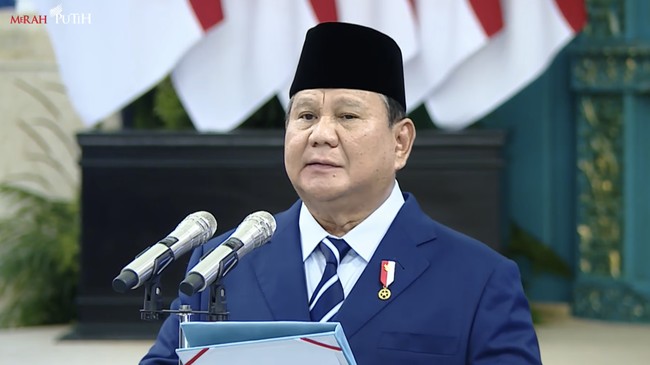
Jakarta, CNBC Indonesia - The Chamber of Commerce of China in Indonesia has sent an official letter to the President of the Republic of Indonesia, Prabowo Subianto. In the letter, business actors highlighted various government policies and emerging concerns.
The letter contains a series of complaints regarding tax and royalty increases, tightened regulations on export proceeds (DHE), reductions in nickel ore quotas, and allegations of excessive law enforcement practices that open doors to corruption and extortion.
In the letter, Chinese investors emphasised that they have fully supported Indonesian government policies and conducted business in accordance with applicable laws. They also claimed to have made significant contributions to Indonesia’s economic growth, job creation, downstream industry development, and social responsibility.
However, they assessed that the situation has changed drastically in recent times.
“In recent times, companies operating in Indonesia have generally faced serious problems, including overly tight regulations, excessive law enforcement, and even corruption and extortion by relevant authorities,” the letter stated, quoted on Wednesday (13/5/2026).
According to them, these conditions have seriously disrupted normal business operations, damaged long-term investment confidence, and caused widespread concerns among Chinese investment companies regarding the business environment and their future in Indonesia.
One of the main highlights is the repeated increases in taxes and levies. Chinese investors also complained about increasingly intensive tax examinations accompanied by threats of very large fines.
“Taxes and fees, including mineral resource royalties, have been raised repeatedly, accompanied by increasingly intensive tax examinations and even large fines of up to tens of millions of US dollars, creating panic among companies,” the letter stated.
Another complaint targeted the planned requirement to place export proceeds from natural resources in Indonesian state-owned banks for at least one year. This policy is seen as disrupting company liquidity.
They assessed that the obligation to store 50% of export proceeds in state-owned banks would severely harm company liquidity and long-term operations.
Chinese investors also protested the massive reduction in nickel ore mining quotas since the beginning of this year. According to them, the quota cuts for large mines reached more than 70% or around 30 million tonnes in total.
This situation is said to disrupt downstream industries such as new energy vehicles and stainless steel.
Not only that, law enforcement in the forestry sector also came under scrutiny. The letter mentioned that the Indonesian Forest Area Regulation Task Force imposed fines of up to US$180 million on Chinese investment companies related to forest area borrowing permits.
In addition, several major projects were reportedly halted by the government. Chinese investors accused authorities of directly intervening in company operations, including on a hydroelectric power plant project accused of damaging forest areas and exacerbating flooding.
“The government ordered the cessation of work and imposed sanctions,” the letter stated.
Issues with work visas for foreign workers also drew attention. They stated that the work visa approval process is now increasingly complicated, expensive, and restricted by specific work location requirements, thus hindering the mobility of technical and managerial personnel.
In addition to existing policies, Chinese investors also expressed concerns about several new government regulations, such as the imposition of additional export duties on certain products, the elimination of electric vehicle incentives, and the reduction of tax facilities in special economic zones.
The biggest concern appears to be focused on the nickel sector. In the letter, the Ministry of Energy and Mineral Resources (ESDM) is said to have recently raised the Benchmark Mineral Price (HPM) for nickel ore and changed its calculation formula by including cobalt, iron, and other associated minerals.
Chinese investors assessed that this policy caused the comprehensive cost of nickel ore to surge by up to 200%.
“As the largest investors and operators in Indonesia’s nickel industry, Chinese investment companies are now facing sharp increases in production costs, widening operational losses, and imbalances in the industrial chain,” it stated.
They warned that the impact would not only affect ongoing projects but also future investments, exports, and jobs for more than 400,000 people in the nickel industry chain.
This situation is assessed to be able to “seriously damage global investor confidence in Indonesia’s nickel sector.”
Although conveying a number of concerns, Chinese investors still emphasised their commitment to Indonesia-China economic cooperation.
“Chinese investment companies in Indonesia are key participants and drivers of China-Indonesia economic and trade cooperation,” they wrote.
They stated that they remain optimistic about Indonesia’s development potential and are ready to continue supporting industrial advancement and national economic growth.
However, they also assessed that many recent Indonesian government policies lack stability and continuity.
“Law enforcement standards in taxation, environmental, forestry, and other fields are not transparent and provide excessive discretionary authority,” the letter continued.
Chinese investors also complained about complaint channels that are deemed closed. They even alluded to third parties charging high fees to help resolve company issues.
“Some problems can only be resolved through third-party intermediaries who charge very high fees,” they wrote again.
Through the letter, the investors requested that Prabowo give serious attention to these issues and ensure that Indonesia maintains a stable, fair, and transparent business climate.