
Fuel Subsidies Need to Shift from Commodities to People, Here's Why
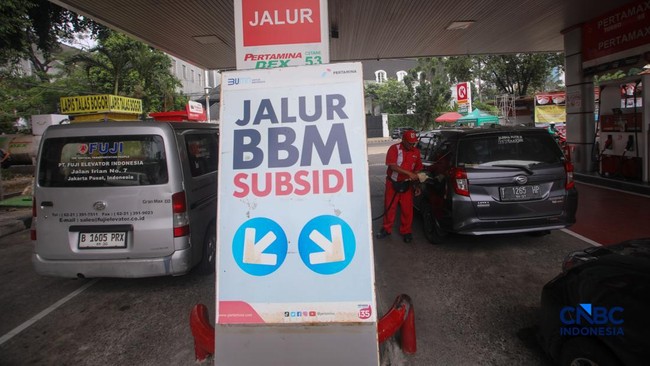
Jakarta, CNBC Indonesia - The Institute for Development of Economics and Finance (INDEF) assesses that allocating energy subsidies directly to the public would be more effective than providing them to products or commodities, as the government currently does through schemes such as 3-kilogram LPG and fuel oil.
INDEF Director of International Collaboration Imaduddin Abdullah calculates that the state budget burden is projected to swell to Rp 526 trillion by the end of 2026 due to global energy price fluctuations and the weakening rupiah exchange rate. Furthermore, 42% of energy subsidies are currently enjoyed by affluent groups in deciles 9 and 10. He proposes that the government begin shifting assistance from commodity price subsidies to direct assistance to eligible individuals so that fiscal allocation is better targeted.
“Our subsidies are undeniably not well targeted. The data shows that deciles 9 and 10, which we categorise as affluent groups, consume around 42% of fuel,” he said in CNBC Indonesia’s Energy Corner programme, quoted Friday (28/8/2026).
Imaduddin detailed that the monthly compensation fund needed per household to replace subsidies on 3-kg LPG commodities amounts to Rp 200,000 per household per month. Meanwhile, direct assistance of Rp 300,000 per household per month is needed for Pertalite users. For subsidised diesel users, the calculation reaches Rp 600,000 per household per month.
The current mistargeting causes nearly half of the subsidy budget to be enjoyed by upper-middle-class groups. This condition is considered detrimental because it limits the government’s fiscal capacity to finance other development sectors that have a broader economic multiplier impact.
“So almost half of fuel consumption is consumed by the upper middle class. This ultimately makes it not well targeted,” he stressed.
On the other hand, Associate Principal of Energy Shift Institute Ahmad Zuhdi Dwi Kusuma assesses that the current subsidy system traps Indonesia in fossil energy dependence. He considers that attaching subsidies to commodities makes the fiscal space in the state budget highly unstable and difficult to predict accurately.
“The problem is that we see the subsidy and compensation system in Indonesia is attached not to people, not to the public, but to commodities. So when there is volatility in the commodities themselves, the fiscal space that had been estimated through the state budget becomes more volatile,” Ahmad explained on the same occasion.
The government estimates that energy subsidies by the end of 2026 will rise to Rp 227.26 trillion. This figure is higher than the average annual energy subsidy realisation during the 2022-2025 period, which reached around Rp 174.73 trillion, or growing 2.5% annually. This was revealed in Book 2 of the Financial Note for the 2027 State Budget Draft, quoted Tuesday (18/8/2026).
The Financial Note document details that the realisation of subsidies for certain types of fuel and 3-kg LPG cylinders dominates with an average of Rp 104.28 trillion per year, while the average electricity subsidy realisation reaches Rp 70.45 trillion per year, growing 12.9%, driven by increased consumption volume, rising national electrification ratio, and the still-high cost of renewable energy supply.
“Targeting reforms have been pursued gradually, including the implementation of targeted electricity subsidies for R1 900 VA household category since 2017, tariff adjustments for non-subsidised categories in 2022, as well as data collection and digitalisation of subsidised fuel and LPG distribution based on NIK and DTSEN since January 2024,” reads Book 2 of the Financial Note for the 2027 State Budget Draft.
“Under normal economic conditions, energy subsidies and compensation are encouraged to be better targeted, particularly for poor and vulnerable communities. However, the distribution of energy subsidies and compensation is still not fully on target, so the state budget’s role in carrying out its distribution function still needs to be encouraged more optimally,” the Financial Note document states.
“Therefore, better-targeted energy subsidy and compensation policies need to be encouraged for a more equitable state budget. However, efforts to encourage targeted subsidies must always consider public purchasing power and the right momentum,” it adds.
In the medium term, the government is encouraging the transformation of commodity-based subsidies into subsidies based on beneficiary targets. Energy commodity prices are formed through market mechanisms according to economic prices without government intervention.
“The government plays a role in protecting the purchasing power and energy access of poor and vulnerable groups through the provision of assistance, either in the form of cash transfers or in-kind benefits,” reads the Financial Note for the 2027 State Budget Draft.
Based on policy evaluation for 2022-2026, the direction of energy subsidy policy for 2027 focuses on three things: First, continuing fixed subsidies for diesel fuel and price-difference subsidies for kerosene, accompanied by volume control and supervision of eligible categories. Second, continuing efforts to transform 3-kg LPG subsidies into beneficiary-based targeting integrated with DTSEN, carried out gradually while considering data readiness, infrastructure, and economic and social conditions. Third, electricity subsidies are provided to poor and vulnerable households according to DTSEN, accompanied by tariff adjustments for non-subsidised customers.