
Fuel Subsidies Burden State Budget, Energy Reform Increasingly Urgent
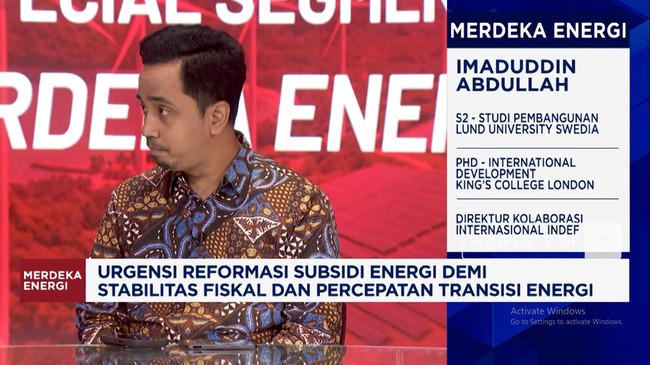
Global geopolitical uncertainty amid the Iran–United States conflict has driven a surge in Indonesia’s energy subsidies, as the country remains a net importer of oil and fuel. By the end of June 2026, realised energy subsidies and compensation had already reached Rp233 trillion and are expected to be even larger in 2027.
INDEF Director of International Collaboration Imaduddin Abdullah said the rising risk to energy subsidies is inseparable from the state revenue and expenditure conditions in the state budget. Because Indonesia still depends on energy imports, energy subsidies will be determined by global prices, the exchange rate and domestic consumption.
When oil prices spike, followed by a weakening exchange rate, the projected burden of energy subsidies and compensation rises by Rp200 trillion, potentially reaching Rp526 trillion. On the other hand, he said energy subsidy distribution in Indonesia is not yet well targeted, with leakage reaching 42 per cent, while fossil energy subsidies limit fiscal capacity to finance national development.
“So, we actually see this is not an old story. If we continue to maintain this kind of subsidy model, an energy use model based on fossil fuels, we continue to expose ourselves to global volatility,” Imaduddin said in Merdeka Energi on CNBC Indonesia.
Imaduddin explained that subsidy removal has so far been equated with price increases. In fact, price increases occur because of momentum. This happened in 2015, when global energy prices fell and the government held prices at relatively the same level.
“Eventually a decoupling began between subsidised and non-subsidised prices, so the public did not feel that prices had not risen. Yet at the same time the subsidy was being removed,” he explained.
He therefore stressed that momentum is important for removing energy subsidies. However, current conditions are not marked by falling energy prices.
In addition, the momentum for subsidy removal can be created by considering the compensation provided. This can be done by changing the scheme from subsidising goods to subsidising people.
“For example, to maintain purchasing power, the compensation need is roughly Rp200,000 per month for households using 3 kg LPG,” he said.
On the same occasion, Energy Shift Institute Principal Ahmad Zuhdi Dwi Kusuma highlighted that energy subsidy distribution focuses on commodities rather than on recipient communities. The subsidy scheme that has been in place becomes problematic when commodity prices rise.
“When there is volatility in the commodity itself, the fiscal space that had been estimated through the state budget becomes more volatile,” Zuhdi said.
According to him, subsidy distribution in Indonesia is multidimensional, covering fuel, LPG and electricity subsidies. Of the three commodities, electricity subsidies are the fastest and best targeted because no households are directly affected.
However, electricity currently receives two types of subsidy: from the coal Domestic Market Obligation and Domestic Price Obligation, and from consumer electricity tariffs. If one subsidy is removed, PLN as the electricity provider must bear greater costs.
“Here we are actually slowly opening space for Indonesia to achieve energy security from other sources,” he added.
Zuhdi explained that Indonesia can learn from ASEAN countries such as Vietnam, the Philippines, Malaysia and Thailand. These countries have lower GDP growth than Indonesia but have higher solar installations.
“This indicates that what initially may look expensive — we always think solar is expensive because we compare it with coal, which is given subsidies, double subsidies and so on,” he said.