
FTSE to Remove HSC-Listed Issuers from Index, Owners Include Salim and Sinar Mas
The Indonesia Stock Exchange (BEI) continues to update its list of shares with high shareholding concentration (HSC). Based on the list reviewed on Wednesday, 19 August 2026, there are 56 shares still carrying HSC status. This figure comes from 57 HSC imposition announcements throughout 2026, minus PT Lima Dua Lima Tiga Tbk (LUCY), whose status was revoked on 2 July 2026. The five most recent additions are MDIA, BAJA, BKDP, ALKA and AGAR.
The HSC issue has drawn attention because most of the share ownership in these issuers is concentrated among a small number of shareholders or affiliated groups. This condition has the potential to limit the number of shares genuinely available for trading and increase the influence of certain transactions on price movements.
Scrutiny has intensified after FTSE Russell postponed the full implementation of its Indonesian stock index adjustments until at least the September 2026 evaluation. The global index provider has also opened the possibility of removing HSC-status shares in the next evaluation. The removal in question is from the FTSE index, not a delisting from the BEI. The shares can still be traded, but they risk losing demand from institutional investors and passive fund managers who use the FTSE index as a benchmark.
The HSC percentage shows the proportion of shares that are in aggregate controlled by a limited number of shareholders based on the methodology of the BEI and the Indonesian Central Securities Depository (KSEI). This figure does not mean that all shares are owned by one person. The HSC percentage is also not always the same as the controlling shareholder’s ownership or the free float figure, because the calculation may involve several shareholders and affiliated groups.
MPRO has the highest HSC percentage at 99.99%, followed by DCII at 99.96%. BBSI and PGUN are both at 99.95%, while POLU reaches 99.94%. Meanwhile, the lowest percentages in the active list are recorded for BBHI at 92.71%, FILM at 92.98%, MGRO at 93.76%, BELI at 93.83%, and BAJA at 93.89%.
These percentage differences cannot be directly used to conclude the quality of a share. Investors still need to examine transaction volume, price spreads, the number of shareholders, company fundamentals and the controlling structure of each issuer.
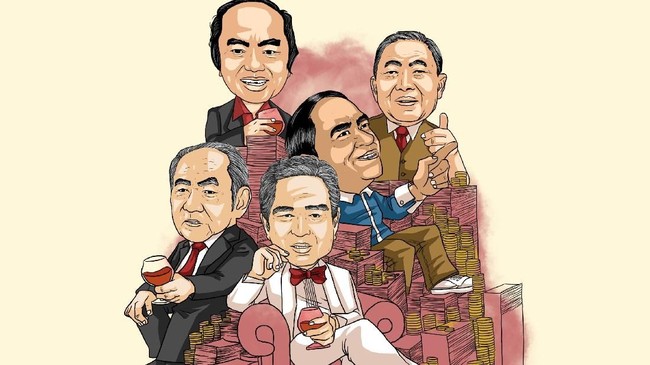
The HSC list is populated by a number of issuers connected to Indonesia’s largest conglomerate families. The Sinar Mas Group is one of the groups with the highest number of HSC shares. In addition, there are issuers owned by or affiliated with Prajogo Pangestu, the Hartono family, Anthoni Salim, the Bakrie family, Dato Sri Tahir, Haji Isam, Hermanto Tanoko, Low Tuck Kwong and the Riady family. A connection to a group does not always mean the shares are directly owned by the conglomerate in question. Ownership may run through parent companies, subsidiaries, investment companies, family members or joint ventures.
DSSA, SMAR, GEMS and MORA are HSC shares connected to the Sinar Mas Group. The four are spread across the energy, mining, palm oil plantation and digital infrastructure sectors. LIFE has a historical connection to Sinar Mas through the name Asuransi Jiwa Sinarmas MSIG. However, its controlling structure is now under the Japanese MSIG group, so it would be inaccurate to say that all control still rests with the Widjaja family.
The Salim Group has BINA and DNET on the HSC list. Anthoni Salim also holds 11.12% of DCII shares. Nevertheless, the largest shareholder of DCII remains Otto Toto Sugiri at 29.90%, followed by Marina Budiman at 22.51% and Han Arming Hanafia at 14.11%. Therefore, DCII is more accurately described as controlled by its founding group, with Anthoni Salim as one of the major strategic investors.
From Prajogo Pangestu’s business empire, BREN is the only share on the HSC list. However, Prajogo’s issuer network is far broader and includes BRPT, TPIA, CUAN, PTRO and CDIA. The Hartono family has BELI on the HSC list. Beyond that e-commerce company, the Djarum Group ecosystem also encompasses BBCA, TOWR, RANC and DATA. Meanwhile, the Bakrie Group has MDIA and ALII on the list. Bakrie’s other issuer network includes BNBR, BUMI, BRMS, DEWA, ENRG, VIVA, VKTR, ELTY and UNSP.
A share’s inclusion on the HSC list does not automatically indicate poor company fundamentals or a violation of capital market rules. The status primarily serves as information that share ownership is considered concentrated based on the BEI and KSEI methodology. The main risk lies in liquidity quality. The fewer shares genuinely available for trading, the greater the potential for certain transactions to influence prices and widen the bid-ask spread. Thus, HSC should be used as an additional risk indicator, not as a recommendation to buy or sell shares. Investors still need to consider fundamentals, valuation, governance and liquidity before making decisions.