
Frost Phenomenon Appears at Bromo Amid Indonesia's Dry Season, BMKG Explains
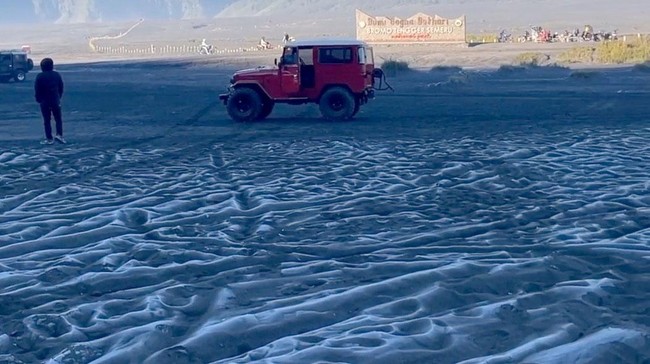
A rare sight appeared in the Mount Bromo area on Monday morning (8/6/2026), with a phenomenon resembling snow, known locally as embun upas or frost, occurring in the Bromo Tengger Semeru National Park in East Java. A layer of ice crystals was seen covering the grass, leaves, and expanses of sand around the Bromo caldera. This rare phenomenon attracted the attention of tourists as Indonesia, which has a tropical climate, is experiencing the dry season.
The Meteorology, Climatology, and Geophysics Agency (BMKG) noted that from its monitoring of seasonal developments at the end of May 2026, out of 699 Seasonal Zones (ZOM) in Indonesia, 200 ZOM or 11.83 percent of the land area are currently experiencing the dry season. This year’s dry season is marked by the El Niño phenomenon with the potential for a Moderate-Strong category, which could reduce rainfall across Indonesia. This year’s dry season is predicted to be drier and longer.
It was stated that the embun upas phenomenon is an annual event in the Bromo and Semeru areas during the peak of the dry season, though it still depends on weather conditions and temperatures at night and into the early morning. ‘The frost phenomenon occurs due to very strong radiation cooling from night until early morning, especially when humidity is low, the sky is clear, and the region is at a high altitude,’ said BMKG Director of Public Meteorology Ida Pramuwardhani.
Under such conditions, heat stored on the earth’s surface during the day is released back into the atmosphere more quickly at night, causing surface temperatures to drop drastically. ‘If the air or surface temperature approaches 0°C or lower, the dew that forms can freeze into ice crystals or frost. This condition is also reinforced by the influx of dry and relatively cold air masses from Australia during the Australian Monsoon period,’ she explained.
‘This phenomenon is still considered normal as long as it occurs according to its seasonal pattern. During the dry season, humidity conditions are generally lower, cloud cover is reduced, nights tend to be clearer, and the flow of dry air masses from Australia becomes more dominant,’ she continued. She noted this is due to clear sky conditions, whereas clouds should trap heat.
‘Clouds act like a "blanket" that traps the earth’s heat. When the sky is clear without clouds, heat from the surface is more easily released into the atmosphere, causing temperatures at night and into the morning to drop faster,’ she said. ‘This condition is generally more pronounced in highland or mountainous areas, as well as parts of southern Indonesia which are more influenced by the flow of dry and relatively cold air from Australia.’
According to Ida, regions beginning to experience cold temperatures, known as bediding, are generally those that have entered or are heading towards the dry season, especially in southern Indonesia. ‘Areas that usually feel this condition earlier and more clearly include East Nusa Tenggara, West Nusa Tenggara, Bali, the southern part of Java up to the highlands on Java Island, as well as parts of southern Sumatra such as South Sumatra and Lampung,’ she said. ‘However, the bediding phenomenon is not uniform because it is influenced by differences in cloud cover, humidity, wind, topography, altitude, and surface characteristics of the region.’
Highland areas, mountainous regions, valleys, and areas far from the influence of the sea usually feel the cold more easily compared to coastal or urban areas. Conversely, coastal regions, urban areas, or areas that are still humid typically do not experience bediding strongly because the air temperature is more stable and heat release is not as rapid as in open areas or highlands.
‘BMKG urges people, especially those around Bromo and Dieng, to be aware of cold temperatures, particularly at night and in the morning, by wearing warm clothing, maintaining their body condition, and being careful when driving as cold air and fog can reduce visibility,’ said Ida. ‘BMKG also reminds the public to periodically monitor official weather forecasts, early warnings, and extreme weather alerts through various BMKG information channels, including the website www.bmkg.go.id, the InfoBMKG application, and social media @infobmkg, as well as to take anticipatory steps in the surrounding environment to minimise the potential impacts of extreme weather.’
Source: jawawa.id (https://jawawa.id/newsitem/frost-phenomenon-appears-at-bromo-amid-indonesias-dry-season-bmkg-explains-1781088815)
Originally published by CNBC Indonesia (https://www.cnbcindonesia.com/news/20260610161933-4-741750/fenomena-bromo-bersalju-saat-ri-musim-kemarau-ini-penjelasan-bmkg), translated from Indonesian