
From Willem’s Toren III Lighthouse, Bustami Opens a Window on the World
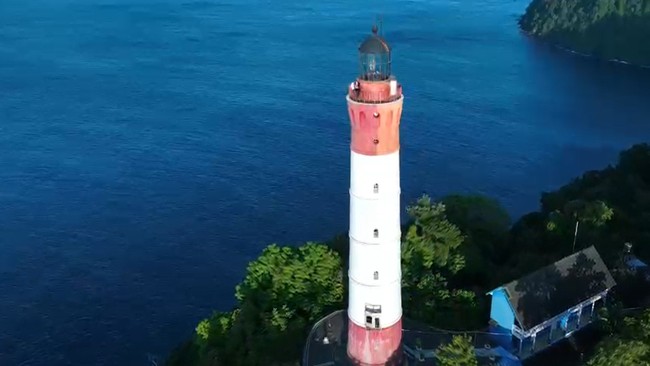
Willem’s Toren III Lighthouse on Breueh Island, Aceh, is said to be one of three such structures built by the Dutch colonial government in different parts of the world. The other two are in the Netherlands, where one now serves as a museum, and in the Caribbean Islands.
The tower was not built for the islanders. It was built to guide ships sailing towards the Strait of Malacca, one of Asia’s most important trade routes, and to monitor the sea that a kingdom on the other side of the continent sought to control.
Bustami, 49, grew up in the lighthouse’s beam. From the remote harbour, his voice can now reach almost anywhere. He often makes calls or uses TikTok, where he shares fish prices with anyone willing to watch and listen, helping him market grouper, mackerel tuna, tuna and, most sought-after of all, octopus.
Before mobile phones arrived, residents of Breueh Island relied on Radio Baiturrahman to hear news about family across the sea.
“Every morning at seven, Radio Baiturrahman had a special programme announcing who had died that day. We listened to the broadcast in our gampong (village). If it was a neighbour or someone we knew, we would tell the others to get ready to pay our respects,” Misbah said.
Misbah said the news sometimes arrived too late for people to travel that day, as passenger boats left at about 8am.
“We then had to wait until the next day to go to Banda [Aceh],” he added.
Fortunately, change came in a much gentler wave. Private operators entered the area in 2012 and the signal began to improve, although many parts of Pulo Aceh remained mobile black spots.
In 2019, the regional government pushed for a major expansion of the network. BAKTI, under the Ministry of Communication and Digital Affairs (Komdigi), built a base transceiver station (BTS) in Alue Raya village. There are now four BTS towers on the island, steel structures that emit no light but reach far wider than any lighthouse beam.
In 2022, BAKTI opened 24 internet access points across Pulo Aceh, at locations ranging from schools to government offices. Statistics Indonesia (BPS) data show that all villages in Pulo Aceh subdistrict, including those on Breueh Island, now have internet coverage, although speeds vary.
For Basri, a 50-year-old fisherman, the change is most apparent when negotiating prices.
“In the past, we would simply hand our fish over to the toke [buyer or middleman] at sea. We accepted whatever price we were offered. Now we can check prices on our phones and negotiate for more,” the fisherman said.
He used to accept the price set by the toke. Now he checks prices on his phone before selling, allowing him to bargain for more. Octopus, his most valuable catch, can fetch up to Rp90,000 per kilogram. Before setting out, he also checks sea conditions, and between tasks he can contact his family at home.
Another fisherman, Buwaizhi, said the signal gave him peace of mind.
“Internet access is a great help. We still have a connection where we fish, so if our engine breaks down or there is an emergency at sea, we can ask for help from shore,” he said.
The network reaches the waters where he fishes. If his engine fails or an emergency occurs, he can now call for help from shore—from friends, relatives or harbour staff. The sea that once swallowed fishermen as far away as the Andaman now has a thread linking it to land.