
From Two Years to 30 Days: Government Races to Approve Permits for 12 Industrial Estates in Central Java
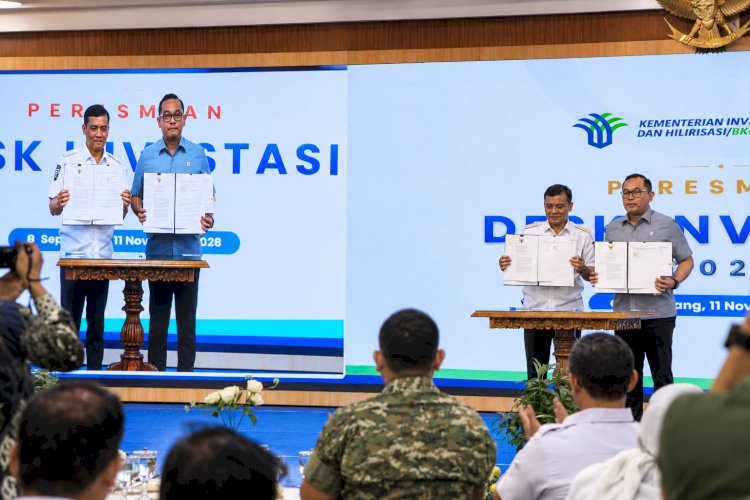
The Ministry of Investment and Downstreaming/BKPM has inaugurated the Central Java Investment Desk to speed up coordination between the central government, regional administrations and businesses, with the aim of strengthening legal certainty, creating a favourable investment climate, stimulating economic growth and increasing national investment realisation.
The Central Java provincial government no longer wants to tolerate years of waiting for permit certainty. As it seeks to attract investment and create jobs, the slow licensing process has become an issue that needs to be resolved urgently.
The central government has now promised a change. Permits for 12 new industrial estates currently being processed in Central Java are expected to be completed within 30 days at the latest.
The pledge was made by Deputy Minister of Investment and Downstreaming and Deputy Head of BKPM Todotua Pasaribu after a memorandum of understanding was signed between the ministry/BKPM and the Central Java provincial government at the Gradhika Bhakti Praja Building in Semarang on Wednesday, 11 November 2026.
“We will take no more than 30 days. The 12 industrial estates mentioned by the Governor, which are currently being processed, will be completed within 30 days at the latest,” Todotua said.
The target offers a boost to Central Java’s efforts to expand its industrial estates. The availability of development-ready land is one of the main considerations for investors deciding where to put their capital.
But the issue is not simply about providing land. Zoning certainty, complete documentation, permits and infrastructure support must all be in place if investment plans are not to remain on paper.
Todotua said his office would promptly summon the 12 developers of the industrial estates. The government wants to hear directly about the obstacles holding up the permits and find solutions so the process does not become protracted again.
He said industrial estates play a strategic role in creating a more competitive investment climate. They provide certainty over land availability and make it easier to integrate licensing services and infrastructure provision.
Untangling investment licensing delays
Central Java Governor Ahmad Luthfi had previously complained about slow licensing. He said lengthy bureaucratic processes risk pushing investors towards other regions or countries that offer an easier business environment.
Luthfi compared the speed of licensing services in Indonesia with Vietnam.
“In Vietnam, permits take just two months. Here, taking two years is considered good,” he said.
The comparison highlights the challenges Indonesia still faces in attracting investment. Amid competition between countries, faster services and legal certainty are important elements of economic competitiveness.
The central government is seeking to address the problem by setting up the Investment Desk. The service is designed as a coordination hub for resolving the various obstacles investors encounter, from permits and land issues to infrastructure readiness.
Central Java is the fourth region to receive an Investment Desk, following Batam, Bali and North Sumatra.
Based at the Central Java Investment and One-Stop Integrated Services Office (DPMPTSP), the desk will handle investment issues not only in Central Java but also in the Special Region of Yogyakarta and East Java.
The Investment Desk will focus specifically on overseeing projects worth more than Rp1 trillion.
“We are also working to clear the bottlenecks affecting investment plans in the regions,” Todotua said.
12 regions prepared as new industrial hubs
Meanwhile, the Central Java provincial government is widening the range of locations available to investors. Twelve regencies and cities are being encouraged to prepare sites for new industrial estates.
Each estate is projected to cover at least 50 hectares and must comply with zoning requirements.
The initiative is part of a strategy to spread economic growth more evenly. Industrial activity has so far tended to be concentrated in areas with established manufacturing bases and supporting infrastructure.
The government hopes new industrial estates will bring investment to more areas. In turn, job opportunities and economic activity are expected to extend beyond existing industrial centres.
Preparations go beyond making land available. Regional authorities are also improving logistics infrastructure to ensure the estates have adequate connectivity.
Plans include developing a dry port in Batang, port facilities in Kendal, and revitalising Tanjung Emas Port in Semarang.
This infrastructure is important for distributing raw materials and shipping finished products. For industrial businesses, efficient logistics directly affect operating costs and product competitiveness.
The industrial estates offered to investors are therefore expected to have not only ample land, but also reliable transport links and logistics facilities.
Tens of trillions of rupiah in investment await certainty
The drive to accelerate permits comes as the Central Java provincial government begins overseeing several large-scale investment plans.
These include a garment industry investment worth Rp4.6 trillion, scheduled to break ground in December 2026.
There are also plans for a Rp2.9 trillion expansion by a Vietnamese company and the relocation of a Chinese industry project involving investment of Rp2.17 trillion.
These plans point to significant investment opportunities in Central Java. But their realisation still depends on certainty in the permitting process, site readiness and infrastructure support.
According to Central Java DPMPTSP data, investment realisation from January to September 2026 reached Rp72.54 trillion, equivalent to 73.21 per cent of the annual target of Rp99.09 trillion.
The investment comprised 82,420 projects and created 340,334 jobs.
In the third quarter of 2026, investment realisation stood at Rp24 trillion, up 16.78 per cent on the same period a year earlier.
The investment came from 26,431 projects and created 127,117 jobs. Central Java’s economy grew by 5.83 per cent year on year over the same period.
Luthfi welcomed the establishment of the Investment Desk as a way to strengthen coordination between central and regional governments. He said the service was expected to provide a channel for resolving the problems investors have faced.
“The Desk will serve as a representative of the central government in addressing investment-related problems,” he said.
The real test is delivery
For Central Java, the 30-day target for completing permits for the 12 industrial estates is about more than cutting bureaucratic delays. The commitment will test whether the government can turn promises of easier investment into practical certainty.
Investors need not only assurances of faster processing, but also clear procedures, legal certainty, prepared land and reliable infrastructure.
If these preparations move forward together, the 12 new industrial estates could open the door to broader investment in Central Java.
The hope is that economic growth will be reflected not only in investment figures, but also in new jobs and emerging economic centres across the region.
The central government’s 30-day deadline is now the first test: can a permitting process that has taken years really be reduced to a matter of weeks?
Source: jawawa.id (https://jawawa.id/newsitem/from-two-years-to-30-days-government-races-to-approve-permits-for-12-industrial-estates-in-central-java-1794390702)
Originally published by rmoljawatengah.id (https://www.rmoljawatengah.id/dari-2-tahun-jadi-30-hari-pemerintah-kejar-perizinan-12-kawasan-industri-di-jateng), translated from Indonesian