
From Trade to Investment, Indonesia Opens the Door to Eurasia
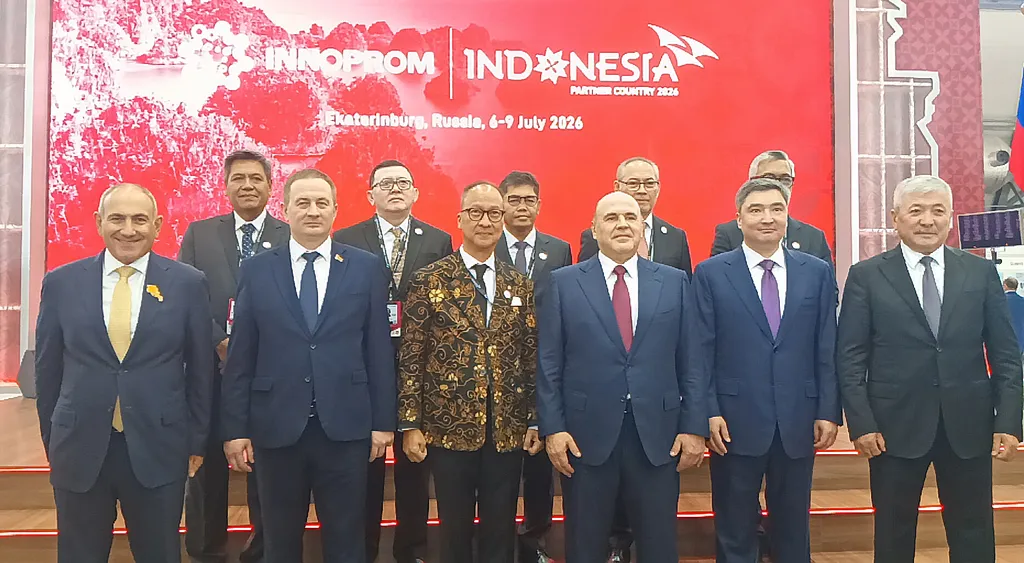
Innoprom 2026 in Yekaterinburg, Russia, has become a new showcase for Indonesia’s strategy of shifting trade relations towards investment, downstream processing and technology transfer with Eurasia. The next challenge is ensuring that a string of agreements turns into real projects.
The four days of Innoprom 2026 (6–9 July) amounted to more than just an industrial exhibition for Indonesia. As the official partner country, Indonesia used the forum to shift the orientation of its economic relations with the Eurasian region from commodity trade towards deeper industrial partnerships, encompassing investment, industrial estate development, downstream processing and technology transfer.
At the international industrial exhibition, the Ministry of Industry brought the New National Industrialisation Strategy (SBIN) as the framework for long-term industrial development, while offering investment-ready industrial estates.
Key points of the SBIN include strengthening manufacturing based on the added value of natural resources, accelerating technological mastery through Making Indonesia 4.0, developing green industry and improving the quality of the industrial workforce.
The results were visible in the signing of at least 13 memoranda of understanding (MoUs), eight bilateral meetings held with the Russian government and Central Asian countries, and various business forums bringing together Indonesian industry players with prospective Eurasian investors.
The 13 MoUs include agreements between the Indonesian Ministry of Industry and the Russian Ministry of Industry and Trade, as well as cooperation with Kyrgyzstan, Kazakhstan and the regions of Chelyabinsk, Kirov and Sverdlovsk.
The MoUs, bilateral meetings and meetings between industry players demonstrate that Indonesian industry has strong competitiveness.
“Indonesia’s participation as partner country at Innoprom 2026 has strengthened the position of national industry in the Eurasian market. This can be seen from the high enthusiasm of industry players from the Eurasian market who want to cooperate with national industry,” said Minister of Industry Agus Gumiwang Kartasasmita on Sunday (12 July 2026).
Behind this cooperation, the government through the Ministry of Industry is no longer merely offering Indonesia as a market of more than 280 million people, but as a regional production base connected to ASEAN.
So far, Indonesia’s relations with Russia and other Eurasian countries have been relatively dominated by trade. The value of Indonesia–Russia trade has continued to rise in recent years, but the contribution of investment and manufacturing cooperation remains limited.
For this reason, almost all of Indonesia’s agenda at Innoprom was directed at broadening the relationship into industrial collaboration.
This is reflected in the substance of the MoUs, which cover manufacturing development, machine engineering, automotive, metallurgy, the chemical industry, mineral processing, the halal industry, industrial estates and the improvement of human resource competencies.
The government also brought together industry associations from both countries so that cooperation does not stop at the government level.
Business-to-business MoUs, for example, involved the Indonesian Offshore and Shipbuilding Industry Companies Association (Iperindo), the Indonesian Ship Component Industry Association (PIKKI), PT Athira Maritim Indonesia, PT PCM Kabel Indonesia and the Indonesian Industrial Estates Association (HKI).
This approach signals a change in Indonesia’s economic diplomacy strategy. Whereas previously investment promotion was mostly conducted through general investment forums, promotion is now specifically targeted at industrial sectors deemed to have the potential to build supply chains together.
Director General of Industrial Resilience, Regional Development and International Access (KPAII) Tri Supondy said the achievements made during Innoprom 2026 show the great interest of international partners in building cooperation with Indonesia.
“The achievements Indonesia attained during Innoprom 2026 show that national industry is increasingly trusted. It is hoped that the various forms of cooperation built through this event will open up more opportunities for investment, trade and industrial collaboration that add value to strengthening the competitiveness of Indonesian manufacturing,” said Tri.
One interesting change in Indonesia’s industrial diplomacy on this occasion is the way the government marketed its industrial estates. Indonesia not only brought manufacturing products, but also presented five industrial estate operators directly to prospective investors.
Batang Integrated Industrial Park, Kendal Industrial Park, Bintan Industrial Estate, KI Wiraraja Indonesia and HKI became the face of Indonesia’s investment promotion in Russia.
This step shows the government wants to reduce the distance between investors and investment locations. Investors could discuss directly the readiness of land, utilities, fiscal incentives, logistics access and licensing services in a single forum.
According to Indonesian industrial data, as of the second quarter of 2026 the country has 180 industrial estates with almost 12,000 companies as tenants. Throughout 2025, these estates attracted investment of Rp 6,744.58 trillion and absorbed around 2.35 million workers.
Agus said industrial estates have now become an important instrument for accelerating downstream processing, creating jobs and equalising economic development. “We want Eurasian investors to see that Indonesia is not only a large market, but also a production partner that is ready to grow together,” he said.
For Eurasian investors, this approach provides greater certainty because industrial estates no longer merely provide land, but also offer ease of starting a business through increasingly integrated infrastructure, services and licensing.
Executive Director of PT Kawasan Industri Terpadu Batang (Persero) Juliani Sari Kusumaningrum noted that investors today are not only looking for land on which to build factories, but also consider the readiness of supporting facilities that allow business activities to begin immediately.
“In our estate, investors do not need to start everything from scratch. Ready-to-build land, utility networks, fiscal incentives through the special economic zone (KEK) scheme and logistics access directly connected to an international port are all available. This way, companies can focus more on accelerating their operations and business development,” she said.
Beyond investment, the government also used Innoprom as a gateway to obtaining industrial technology. This was evident in the cooperation explored in the shipbuilding sector. Indonesia needs large numbers of logistics vessels, passenger ships, fishing vessels and vessels supporting the offshore industry.
Russia, meanwhile, has long experience in ship engineering, propulsion technology and vessel design of various sizes.
A similar approach was taken in the chemical and pharmaceutical sectors. Indonesia brought companies in fertilisers, chemicals, industrial glass, ceramics, flexible packaging and plastic recycling.
For the government, such cooperation is not merely about expanding exports, but about strengthening the domestic industry’s ability to produce value-added products.
Director General of Chemical, Pharmaceutical and Textile Industries Taufiek Bawazier said Russia has experience in developing petrochemicals and research-based pharmaceuticals that could complement Indonesia’s needs.
Notably, Indonesia’s diplomacy at Innoprom did not target Russia alone. Kazakhstan emerged as one of the new strategic partners.
In a bilateral meeting, the two countries signed an industrial cooperation MoU covering automotive, machinery, metallurgy, mineral processing and industrial estate development.
Geographically, Kazakhstan is viewed as a gateway to Central Asia and the wider Eurasian market.
The value of trade between the two countries is still relatively small, at around US$172.2 million in 2025. However, trade growth between January and April 2026 reached more than 62 per cent, showing that room for expansion remains open.
The agreement also forms part of preparations for the implementation of the Indonesia–Eurasian Economic Union Free Trade Agreement (I-EAEU FTA), which is currently at the ratification stage.
Once the agreement comes into force, Indonesia’s market access to Russia, Kazakhstan, Belarus, Armenia and Kyrgyzstan is expected to open up further.
The same applies to the agreement with Armenia. Total trade between the two countries was only around US$26.7 million in 2025. However, average trade growth reached more than 70 per cent over the past four years (2021–2024), supported by the non-oil and gas sector.
Indonesia’s main export commodities to Armenia include coffee, tea, spices, machinery and mechanical equipment, palm oil products, cocoa, soap, rubber, optical fibre, musical instruments and leather products.
Indonesia, said Agus, views Armenia not only as a bilateral partner but also as a strategic gateway to the Commonwealth of Independent States (CIS) region through its membership of the Eurasian Economic Union (EAEU).
Although various agreements have been signed, the real challenge only begins once the exhibition ends. Project realisation will be determined by follow-up from both sides, regulatory certainty, the readiness of industrial estates, logistics convenience and the cost competitiveness of Indonesian production.
Indonesia’s success at Innoprom 2026 is not measured solely by the number of MoUs signed, but by the ability to turn commitments into investment, new factories, technology transfer and jobs.
Nevertheless, as an industrial diplomacy strategy, Indonesia’s presence as official partner country at the international industrial exhibition shows an increasingly clear shift in policy direction. Indonesia is no longer merely selling products, but offering an industrial ecosystem ready to become part of global supply chains.
Amid global competition for investment, such an approach is an important asset so that national industrialisation does not rely solely on the domestic market, but also connects with new centres of economic growth in Eurasia.