
From the Strait of Hormuz to El Niño, a Major Test for Indonesia’s Energy Resilience
Jakarta, CNBC Indonesia — Geopolitical turmoil and rising risks from natural disasters pose major challenges to Indonesia’s energy resilience, including efforts to accelerate the use of renewable energy.
Geopolitical crises and natural disasters are putting the energy sector under dual pressure. Reliance on fossil fuels leaves Indonesia vulnerable to global price volatility, while climate change is testing the reliability of domestic power plants and electricity networks.
Deon Arinaldo, a researcher at the Institute for Essential Services Reform (IESR), said geopolitics and climate change were increasingly shaping the direction of Indonesia’s energy policy. International conflicts can push up energy commodity prices, while extreme weather could disrupt power generation and electricity distribution.
One example of geopolitical pressure is the conflict between the United States and Iran, which has been under way since March 2026. The tensions have contributed to rising global energy commodity prices and increased the burden on countries that remain dependent on fossil fuels.
Indonesia’s energy resilience, however, faces challenges not only from abroad. The effects of climate change are also beginning to be felt directly by the national electricity system.
Deon cited flooding in Aceh in late 2025, which disrupted transport, communications and electricity supplies in several areas. Then, in May 2026, strong winds and heavy rain damaged transmission networks across more than half of Sumatra, triggering a collapse of the electricity system.
Lower rainfall and falling reservoir levels have also affected hydropower production. These conditions have contributed to electricity supply disruptions in Sulawesi and Kalimantan.
“Since June, we have also been facing pressure from the El Niño phenomenon. This is truly testing the resilience of Indonesia’s electricity system,” he said at a workshop organised by the Indonesian Next Generation Journalist Network on Korea, held by the Foreign Policy Community of Indonesia (FPCI) and the Korea Foundation. He was quoted on Tuesday (3 November 2026).
Coal supplies for power plants are another concern. Although Indonesia is one of the world’s largest coal exporters, the delivery of fuel to domestic power stations is not entirely immune to weather risks.
Several coal mines in Sumatra and Kalimantan rely on river routes to transport output to ports. When El Niño reduces river flows, coal transport can be disrupted.
Deon also drew attention to changes in El Niño patterns. Whereas the phenomenon was previously expected to recur every seven to 10 years, the events of 2023 and 2026 were only about three years apart.
This is a warning for an energy system that still depends on fossil fuels and on power plants, such as hydropower stations, whose output is affected by natural conditions.
Infrastructure and investment readiness
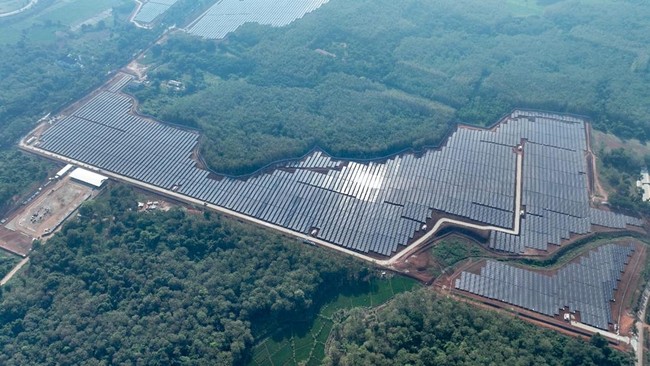
On the government’s push to develop 100 GWp of large-scale solar power through its programme, Deon said building generating plants alone would not be enough. The government must also ensure that transmission networks and battery-based energy storage systems are ready to deliver stable electricity from renewable sources.
Investment needs for renewable energy development in Indonesia are also substantial. Deon said the investment required for utility-scale power plants alone was estimated at nearly US$80 billion. Including energy storage and transmission networks could take the total above US$100 billion.
He said Indonesia currently invests about US$2 billion to US$3 billion a year in renewable energy. Investment therefore needs to increase significantly for clean-energy development to match the government’s ambitions.
Vulnerable countries
Gahee Han, head of the power programme at Solutions for Our Climate (SFOC), said conflict in the Middle East showed how vulnerable countries that rely heavily on imported energy could be.
About 70% of South Korea’s imported crude oil and 30% of its imported liquefied natural gas (LNG) pass through the Strait of Hormuz. Tensions in the region could disrupt energy supply routes and put pressure on the country’s economy.
Gahee said this made renewable energy about more than meeting carbon-emissions reduction targets. Solar and wind power also play a strategic role in strengthening supply security because they do not depend on fuel shipments through sea routes vulnerable to conflict.
Even so, accelerating renewable energy requires major changes to the electricity system. South Korea, for example, aims to reach a combined solar and wind capacity of 100 gigawatts (GW) by 2030.
To meet that target, the country will need to add around 14 GW of capacity each year, almost three times its current annual additions of about 3–4 GW.
Gahee also warned that the electricity grid could become a bottleneck. Limited transmission capacity makes it difficult to connect new renewable energy to the system, while some of the existing grid capacity remains in use by conventional power plants.
Source: jawawa.id (https://jawawa.id/newsitem/from-the-strait-of-hormuz-to-el-nino-a-major-test-for-indonesias-energy-resilience-1793706685)
Originally published by CNBC Indonesia (https://www.cnbcindonesia.com/news/20261103171902-4-781992/dari-selat-hormuz-hingga-el-nino-ujian-besar-ketahanan-energi-ri), translated from Indonesian