
From the Lecture Hall to the Streets
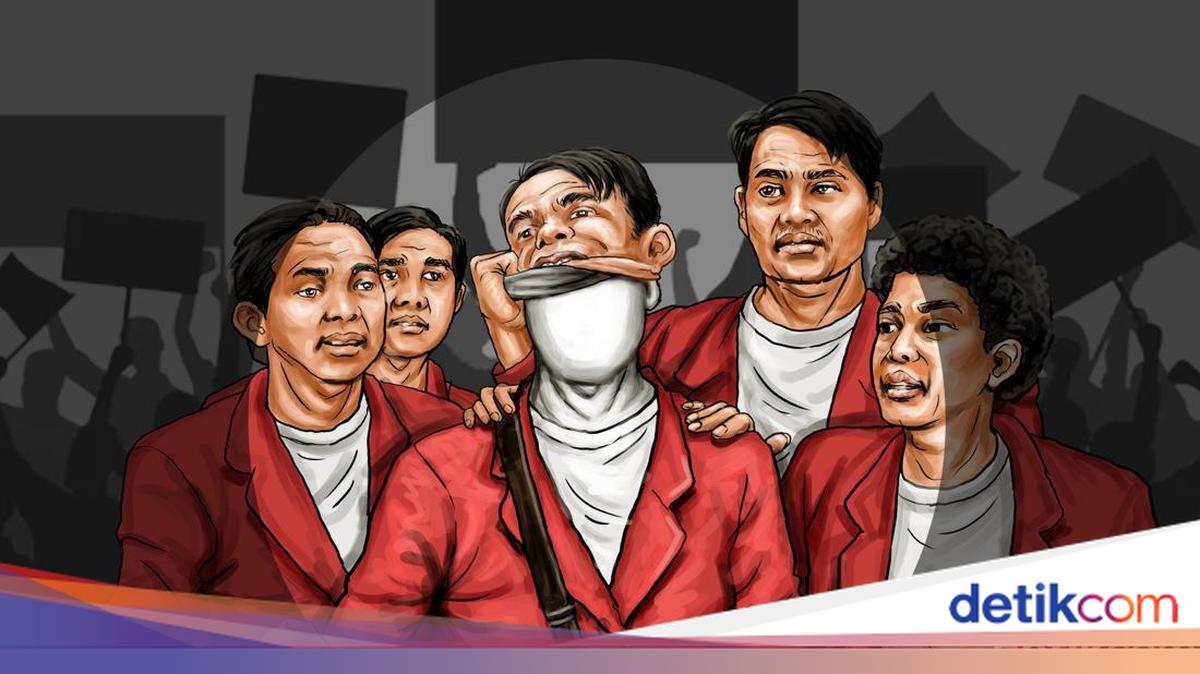
At Universitas Muhammadiyah Yogyakarta (UMY), the boundary between classroom lectures and street protests is made flexible. Student presence is also recognised through participation in demonstrations.
UMY Communication Studies lecturer Denis Hida Lutfiana Stefani stated that the campus openly permits students to join demonstrations and continues to acknowledge their participation as part of class attendance. This policy is formalised through a letter from the Directorate of Student Affairs, which grants lecturers the authority to accommodate the attendance of students who take part in protests.
“So it is actually addressed to the lecturers, whoever is teaching at that time, yesterday at 1 p.m. WIB. Please allow the students to participate in the demonstration at Titik Nol Kilometer,” Denis told detikX.
She explained that in practice, lectures can be adjusted by giving students the option to substitute class attendance with proof of protest participation or a written reflection assignment. This scheme, she noted, has been implemented several times in the Communication Studies programme at UMY.
“So it is fine not to attend because it is also democratic; there are those who may not want to join a protest due to various fears or because of perceptions that demonstrations will become heated and so on. But we always accommodate them,” she clarified.
Denis believes the policy makes students feel supported, especially when several lecturers are also present on the ground during the demonstrations. Their presence at a protest is not considered an act of indiscipline, provided it is conducted peacefully and in accordance with the law.
Vice Rector for Education and Student Affairs at UMY, Zuly Qodir, added that this stance stems from the belief that expressing opinions is a citizen’s right guaranteed by law. As part of the academic community, he argued, the expression of opinions can take various forms. Some people choose to write articles, journals, or books. Others speak at seminars and scientific forums. A demonstration is merely another form of expressing an opinion in the public sphere.
“A demonstration conducted properly, politely, peacefully, and without disturbing public order is, in my view, something natural,” said the professor of sociology to detikX.
The campus’s open attitude also arises from a more pragmatic consideration. According to Qodir, providing an official space for students to express their aspirations actually makes their activities more organised and controlled. Rather than moving individually without coordination, students are given the opportunity to voice their aspirations with a clear campus identity and under mutually agreed rules.
Support for students taking to the streets does not only come from campus policies like those at UMY. At several universities, similar support is also provided directly by lecturers who consider demonstrations as part of the learning process.
Dhia Al Uyun, Chairperson of the Campus Workers Union (SPK) and a lecturer in Constitutional Law at the Faculty of Law, Universitas Brawijaya, is among them. For her, demonstrations are not an activity that disrupts lectures but rather an integral part of the learning itself. In the classes she teaches, such as human rights and advocacy, taking to the streets can serve as an extension of the material discussed in the lecture hall. Therefore, when students participate in a demonstration, she does not regard it as an absence.
“It is part of their fieldwork,” Dhia told detikX.
After a demonstration takes place, she usually invites the students to gather and discuss their experiences in the field. This includes how they conveyed their opinions, dealt with security forces, formulated demands, or navigated crowd dynamics. The experience is then reflected upon through the lens of law and human rights. She considers such field experience a ‘direct laboratory’ for students, and as a result, involvement in a protest can contribute to their academic assessment.
“It has the potential to earn an A grade,” she said.
The support does not stop at providing a learning space. On several occasions, Dhia herself has taken to the streets alongside the students. She admits to frequently sharing information about planned protests and inviting interested students to get involved.
“Let’s go down. There is no lecture today, let’s all go there together,” she said.
An attitude like this, according to Dhia, is becoming increasingly rare on Indonesian campuses. She perceives a kind of restriction on student activities. This restriction does not always manifest as an outright ban. In recent years, she has observed the emergence of more subtle mechanisms through internal campus regulations. One example is an integrity pact that students must sign upon entering a university. Based on numerous accounts she has received from students, the document often contains clauses about the obligation to safeguard the good name of the campus, the nation, or the state.
“The problem is, phrases like ‘harming the state’ or ‘harming the institution’ are often interpreted very subjectively,” Dhia said. In practice, she assesses that such clauses can become a tool to suppress students who voice criticism of government or campus policies.
Furthermore, Dhia sees the emergence of various forms of restriction against students wishing to demonstrate, ranging from threats of low grades and administrative pressure to being summoned by campus authorities. She recalled the case of a professor who allegedly gave a C grade to a student who participated in a demonstration against the Job Creation Law.