
From the Jakarta Charter to the Caliphate
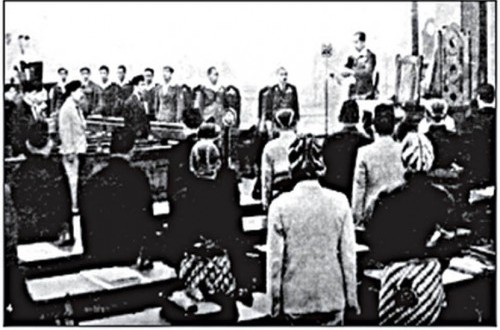
The Jakarta Charter represents one of the most important points in the political history of Islam in Indonesia: how Muslims have fought for religious values within a pluralistic state. Eighty-one years later, that debate has evidently not been concluded, even if it may have dimmed.
Questions about the relationship between Islam and the state have emerged in various forms: from the struggle to incorporate sharia into the constitution, to the creation of regulations accommodating Islamic law, to the question of whether the nation-state is the final political form for Muslims or whether the caliphate must continue to be pursued.
The Jakarta Charter was formulated by the Committee of Nine on 22 June 1945. It contained the formulation of the first principle: ‘Belief in God, with the obligation to carry out sharia for its adherents.’
This formulation demonstrated that Islam was a very significant force in the process of establishing the Indonesian state. Within the Committee of Nine, there was an encounter between Islamic nationalist figures and secular nationalists, who naturally held differing views on the foundation of the state. The meetings of this committee were therefore an effort to find common ground regarding the position of Islam in a plural Indonesia.
However, one day after the Proclamation of Independence, on 18 August 1945, when the constitution was about to be ratified, the seven words in the Jakarta Charter were removed. Mohammad Hatta conveyed objections from a number of figures from Eastern Indonesia and concerns about the impact on the unity of the state that was to be formed.
This change was not easily accepted by Islamic figures. Ki Bagus Hadikusumo, a Muhammadiyah leader, was among those who vigorously defended the Jakarta Charter formulation. For him, the formulation was the result of an agreement that had been reached previously. Nevertheless, a compromise was ultimately found.
In the situation of a newly born state, that compromise can be understood as a strategic choice. Indeed, from the perspective of Islamic political history, the willingness to accept the change did not mean surrendering all Islamic aspirations. What was sacrificed was a particular constitutional formulation, not the entire aspirations of the Muslim community. Ki Bagus Hadikusumo accepted the formulation of ‘Belief in the One and Only God’ in the sense of tawhid.
For this reason, the removal of the seven words should not be read simply as a victory of the nationalist group over Islam, but rather as a political compromise in an emergency situation. ‘We must immediately have a constitution and a president today. Later, once the state is stable and the People’s Consultative Assembly has been formally established through elections, Muslims can constitutionally fight again for the aspirations of the Jakarta Charter,’ was roughly the persuasion of Kasman Singodimedjo and Mohammad Hatta to Ki Bagus Hadikusumo.
The struggle did not stop
Indeed, after the elections were held in 1955, Islamic political aspirations were again pursued through the Constituent Assembly. Islamic groups sought to obtain a firmer constitutional basis for Islam. The debate lasted a long time, but again no agreement was reached. The deadlock was then broken by the Presidential Decree of 5 July 1959, which reinstated the 1945 Constitution.
Interestingly, the Decree stated that the Jakarta Charter ‘inspired’ the 1945 Constitution and constituted an inseparable series with the constitution.
Even though such a strong statement had been made, the debate on this fundamental issue resurfaced after the 1998 Reformasi. During the process of amending the 1945 Constitution in 1999–2002, the idea of reinserting the seven-word formulation was again proposed. However, the idea once again failed to obtain adequate support. Moreover, unlike in 1945 and 1959, this time not all Islamic groups saw the restoration of the seven words as the only path of Islamic struggle. The idea in the MPR session was only championed by two small parties, the Crescent Star Party and the Justice Party.
Apparently, in the development of Islamic political thought in Indonesia, a more substantive approach had emerged: not merely asking how the text of sharia could be inserted into the constitution, but how the values of justice, public benefit, trustworthiness, and Islamic morality could be realised in the life of the state.
From the Jakarta Charter to the caliphate debate
Through a journey of more than a century, the spectrum of Islamic politics in Indonesia has indeed become increasingly complex. There are groups that have wholeheartedly accepted the Indonesian nation-state and seek to fill it with Islamic values. There are those who still desire the formalisation of Islamic law through legislation. There are also groups that question whether a nation-state like Indonesia is a political form consistent with the ideals of Islamic governance.
The last question brings us to the idea of the caliphate. This idea is not the same as the struggle to restore the seven words of the Jakarta Charter. The Jakarta Charter essentially sought to provide a place for sharia within the Indonesian state. The idea of the caliphate, by contrast, questions the very form of the state and the system of government itself.
For supporters of the caliphate idea, the issue is not merely whether the state accommodates Islamic law. The state and its political system themselves are seen as needing to be reconstructed based on the principles of Islamic governance. Therefore, the debate about the caliphate cannot be equated with the debate about the Jakarta Charter.
In the history of Islamic political thought, the question of the form of government has indeed long been debated. And in practice, from the era of the Rightly Guided Caliphs, through dynasties and sultanates, to modern Muslim states, there has been a wide variety of political institutions and mechanisms. In the Indonesian context, the idea of the caliphate then confronts the reality of the nation-state, which today is generally accepted as a national consensus.
Attention to the caliphate is actually not a new matter in politics.