
From Tariffs to Regulation: The Hurdles in Indonesia-UK Trade Cooperation
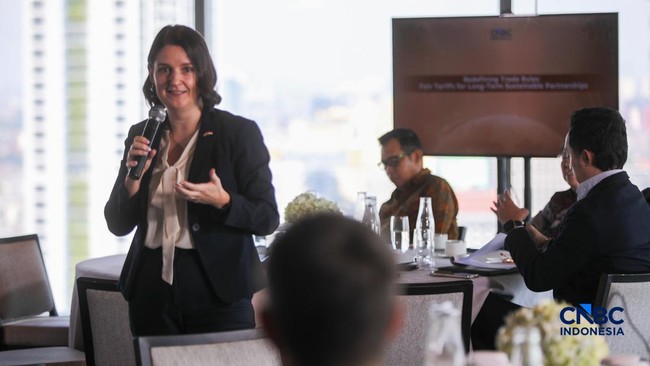
Jakarta - The potential for economic cooperation between Indonesia and the United Kingdom, discussed during a bilateral meeting in January this year, remains far from optimal. Indonesia is not yet a major trading partner for the UK, currently ranking 55th and accounting for just 0.2% of total British trade, placing it 54th among exporters to the UK.
There are several reasons making trade between Indonesia and the UK quite challenging. Firstly, strict standards and regulations. The UK applies quality, food safety, health, and environmental certification standards similar to the European Union. A number of products are also still subject to a Tariff Rate Quota scheme, which imposes specific tariffs on import quotas.
Secondly, high logistics costs and long shipping distances. Thirdly, ESG regulations with requirements for environmentally friendly, low-emission, deforestation-free products aligned with the Paris Agreement commitments.
Fourthly, Indonesia’s export structure remains dominated by raw or semi-finished commodities. More than 50% of Indonesian exports are still dominated by commodities ranging from coal and crude palm oil to nickel. With this commodity structure, Indonesian exports are heavily concentrated in countries that require raw commodities, such as China and India.
On the investment side, the UK invests quite significantly in Indonesia, ranking 20th on the list of foreign investors. According to data from the Investment Coordinating Board (BKPM), the value of UK investment in Indonesia in 2019 was recorded at US$142.1 million across 757 projects. This figure surged to US$628.3 million in 2022, then increased to US$745 million in 2024, before declining to US$488.1 million in 2025.
Expert Staff to the Government Communication Agency (BAKOM), Fithra Faisal, assesses that more effective trade policy relies on measured tariffs. He argues that various import barriers often trigger economic rent-seeking practices and make it difficult for industries to obtain competitively priced raw materials.
“If we want to have a trade policy, the instrument might be through tariffs, not import quota restrictions, because most quotas actually trigger rent-seeking activities,” Fithra said recently.
According to him, restructuring competitive tariffs is crucial so that domestic industries can obtain raw materials at affordable prices, ultimately producing finished products ready to compete in the global market. Fithra added that the government is not turning a blind eye to the challenges faced by business actors and affirmed that tariff and non-tariff policies are always open for discussion.
“All forms of non-tariff and tariff policies must be open for discussion because our main target is to increase growth, and growth comes from investment and exports,” he explained. Fithra further stressed that Indonesia must be able to match Vietnam’s aggressiveness in reforming trade policy and upskilling the local workforce. If rigid protectionism continues, Indonesia risks falling further behind its neighbours.
“There was once a saying that we must learn as far as China. But now it is no longer China, but Vietnam that is taking much more aggressive action in this region,” he said.
On the other hand, Country Director for Trade at the British Embassy Jakarta, Sophie Freeland-Haynes, stressed that tariff reform policies must be accompanied by regulatory transparency as outlined in the Comprehensive and Progressive Agreement for Trans-Pacific Partnership (CPTPP). According to her, both are crucial for sustaining economic growth, including for Indonesia.
“We see the CPTPP as a way out to cut through the spaghetti bowl of overlapping regulation and tariff disparities across a wider network,” Sophie emphasised. The CPTPP is a high-standard free trade agreement designed to strengthen economic integration and expand trade and investment connectivity among member countries in the Indo-Pacific region.
However, Sophie acknowledged that tariff reform will not have an optimal impact if the government ignores invisible barriers, such as unilateral regulations imposed without business consultation. “That could be, for example, regulations implemented without prior consultation with business actors, or without providing sufficient deadlines for businesses to adapt and make adjustments,” she explained.
This was also acknowledged by the Chair of the British Chamber of Commerce (BritCham) Indonesia Advisory Board, Donny Donosepoetro OBE. He urged the government to balance domestic industry protection with investment attractiveness. According to him, foreign investors currently understand the market risks in developing countries like Indonesia very well, but they also require legal consistency.
“The Indonesian government always has ways to protect domestic production and boost value-added exports, without having to lose its attractiveness as an investment destination or trading partner,” he asserted. BritCham is encouraging the Indonesian Government to immediately improve policy consistency, align import regulations, and fully digitalise trade finance services. Furthermore, accelerating discussions on a Free Trade Agreement between Indonesia and the UK is also considered urgent to enhance national economic competitiveness on the global stage.