
From Tabanan, Deputy Minister Fajar Asserts School Revitalisation is an Investment in the Nation's Future
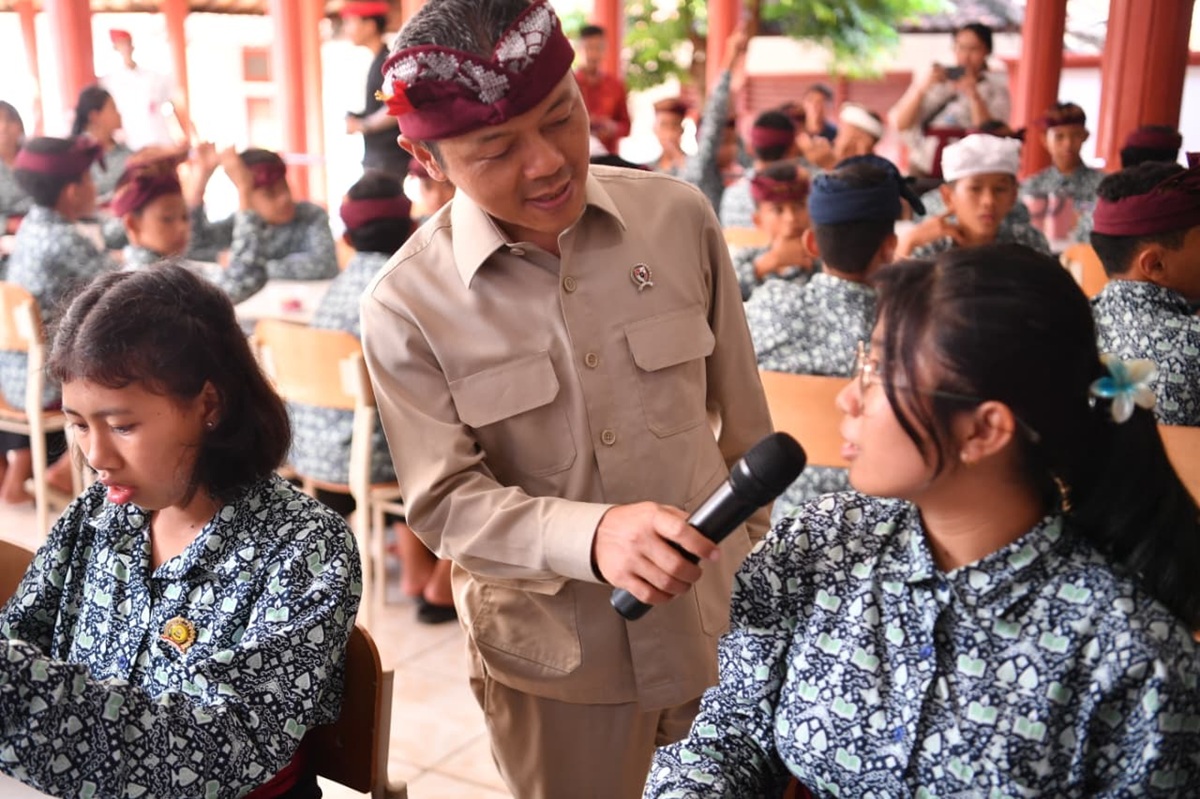
In Tabanan, the atmosphere at local schools has noticeably changed. Buildings that previously faced various limitations now stand more dignified and representative. However, for the Deputy Minister of Primary and Secondary Education, Fajar Riza Ul Haq, the inauguration represents more than just new classrooms or renovated walls; it represents the construction of Indonesia’s future.
While inaugurating the school revitalisation programme in Tabanan on Thursday (4/6), Fajar asserted that human resource development must begin with the provision of safe, comfortable, and high-quality learning environments. He stated, ‘Today we are inaugurating revitalised school buildings. But in truth, what we are building is not merely classrooms, but the future of Indonesia.’
This statement reflects the current direction of the government’s educational policy. Under the human resource development agenda, which is a priority for President Prabowo Subianto, education is no longer viewed solely as an expansion of access, but also as an enhancement of the quality of services received by students. Within this framework, school revitalisation is positioned as a strategic investment. The government aims to ensure that no Indonesian child has to study in classrooms that are damaged, unsafe, or unsupportive of the learning process.
Nevertheless, physical construction is only one part of the broader task of national education. Indonesia faces complex challenges; while access to education is expanding, the quality of learning remains a significant task. Many students have yet to achieve basic competencies in literacy and numeracy. Therefore, Fajar noted that school revitalisation must go beyond building structures. The more important aspect is how these improved learning spaces can foster better learning outcomes. ‘Better classrooms must produce more active learning. Better libraries must foster a stronger culture of literacy. Better laboratories must yield higher levels of creativity and innovation,’ he said.
In this context, Tabanan is seen as having strong foundations to continue improving educational quality. According to the 2025 Education Report, Tabanan Regency recorded a Minimum Service Standard Index for Education of 81.46, categorised as ‘Tuntas Madya’ (Intermediate Completion). Achievements in literacy, numeracy, school safety climate, and diversity also show positive progress.
For the government, these achievements prove that good education is measured not only by academic grades but also by a school’s ability to build character and a healthy learning ecosystem. Furthermore, the world facing Indonesia’s younger generation is changing. The development of artificial intelligence, digital transformation, climate change, and global competition demand that schools prepare more complex skills. Children must be equipped not just with knowledge, but with the ability to think critically, collaborate, adapt, and solve evolving problems. Consequently, strengthening literacy, numeracy, science, technology, creativity, and character serves as the primary foundation for future education.
During his visit to Bali, Fajar also met with Muhammadiyah teachers across the province. He reminded educators that educational progress cannot be achieved by the government alone; it is a collective effort involving society, religious organisations, families, the business world, and the government. He noted that the spirit of universal participation currently encouraged by the Ministry of Primary and Secondary Education has long been practised by Muhammadiyah through its tradition of community-based educational management. While the state provides policy and facilities, the ultimate quality of education is determined by the involvement of the entire educational ecosystem. Ultimately, Fajar emphasised that the most decisive factor remains the teachers. Regardless of how excellent the government-built school buildings are, education will not progress without teachers capable of inspiring, fostering curiosity, and shaping student character.