
From Stability to System Transformation: The Robustness Trap and Energy Dynamics
For years, global energy dynamics have been interpreted through the lens of cycles. Disruptions were seen as deviations from equilibrium that ultimately returned to the original pattern. Prices rose, then fell. Supplies were interrupted, then recovered. Within this framework, policies focused on stabilisation to manage short-term impacts.
However, in recent years, this pattern has shown its limitations. Disruptions no longer occur in isolation but are interconnected, forming non-linear dynamics. Energy distribution routes have become increasingly vulnerable, interactions between countries more complex, and actors’ behaviour does not always follow economic efficiency logic.
Developments in the Middle East region illustrate this shift. Risks to strategic distribution routes like the Strait of Hormuz were previously categorised as extreme, considered irrational both economically and militarily. Yet, the escalations that have occurred show that the boundary between what is deemed possible and impossible is shifting.
This change can be understood through the concept of bounded rationality from Herbert A. Simon (1957). Under conditions of pressure and limited information, decisions are no longer optimal. In loss situations, this tendency becomes stronger.
Actors tend to take greater risks than in normal conditions, as explained by Daniel Kahneman and Amos Tversky (1979). In a geopolitical context, economic pressures and domestic dynamics can drive actions previously considered irrational to become part of the system dynamics.
At the same time, the global energy system increasingly reflects the characteristics of complex systems far from equilibrium, as described by Ilya Prigogine (1984). In such conditions, systems no longer return to the starting point but evolve towards new configurations.
The world’s energy system is currently undergoing structural change. This change has direct implications for how domestic energy dynamics are read. In many cases, energy dynamics are still understood as issues of price and supply. When prices rise, the focus is on stabilisation. When supplies are disrupted, attention turns to securing distribution.
This approach remains relevant but starts from the assumption that disruptions are temporary. When changes are structural, this approach is not always sufficient to capture deeper dynamics. The changes occurring are not just in price or supply volume but in the very foundation of the system itself.
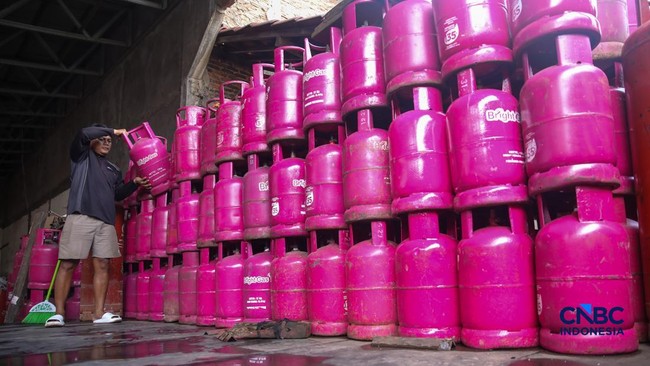
In the Indonesian context, this vulnerability is most evident in LPG as a fragile point in the energy system. National consumption has reached around 8 million to 9 million tonnes per year, while domestic production is only about 1.7 million to 1.9 million tonnes.
Thus, approximately 75 to 80 percent of national needs depend on imports. This dependence also shows an increasing trend, from around 66 percent in 2015 to approaching 78 percent in recent years (Katadata Databoks, 2024; processed from various sources). In this structure, LPG is not just an energy commodity but a key node connecting domestic stability to global system dynamics.
The supply structure is also concentrated in a few main regions, particularly the United States and the Middle East (Institute for Essential Services Reform, 2026). In normal conditions, this structure is efficient. But in conditions of global disruption, it creates high exposure to distribution and geopolitical risks.
This vulnerability is not just about the volume of imports but reflects the system structure. When household energy needs depend on imports, domestic stability becomes highly sensitive to global dynamics.
In this context, the difference between robustness and resilience is key. Based on the Merriam-Webster definition, robustness refers to the ability to remain strong and undisturbed, while resilience refers to the ability to recover and adapt after disruption. This difference leads to two distinct approaches in building system resilience.
The robustness approach focuses on maintaining stability. In the short term, this approach has very tangible benefits. Social impacts can be suppressed, inflation controlled, and economic activity kept running. In the context of household energy like fuel and LPG, price stability plays an important role in preserving people’s purchasing power.
However, in a continuously changing system, this approach also carries consequences. When prices do not reflect external conditions, consumption does not adjust. When consumption does not adjust, dependence on imports increases. When dependence increases, exposure to global risks becomes greater.
This dynamic forms what can be called the Robustness Trap. The Robustness Trap occurs when efforts to maintain short-term stability gradually increase long-term vulnerability. Internal stability is achieved, but with increasing dependence on an external system that is itself becoming more unstable.
On the other hand, rapid adjustments, such as through significant price changes, can drive faster system adaptation. Consumption will adjust, efficiency will increase, and pressure on imports can decrease.
However, this approach has significant short-term social consequences, especially for vulnerable groups. In this context, there is no choice that is entirely cost-free. Each approach has trade-offs.
The stabilisation approach provides short-term social protection. The rapid adjustment approach drives