
From silver travel to gig carers, how 6 changemakers in Asia are reimagining what it means to age
From silver travel to gig carers, how 6 changemakers in Asia are reimagining what it means to age
With accessible travel in Taiwan, tech-enabled caregiving in Hong Kong and digital upskilling in Indonesia, communities in Asia are starting to redefine the ageing experience. These are just some of the initiatives backed by the DBS Foundation.
In partnership with the DBS Foundation
SINGAPORE: Pan Bao-Chu, 76, feels both gratitude and guilt whenever she goes out with her friends.
Two decades after losing both legs in a traffic accident, every outing makes her feel like a burden to the friends who lift her, wheelchair and all, up stairs and across uneven paths.
“I’m a person who can’t put my feet on the ground,” she said. “My whole day is spent either in bed or in a wheelchair.”
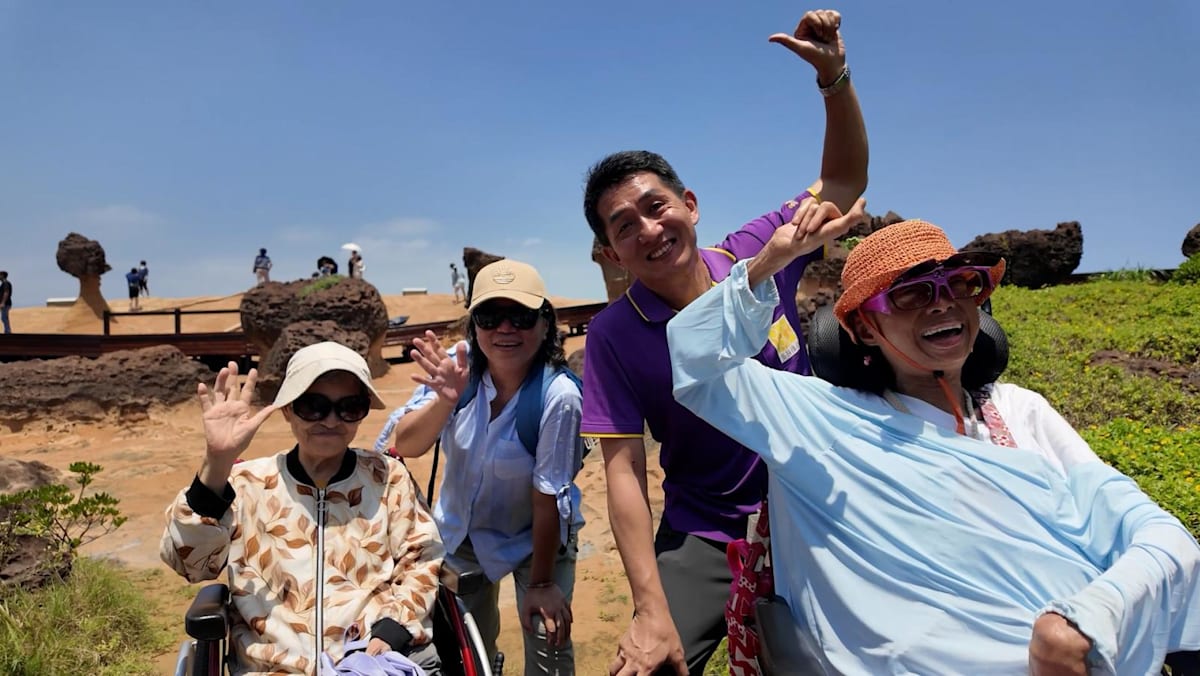
But those feelings lifted for the first time in a long while, in Taiwan’s Yehliu Geopark, where she joined a tour group specially designed for mobility-challenged seniors.
“I was really happy,” she told CNA Insider. “(The tour) let me move around freely and comfortably. But when my friends take me out, … they even have to carry me on their backs. It’s very tiring for them.”
Her joy proved infectious. “Sister Bao-Chu bought so many things to share with fellow group members and even with strangers,” said Jeff Hsu, the founder of DuoFu Holidays, the trip’s organisers.
“That gave the group (a good) atmosphere and created a ripple of joy.”
That ripple is what Hsu is striving for: To bring back adventure, purpose and connection to the lives of Taiwanese seniors with mobility or cognitive challenges — many of whom rarely leave their neighbourhoods, afraid of burdening their families.
Since DuoFu Holidays opened in 2016, it has crafted accessible travel experiences, both local and overseas, aimed at restoring dignity and delight to the elderly.
Hsu and his team visit sites, consult with authorities and work with businesses to make travel inclusive, right down to sugar-free drinks and “soft sofa cushions” for folks who have, as Hsu put it, “lost the flesh on their buttocks”.
“To keep on living, they must have something to hope for,” Hsu said. “Travel has become that hope and the very centre of their lives.”
With one in five Taiwanese aged 65 or over, such a shift in mindset could not be timelier.
In Asia, populations such as Taiwan, Singapore, Hong Kong and China are already considered aged, if not super-aged, societies. Others like India and Indonesia, while relatively younger, are still home to a huge number of seniors and on the cusp of facing this demographic trend.
WATCH: Changing Ageing In Asia (44:42)
Across Asia, bold ideas are taking shape, creating innovative solutions that help seniors live well today, stay connected, and face the future with greater confidence and security.
Longer lives should not mean smaller worlds, and across the region, organisations like DuoFu prove that older adults can age meaningfully with the right support.
To further DuoFu’s mission, the DBS Foundation awarded it a grant in 2024, part of which will go towards subsidising tours for low-income seniors.
It was one of several businesses for impact recognised by the foundation for reimagining ageing. Here is how these changemakers are empowering communities in Asia to live fully at all ages:
EASING INSTITUTIONAL CARE
In Hong Kong, about 35 per cent of seniors live alone or only with their spouse. But when illness strikes, staying at home is often no longer possible.
“We’d typically think it’s impossible to care for (ill seniors) at home, and believe the only option is to send (them) to a health institution,” said Katie Wong, the Hong Kong Council of Social Service’s chief officer for elderly service.
That belief is putting pressure on Hong Kong’s healthcare system. By 2050, over 40 per cent of residents will be 65 and older; by 2032, warns property agency JLL, the city may face a shortfall of 60,000 care home spaces.
People on the frontline are feeling it the most. In a 2023 survey on carer burnout, conducted by nursing care provider Evercare Health, around 30 per cent of more than 500 healthcare professionals were thinking of quitting their jobs.
Six in 10 said their hospitals or facilities were extremely short-staffed and getting worse.
As the pressure mounts, a new group of professional gig carers are emerging to fill the gaps in Hong Kong’s ecosystem of care.
Lisa Leung, a former medical beauty professional in her 50s, joined the healthcare field just over two years ago. After completing care support training, she signed up with Evercare, whose app connects 30,000 freelance carers with clients seeking in-home elderly care.
That is how she met Madam Fung, 80, who has dementia. Leung visits her thrice weekly, two hours at a time, offering hands-on care, companionship and practical advice.
“The stability over these two years has been very unexpected for me,” said Esther Lee, Fung’s daughter. “My relationship with my mother has naturally improved a lot.”
Evercare is one of four winners of the inaugural DBS Foundation Impact Beyond Award and received S$500,000 (US$391,000) in funding. With that, it is working on growing its home care network and rolling out a client portal for app-based bookings.
But not every family is comfortable bringing carers into their homes.
In Shanghai, Huang Lan thought about hiring one for her mother, Ni Biyun, 86. “But first, (the carer) would have to move into my home, which would take up my mum’s private space,” she said. “(My mum) would feel uncomfortable.”
Most seniors in mainland China prefer to age at home. About 90 per cent of seniors live with family, 7 per cent are supported by community services and 3 per cent live in institutions. With smaller families and people living longer, however, that model is becoming harder to sustain.
Juggling work and caregiving has taken a toll on Huang, but putting her mother in a nursing home still carries a stigma.
“People have long associated nursing homes with welfare home