
From Scavenger to Student: A Young Boy Finds Hope in Prabowo's 'Sekolah Rakyat'
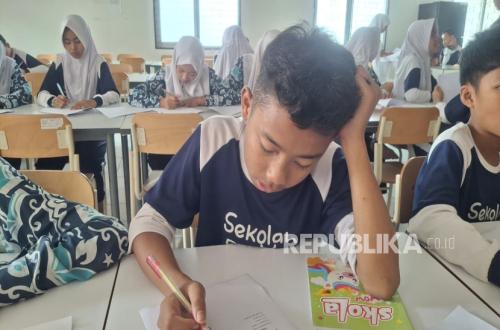
The hope of continuing his education never faded for M Ricki Aditia, a 13-year-old boy from Cimahi, West Java. Despite severe economic hardship, that hope was finally realised with the existence of Sekolah Rakyat Menengah Pertama (SRMP) 08 Cimahi. Adit, as he is known, initially felt pessimistic about being able to continue his education to junior high school after graduating from primary school in 2025. The reason was that since childhood, he had only been raised by his grandmother, a travelling coffee seller. The boy even became a scavenger to earn pocket money and help his grandmother, while his parents had left for an unknown destination. However, the Sekolah Rakyat (SR) programme, initiated by President Prabowo Subianto and run by Social Affairs Minister Saifullah Yusuf, became a bright light for Adit. His life changed dramatically as he can now experience sleeping in his own bed, complete with a small writing desk where he studies when there are no teaching and learning activities. This was something that felt impossible a year ago, as for years he was accustomed to squeezing into a small rented room with his grandmother and sibling, constantly moving from place to place. Aditia is currently visiting his grandmother’s rented house in Cigugur Tengah Village, Central Cimahi District, as SR is on holiday until 5 July 2026. ‘Now I’m comfortable in the dormitory, I have many good friends too. Everything is provided here, alhamdulillah I am happy to be able to enter Sekolah Rakyat,’ Adit said recently at SRMP 08 Cimahi. Adit’s journey was quite tough from a young age, as he no longer felt the warm embrace and love of his mother and father who left him. He was raised by his grandmother, who sells coffee daily. They lived in a rented house that was never permanent in one location. When he was still in primary school, they lived around Padasuka Village, Central Cimahi District. He already understood how hard his grandmother struggled to raise and support him. Amid these limitations, Adit maintained a high spirit for schooling. At an age where he should only be thinking about school and play, Adit already knew how difficult it was to earn money. He scavenged for items that could be recycled and had economic value. This habit was usually done after school because education remained the most important thing for him. ‘I started scavenging around the 4th grade. Usually after school I would rest first, then scavenge until about half past two,’ Adit said. The collected waste was then cleaned and sold. The money was used for his pocket money to reduce his grandmother’s burden. ‘At most I’d get about one sack, collect it, clean it, then my grandmother would sell it. To lighten my grandmother’s load. She still sells coffee to this day,’ Adit said. Amid these economic limitations, Adit had a high spirit for school. As if answering his prayers, his hope was realised because coinciding with his graduation from primary school, President Prabowo and Social Affairs Minister Gus Ipul opened the SR programme. SR is a tangible form of state affirmation to reach invisible community groups who have been hindered from accessing education due to social or family economic factors. The programme specifically targets families in extreme poverty within the first or second lowest deciles. Its main goal is to break the intergenerational poverty chain through the provision of free, quality education. ‘So after graduating from primary school, someone came to my grandmother to tell her about Sekolah Rakyat, and I immediately registered,’ he said. Together with other students, Adit entered the SR dormitory at Sentra Abiyoso, South Cimahi District, in July 2026. Adaptation was necessary for the new habits in the boarding school system. Adit had to get used to a structured daily routine and time discipline. SR promotes a holistic education concept that focuses not only on academic ability but also character building, where students are trained to live independently, have self-confidence, and dare to dream. With the boarding school system, they must get used to a structured daily routine and time discipline. Student activities begin at 3.30 a.m. for those who wish to perform the Tahajud prayer. Those who wish to fast on Mondays and Thursdays are also woken up and provided with a pre-dawn meal. Group activities start with a morning assembly, followed by the dawn prayer in congregation at the mosque. At 6.00 a.m., it is breakfast time for the students, followed by cleaning the environment. Teaching and learning activities run from 7.00 a.m. to 2.30 p.m., following the national curriculum. Afterwards, activities continue with dormitory programmes and extracurriculars according to the students’ interests, self-study, and more environmental cleaning. Evenings are filled with Quran recitation, literacy and numeracy classes, specialisation classes, and additional classes for children who need them. The day’s activities conclude with a reflection session and lights out at 9.00 p.m. Adit persevered through a routine that initially felt tedious. His reason is both touching and noble. He wants to make his grandmother happy and proud, even though he can never repay all the time, energy, thought, and material she poured into raising him. ‘At first it was sometimes boring because I wasn’t used to it. But over time I got comfortable here, having lots of friends to sleep with in the dormitory and so on,’ he said. At SR, Adit has begun to weave his dreams and aspirations. Now in the 8th grade, he is making the most of this opportunity.