
From Sanders to Mamdani: The New Power Map Reshaping the US Democratic Party
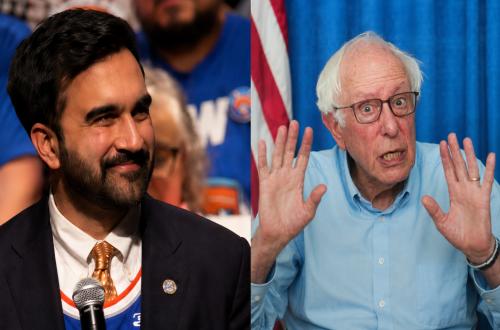
The biggest battles within the United States Democratic Party lately have not always been against the Republican Party. Within the Democratic Party itself, the contest over political direction between moderates, mainstream liberals, progressives, and democratic socialists is increasingly open. The victories of a number of new candidates show that the power map within the party is changing.
Evan Barker, a former Democratic fundraiser and political activist who once moved within Bernie Sanders’ political circles, views this change from a highly critical angle. Barker, who later left the Democratic Party and voted for Donald Trump in the 2024 presidential election, believes the progressive faction now wields far greater influence over donors, activists, campaign staff, and the Democratic nomination process. That influence, according to Barker, has even grown beyond the ability of the party’s top leadership to control it.
However, Barker is not an observer coming from outside the arena. He comes from a union family in Kansas City, became involved in politics during the wave of Barack Obama’s campaigns, was once an organiser for Hillary Clinton, and later worked at the progressive fundraising firm Left Rising. Throughout his political career, Barker claims to have helped raise around 50 million US dollars for Democratic candidates before ultimately turning into one of the harshest critics of the party’s political direction.
It is because of that background that Barker’s statements are worth examining. It does not mean his views automatically become an objective picture of the entire Democratic Party, but rather because the criticism comes from someone who was once inside the progressive political network. One of his remarks even summarises nearly a decade of internal Democratic battles in just a few sentences, as reported by Fox News on Monday (17/8/2026).
“Part of the reason that position shifted is because the establishment tried really hard in 2020 to block us, and in 2019, after AOC won, they made a blacklist, and it backfired on them. And it made the far-left wing stronger,” Barker said on Jesse Watters Primetime. So, what exactly did Barker mean?
AOC Wins, Democratic Elite Shaken
The story must be traced back to June 2018, not 2019. Alexandria Ocasio-Cortez, then a 28-year-old activist who had worked as a bartender and been a Bernie Sanders campaign organiser, surprisingly defeated Joe Crowley in the Democratic Party primary in New York. Crowley was no ordinary politician; he was a senior member of Congress and at the time one of the most influential figures in the Democratic leadership in the US House of Representatives.
AOC’s victory was a major shock. A young candidate with the support of volunteers, grassroots donations, and a progressive agenda was able to bring down a senior politician with strong ties to the party’s main structure. AOC subsequently developed into one of the most recognisable faces of America’s new progressive generation.
Her reputation was built through various issues, from the Green New Deal, the expansion of social protections, workers’ rights, the reduction of economic inequality, to criticism of the outsized influence of corporate money in politics. Her ability to use social media also made her an important figure in connecting progressive politics with young voters. AOC’s victory ultimately showed that candidates who are not the top choice of the party elite can still win through grassroots mobilisation.
In the eyes of the progressive faction, that victory became proof that primaries could be used to replace Democratic incumbents deemed too moderate or too close to the old political structure. However, for the mainstream Democratic leadership, the wave of challengers against fellow party members presented another problem. Internal battles were seen as potentially draining money, energy, and resources that should have been used to face the Republican Party. From this emerged what Barker called the “blacklist”.
What Exactly Was the 2019 “Blacklist”?
In 2019, the Democratic Congressional Campaign Committee, or DCCC, the official Democratic Party body that helps candidates win seats in the US House of Representatives, implemented new rules for consultants and political service firms. In essence, the DCCC would not award contracts or recommend vendors that helped challenger candidates run against sitting Democratic members of Congress. The policy was intended to protect Democratic incumbents from attacks by fellow party members.
For Indonesian readers, the mechanism can be imagined like this. A congressional candidate in America needs polling firms, communications consultants, digital media experts, fundraisers, ad makers, and campaign strategists. These firms also seek contracts from the DCCC because they are large in value and open access to many Democratic campaigns.
So, the new rule created a choice that was not simple. If a firm helped a progressive candidate challenge a sitting Democratic member of Congress, that firm risked losing business from the party’s official structure. In practice, the policy applied economic pressure on consultants not to help insurgent candidates.
Source: jawawa.id (https://jawawa.id/newsitem/from-sanders-to-mamdani-the-new-power-map-reshaping-the-us-democratic-party-1787010665)
Originally published by Republika (https://news.republika.co.id/berita/tjx5z4451/dari-sanders-ke-mamdani-peta-baru-kekuasaan-yang-mengubah-partai-demokrat-as), translated from Indonesian