
From Salt Pans to Industry: Bima Salt Seeks Added Value
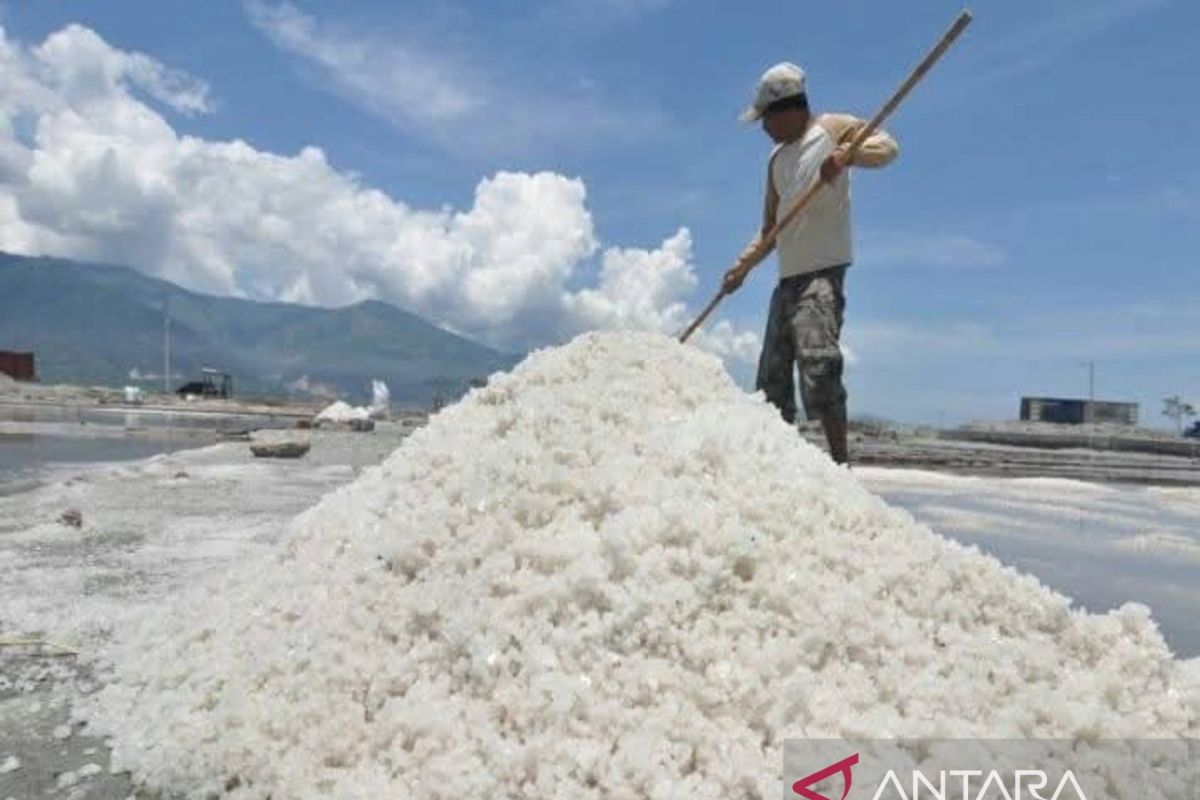
During the harvest season, the salt pans in Bima Regency, West Nusa Tenggara, transform into a dazzling expanse of white. Salt crystals are collected, piled, and then await buyers to collect them.
Behind this white expanse lies the livelihood of approximately 3,000 farming families who depend on these salt pans for income. With each family averaging three to four members, this sector supports the livelihoods of around 9,000 to 12,000 people.
However, Bima is currently tackling a significant challenge: how to ensure that the salt harvested from these pans achieves higher economic value once it leaves the hands of the farmers. This question is vital as Bima’s salt production reached 119,311.24 tonnes in 2025. While this figure represents an 8.35 per cent decrease compared to the 2024 production of 130,186.32 tonnes, it still demonstrates the vast potential of the region’s raw materials.
Bima no longer wishes to be known merely as a salt-producing region. The local government is beginning to encourage the commodity to move further along the value chain, from the salt pans to the industry.
Data from the Bima Regency Marine and Fisheries Office (DKP) shows that salt production reached 100,815 tonnes in 2021. A year later, production fell to 77,739.68 tonnes. Subsequently, production rose again to 108,686.98 tonnes in 2023, reaching a peak of 130,186.32 tonnes in 2024. In 2025, production stood at 119,311.24 tonnes, harvested from approximately 1,564.59 hectares spread across the Palibelo, Woha, Bolo, Sape, and Lambu districts.
This production base serves as a vital economic pillar for the coastal communities of Bima. However, high production volumes do not automatically strengthen the farmers’ position within the value chain. Most of the salt produced is still of KW2 and KW3 quality. “The majority is still KW2 and KW3. There is also KW1, but it is usually in the Nanga area because it is close to the sea, though road access is not yet available,” said the Head of Institutional and Investment at Bima DKP, Irmalashari, to ANTARA on Wednesday.
This is where the issue of Bima’s salt becomes more complex. While production is important, industry requires more than just quantity. Quality, continuity of supply, and adherence to specifications are essential components for entering broader processing chains. Lower-quality salt has more limited market opportunities, whereas improving quality can pave the way to markets that require salt as an industrial raw material. In other words, the path to downstreaming does not only begin at the factory; it begins at the salt pans, through the quality of salt produced by the farmers.
Regarding the industrial market, the Vice Regent of Bima, H. Irfan Zubaidy, views quality improvement as the way to enhance the economic value of salt and expand markets for salt farmers. “If we want good salt prices, we must upgrade our salt to industrial grade. It can be used for mining, cosmetics, and food and beverages. The opportunities are vast,” he stated during the launch of the ‘Garam Merah Putih Bima’ iodised consumer salt brand on Tuesday.
His statement addresses the core issue of Bima’s salt commodity: production is available in large quantities, but the added value has not been fully realised within the region. To date, Bima salt has been distributed to various regions across Indonesia, including Bali, Java, Makassar, East Nusa Tenggara, Banjarmasin, Kabaena, Medan, and Jakarta.
Source: jawawa.id (https://jawawa.id/newsitem/from-salt-pans-to-industry-bima-salt-seeks-added-value-1791395746)
Originally published by Antara (Indonesian) (https://www.antaranews.com/berita/5776084/dari-tambak-ke-industri-garam-bima-mengejar-nilai-tambah), translated from Indonesian