
From Rp18 Million Capital to Rp625 Million Profit: Village Cooperatives Become Economic Engines
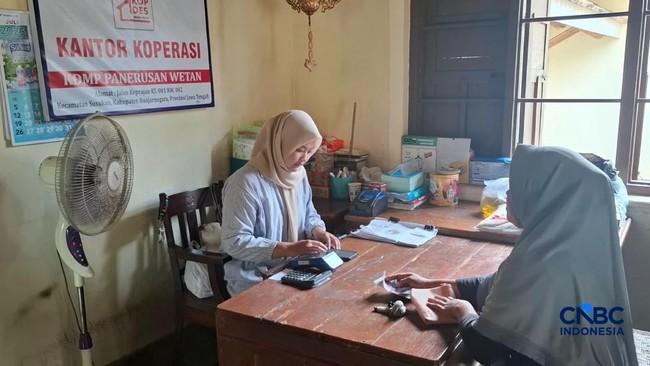
Banjarnegara, CNBC Indonesia - The presence of the Merah Putih Village Cooperative (KDMP) is bringing numerous benefits to the residents of Panerusan Wetan Village, Banjarnegara Regency, Central Java.
According to investigations by CNBC Indonesia, the KDMP’s presence in the village is actively supporting farmers as well as micro, small, and medium enterprises (MSMEs). The majority of the population in Panerusan Wetan Village relies on farming, specifically cultivating rice, maize, and coffee.
Panerusan Wetan is one of 15 villages in the Susukan District, covering an area of 2.99 km² with a population of 3,215 people. Many residents, particularly farmers and MSME owners, have begun to benefit from the KDMP, ranging from easier access to fertiliser to the availability of LPG gas.
One such resident is Suhardi, a rice farmer in Panerusan Wetan Village. He noted that since the establishment of the KDMP, it has become much easier to obtain subsidised fertiliser for his crops, and the prices offered are relatively affordable.
“Since the Merah Putih Village Cooperative arrived in Panerusan Wetan Village, we have been greatly assisted. If we want to buy fertiliser, we no longer have to travel far, and the prices are cheaper,” Suhardi told CNBC Indonesia on Wednesday (19/8/2026).
Suhardi admitted that before the KDMP, he had to travel quite far to the east of the village, specifically to the Purwareja Klampok Market, which is approximately 5 km away. Previously, fertiliser prices were higher, sometimes exceeding Rp8,000 per kg. Now, fertiliser is available at the KDMP for a more affordable price of around Rp8,000 per kg.
He added that before the KDMP, the requirements for collecting subsidised fertiliser were quite complicated, as he was required to possess a ‘Kartu Tani’ (Farmer Card). “Since the KDMP exists, if we want to buy fertiliser, we can just buy it directly, making it much easier,” Suhardi said.
Beyond farmers, Eko, an MSME owner selling Robusta coffee, also reported benefits from the KDMP. Before its arrival, he only sold his coffee to small buyers near his home, with daily sales limited to 3–5 kg and daily income of around Rp600,000.
Since the KDMP’s involvement, his coffee sales have increased to 7 kg per day, and his income has risen drastically to Rp1.5 million per day. Eko noted that last year, a buyer from Australia even requested that his products be shipped there.
Eko mentioned that the coffee produced and sold originates from farmers in the Sitata Mountain area. The Susukan District possesses strong agricultural potential due to its fertile land, adequate rainfall, and diverse ecosystem. This makes the agriculture and forestry sectors the backbone of the local economy, with commodities ranging from rice, vegetables, and horticulture to plantation crops like coffee and tea.
Data from the Banjarnegara Regency Central Bureau of Statistics (BPS) shows that coffee dominates the plantation sector. As of 202\0, the number of coffee trees in Banjarnegara reached 3.92 million, accounting for 79% of total plantation crops. Susukan is a major coffee hub, with an area of 31.24 hectares.
Adi Wibowo, Head of the Panerusan Wetan KDMP, stated that the cooperative has been warmly welcomed by the village community. “The presence of the KDMP is very helpful to our villagers. Farmers no longer need to travel far to Purwareja Klampok Market for fertiliser, and others can now buy rice and LPG gas close to home,” said Adi.
Adi explained that when the KDMP was first formed on 17 August 2025, the initial capital was Rp18 million. By November 2025, he had achieved a profit of approximately Rp200 million. After one year of operation, profits have surged to Rp625 million.
“The initial capital on 17 August last year was around Rp18 million; now, we have achieved profits of up to Rp625 million,” Adi explained.
The number of active members in the Panerusan Wetan KDMP has also grown from 314 members last year to 525 members today, including both farmers and MSME owners.
With the presence of the KDMP, the agricultural sector in Panerusan Wetan and Banjarnegara Regency is expected to grow rapidly. BPS data shows that over the last five years (2021–2025), Banjarnegara’s economic structure has been supported by the Agriculture, Forestry, and Fisheries sectors. The contribution of agriculture to Banjarnegara’s GDP exceeds 27%.
Banjarnegara’s economy continued to grow, reaching 5.26% in 2025, which is above the national average of 5.11%.
The Regional Secretary of Banjarnegara, Hendro Cahyono SE, M.Si, explained that village cooperatives hold two strategic values: reviving the sense of community and mutual cooperation (gotong royong) that has begun to fade, and revitalising the village economy.
“Cooperatives can serve as a vessel to revive that spirit while simultaneously strengthening the community’s economy,” he said during an interview with CNBC.
Banjarnegara comprises 20 districts, each with unique advantages and potential, ranging from vegetables and coffee to livestock and other commodities. As digital technology advances, agricultural products within the cooperative are also progressing. Hendro added that sales no longer need to be conducted physically, as digitalisation and online sales are increasingly being utilised.
Source: jawawa.id (https://jawawa.id/newsitem/from-rp18-million-capital-to-rp625-million-profit-village-cooperatives-become-economic-engines-1789027229)
Originally published by CNBC Indonesia (https://www.cnbcindonesia.com/research/20260910115431-128-766916/modal-rp18-juta-kini-cuan-rp625-juta-koperasi-desa-jadi-mesin-ekonomi), translated from Indonesian