
From ‘red ocean’ to ‘blue ocean’: Why Singaporean firms are exploring Nanning to enter China’s market
From ‘red ocean’ to ‘blue ocean’: Why Singaporean firms are exploring Nanning to enter China’s market
Recent pyramid scheme arrests involving Singaporeans have put Nanning in the spotlight, but businesses told CNA they remain undeterred from entering the Chinese market - and that making inroads can take months or even years.
NANNING, Guangxi: Singaporean sales director Tracy Low, 46, came to Nanning in search of a partner to distribute her company’s coffee in China.
The company, Kim’s Duet, which sells Singapore-style coffee in single-serve sachets, began exploring the Chinese market earlier this year.
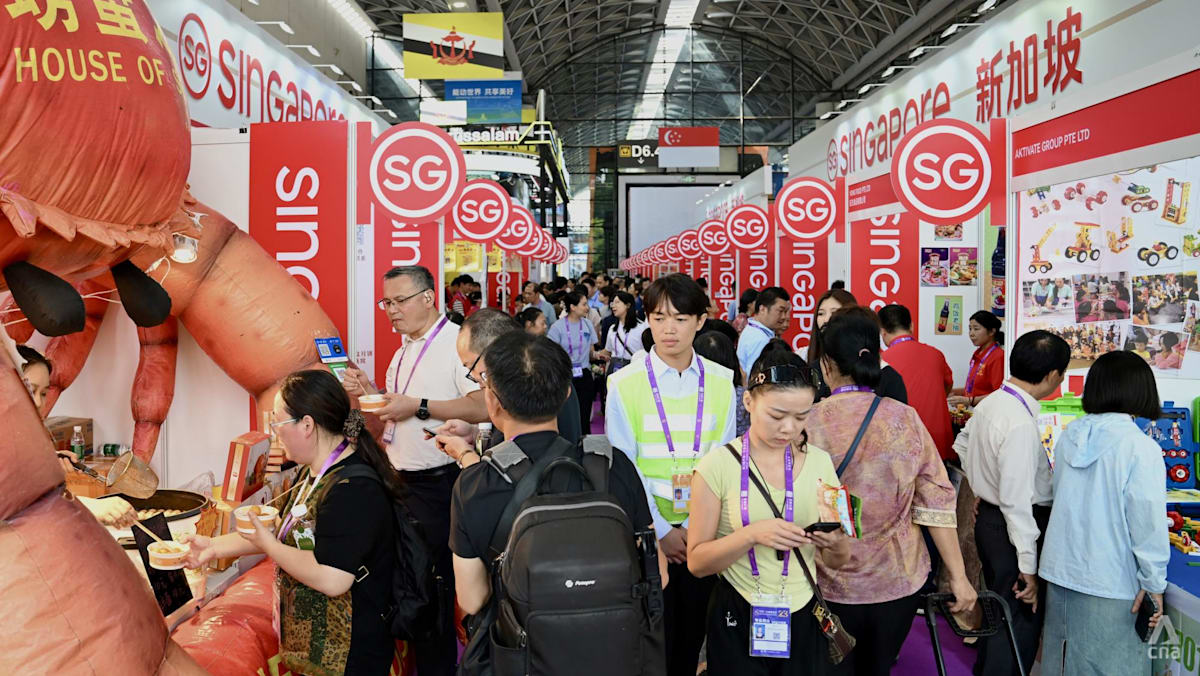
At the China-ASEAN Expo (CAEXPO) held in Nanning from Sep 17 to 21, Low met several potential distributors.
“It could take between three to six months to filter these distributors before we engage them,” she said.
More than 50 exhibitors from Singapore took part in the five-day event - the highest number since 2023. Some were testing the market for the first time while others had spent years building contacts and turning discussions into business deals.
For many Singaporean companies looking to expand in China, Nanning offers a foothold in a less familiar market.
The capital of Guangxi has been in the spotlight after 52 Singaporeans were arrested over suspected involvement in pyramid-scheme activities, amid longstanding warnings over investment pitches that promised unusually high returns.
The Singapore Business Federation (SBF) said it was not aware of companies raising concerns about entering Nanning following the news.
Businesses had still been asking the usual questions about “market access, market opportunities, and how they can enter a market”, executive director for international business Soo Wei-Chieh told CNA.
Businesses described to CNA a slow process of breaking into China’s massive market - one that can involve spending months or even years finding the right partners, testing relationships and assessing whether opportunities can turn into real business.
A “BLUE OCEAN”
When most Singaporeans think of China, they often think first of major cities like Beijing and Shanghai, said Tan Teck Yong, chairman and CEO of Singapore education company KinderWorld International Group.
But Tan is looking further afield.
First-tier cities such as Beijing, Shanghai, Guangzhou and Shenzhen are a “red ocean”, Tan said, referring to a business term for crowded and competitive markets.
The Guangxi region, by contrast, is a “blue ocean”, he said - a less saturated market with more room for growth.
KinderWorld first entered China in 2000 before expanding into Vietnam. For Tan, venturing into new markets is part of the company’s broader strategy.
“We are a Singapore company. Our motto is very clear: internationalise,” he said.
Since the COVID-19 pandemic, Tan has attended CAEXPO in Nanning three times, using the fair to build connections, meet officials and gain a better understanding of the local market.
Those visits became part of a longer process of exploring opportunities in Guangxi, he said.
Turning connections into concrete opportunities also takes time. Tan spent a year and a half in discussions before KinderWorld’s plans in Guangxi began to take shape. The group has since signed agreements with local education institutions.
And the Singapore government has been trying to get more companies to do just that.
“With our small domestic economy, many growth opportunities lie beyond Singapore’s shores,” Deputy Prime Minister and Trade and Industry Minister Gan Kim Yong said during a speech in March, as the government announced increased support for local firms venturing abroad.
Senior Minister Lee Hsien Loong also visited Guangxi in May to better understand its role in ASEAN-China connectivity, with MFA describing the region as a “key gateway” linking China with Southeast Asia.
But for some businesses taking that step, unfamiliar markets can come with steep learning curves.
Wayne Eo, director of Singapore building materials company Sixth Harmony Global, knew little about Nanning before attending his first CAEXPO back in 2024.
He thought of it as an up-and-coming second-tier Chinese city but was surprised to discover modern high-rises and shopping malls.
People he met in restaurants and at street-food stalls were “all very earnest” and local food also took a bit of getting used to, he said.
“If you aren’t a bamboo fan … you will be really shocked,” he joked, referring to the local fondness for bamboo shoots.
He has kept coming back since. Through CAEXPO, Sixth Harmony has expanded its contacts beyond Nanning and now supplies customers elsewhere in Guangxi and also in Guangdong.
“Nanning is the entry point for us,” Eo said.
BUSINESSES UNDETERRED BY PYRAMID SCHEME ARRESTS
Guangxi’s capital is also becoming better connected. Just this month, the Pinglu Canal opened, giving Nanning and other parts of inland southwestern China a shorter water route to the sea.
But its growing role as a link between China and Southeast Asia has also featured in pitches for a very different kind of opportunity.
Last December, Zhang Fan, a 40-year-old Singaporean working in cybersecurity, recalled being approached by a close university friend with an investment proposal.
He was told that Nanning was becoming a strategic geographical link and could even become “the next Shanghai” within a decade.
His friend had also offered to take him around the city to see its high-rises and development projects, presenting them as signs of the city’s potential.
The pitch came with eye-catching figures: an investment of as much as S$40,000 to S$50,000, he recalled - with the prospect of receiving more than S$1 million over two years.
But all that said little about whether the investment being promoted was legitimate.
Zhang ultimately turned down the proposal and said it “sounded too good to be true”.
News of the arrests over suspected pyramid scheme activities in Guangxi, however, has not deterred Singapore businesses looking for opportunit
Source: jawawa.id (https://jawawa.id/newsitem/from-red-ocean-to-blue-ocean-why-singaporean-firms-are-exploring-nanning-to-enter-chinas-market-1791067817)
Originally published by CNA (https://www.channelnewsasia.com/east-asia/nanning-business-caexpo-singapore-china-6407501)