
From Packed Meals to Souvenirs: Weekend Rail Travel Revives Small Traders
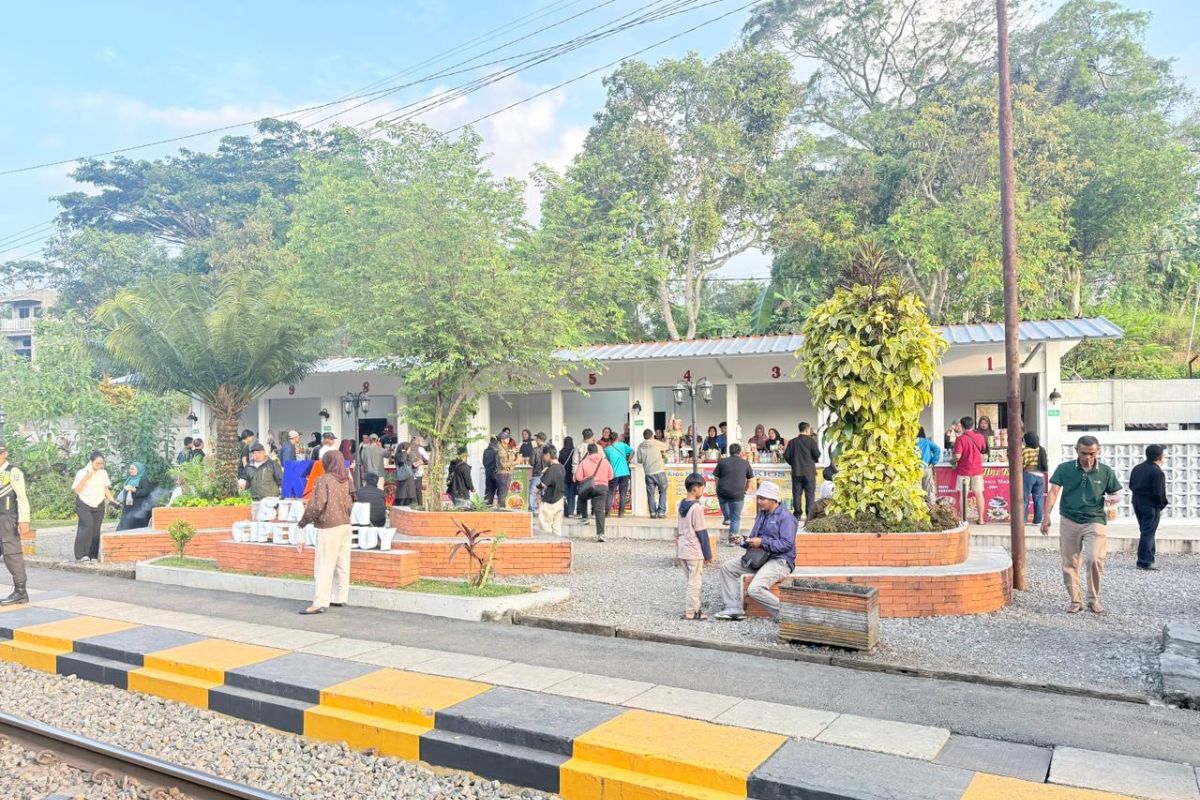
There is a sound often lost in the bustle of train travel—the sound of a small stove lit in a modest home, the rustle of plastic wrapping tidied around portions of rice, and the quiet prayer of a vendor hoping for a customer to stop by. For passengers, a station is a place to depart and arrive. For the small traders around it, the station is a place to place hope. Every train that stops brings new possibilities: a packed rice meal that gets bought, hot coffee that is drunk, fried snacks sold out before noon, a local motorcycle taxi finding a fare, and homemade souvenirs finally carried away to another city.
Weekend travel by train often appears simple. Someone buys a ticket, carries a bag, then sits waiting for the departure schedule. But beyond the window of that journey, many families also depend on the busy mobility of passengers. There is a mother who wakes earlier to cook provisions, a father who arranges a small stall near the station, and micro-enterprise operators hoping their products become more widely known through the hands of passing passengers.
Therefore, when a station resumes serving passengers boarding and alighting, what arrives is not merely a figure in a report. What arrives is a new breath for the surrounding area. A previously quiet spot begins to know the footsteps of passengers. Stalls once hesitant to open now dare to arrange their wares. Residents who previously only watched trains pass by now see opportunity coming closer to the yard of their lives.
PT Kereta Api Indonesia (Persero) recorded that from January to May 2026, the KAI Group served 214,045,803 passengers, an increase of 7.2 percent compared to the same period in 2025 of 199,663,907 passengers. This figure comes from KAI’s long-distance and local train services totalling 24,372,733 passengers, KAI Commuter 169,047,494 passengers, KAI Airport 2,905,389 passengers, Jabodebek LRT 13,211,856 passengers, KAI Wisata 131,843 passengers, South Sumatra LRT 1,815,017 passengers, Makassar–Parepare train 145,735 passengers, and Whoosh 2,415,736 passengers.
KAI Vice President Corporate Communication Anne Purba said the mobility of train passengers carries a meaning very close to community life. Every passenger who comes to the station can become a buyer, a guest, a service user, or a bearer of good news for local products. “Behind one train ticket, many small hands also feel the benefits. There are provision sellers, coffee vendors, breakfast stalls, onward transport drivers, regional snack makers, and souvenir micro-enterprises. When passengers come to the station, it is not only the journey that comes alive, but also the hopes of many families,” Anne said.
For KAI’s long-distance and local train services, 24,372,733 passengers were recorded from January to May 2026, growing 9.9 percent compared to the same period in 2025 of 22,168,570 passengers. In May 2026 alone, passenger volume reached 5,154,293, up 15.6 percent compared to May 2025 of 4,458,901 passengers. This growth shows that trains are increasingly becoming the public’s choice for daily travel, family, education, work, tourism, and weekend trips.
However, the most touching story is evident from the small stations. Based on passenger boarding and alighting volume data per station, there are nine stations that throughout 2025 recorded no boarding and alighting passengers, then began recording passenger activity in January–May 2026. At points like these, figures that were once empty turn into life.
Throughout January–May 2026, these nine stations recorded a total of 184,136 boarding and alighting passengers, consisting of 91,850 boarding and 92,286 alighting. These stations are Wonogiri 63,667 passengers, Kayutanam 52,475 passengers, Sicincin 41,681 passengers, Sukoharjo 8,424 passengers, Solo Kota 8,107 passengers, Comal 6,135 passengers, Pasarnguter 3,007 passengers, Plabuan 398 passengers, and Rajapolah 242 passengers.
For a report, that figure is data. For residents around the station, that figure could mean the first buyer after a stall opens. It could mean goods selling out faster. It could mean a local motorcycle taxi getting a fare. It could mean a small food stall daring to add stock. It could mean a mother returning home with enough money for tomorrow’s kitchen shopping.
One strong example is seen at Comal Station, Operational Area 4 Semarang. Throughout 2025, this station recorded no boarding and alighting passengers. In January, February, and March 2026, the figure was also still zero. However, in April 2026, 512 boarding and alighting passengers began to be recorded, then increased to 5,623 boarding and alighting passengers in May 2026. The total for January–May 2026 reached 6,135 passengers, consisting of 3,027 boarding and 3,108 alighting.
“For small traders, the change from zero to thousands of passengers is not an ordinary number. It can be a change in daily fortune. Around the station, arriving passengers bring opportunities for packed rice meals, coffee, fried snacks, traditional market cakes, local transport, and regional souvenirs,” Anne said.
A similar story is also seen at Plabuan and Rajapolah. Both stations recorded no boarding and alighting passengers throughout 2025 and January–March 2026. In April and May 2026, Plabuan began recording a total of 398 passengers, while Rajapolah recorded 242 passengers. The numbers may not yet be large, but for the small economy around the station, every passenger still matters.
In another region, Wonogiri became an example of how station services can open new mobility flows. After not serving boarding and alighting passengers in 2025, Wonogiri served 63,667 boarding and alighting passengers throughout January–May 2026. This figure consists of 30,703 boarding and 32,964 alighting passengers.