
From Marble Quarry to World Icon: The Transformation of Rammang-Rammang
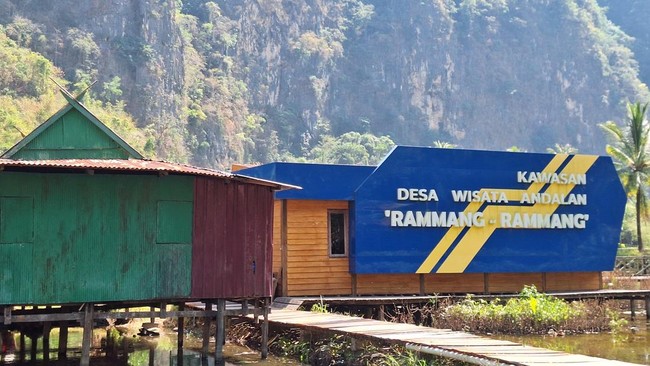
Rammang-Rammang has become one of South Sulawesi’s flagship tourist destinations. Located in Salenrang Village, Bontoa District, Maros Regency, it offers a stunning panorama of majestic and charming karst mountain formations. This karst range is said to be the second largest in the world after Chilind in China and Tsingy in Madagascar, and the area is recognised as a UNESCO Global Geopark.
Sunardi, from the Anak Sungai Community, explained that before the area became a tourist destination in 2007, the site from Dock I to Dock II was used for marble and cement mining. This activity faced opposition from environmental activists and local residents who depended on the area for their livelihoods. Another reason for the rejection was that Rammang-Rammang possesses a spring that supplies water to three villages.
"We only realised after the tourism area was established, researchers came in, students came in. We invited various activities to Rammang-Rammang. After research, it turned out we are in the second largest category in the world after China," he said at Kampung Berua, Rammang-Rammang.
Beyond the breathtaking karst scenery, the Rammang-Rammang tourist village offers various attractions and activities. Visitors can cruise along the white river by boat, enjoy the atmosphere of Kampung Berua—the main landmark accessible only by water—explore caves, trek through the stone forest, stay at the Rammang-Rammang Eco Lodge, and watch the beautiful sunrise. The area also features expanses of rice fields, fishponds, plantations, and settlements, along with approximately 1,250 historical caves, 1,340 species of flora and fauna, and 123 local cultural traditions.
Sunardi noted that world heritage recognition began when UNESCO assessed Rammang-Rammang in 2022. During that visit, the UNESCO assessor team toured the area using an electric boat. "We prepared the electric boat for the assessor from UNESCO. That’s how it happened. Alhamdulillah, he enjoyed the journey. He was even interested in staying here," Sunardi explained.
The electric boats were provided by PT PLN (Persero) through PLN’s North Makassar Customer Service Unit (UP3). The assistance began when the Anak Sungai Community, as the manager, applied for electrical infrastructure in the Rammang-Rammang tourism area. Once the infrastructure was in place, the community and PLN UP3 initiated the use of electricity to power boats transporting tourists around the site. The electric boats allow guides to share information without the disturbance of a motor engine. "Since the arrival of these boats, they have greatly helped the presence of Rammang-Rammang, especially for foreign tourists. Foreign tourists are very happy using electric boats," he said. Tourists visiting Rammang-Rammang come from various countries across Asia, Australia, and Europe.
The modified electric boats are equipped with a 1.47 kW engine and a 2x58 Volt DC battery. Compared to diesel engines, the electric boats are silent, making the visit more comfortable for tourists. Sunardi added that the tourism site supports around 300 local families, providing jobs as boat drivers, parking attendants, vendors, canteen operators, and guides.
Sadrach, Manager of PLN’s Maros Customer Service Unit, explained that the electric boat assistance was provided not only to overcome noise but also for environmental reasons, as the preservation of the karst area must be maintained. PLN has also provided a Public Electric Vehicle Charging Station (SPLU) with a capacity of 7,700 Volt Ampere at Dock 2 bridge to facilitate battery recharging. "If more electric boats are developed in the future, we will add more SPLU units, perhaps at Dock I and Dock III, and we will also prepare the electrical infrastructure," Sadrach said. PLN’s initiative in providing electric boats has been followed by the local and provincial governments. Currently, seven electric boats are in operation, with two units from PLN and five from the local government.