
From Lighthouse Beam to Mobile Screen: Bustami Connects with the World at Indonesia’s Edge
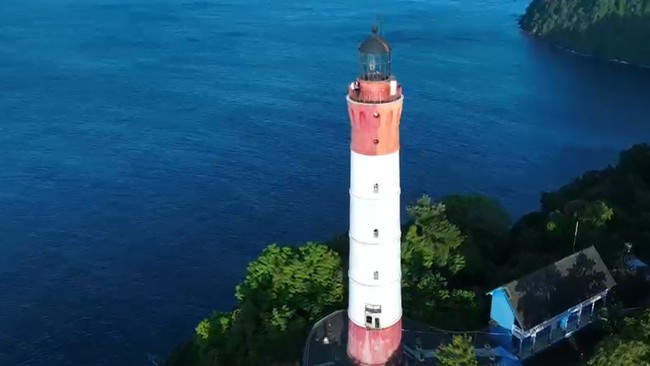
For nearly 150 years, the world for residents of Pulau Breueh extended only as far as the beam of a colonial lighthouse. Life on the 90.56-square-kilometre island is now beginning to change.
Every day, much of the fish landed by boats at Seurapong Pier ends up in Bustami’s records. The pier is one of the busiest on Pulau Breueh.
There are grouper, mackerel tuna and tuna, and, most sought after, octopus. At the small pier on Pulau Breueh, at the westernmost tip of Aceh, the 49-year-old weighs and records the catch, then picks up his mobile phone.
He calls buyers to find out who is willing to pay the most that day. He is often busy phoning contacts from Banda Aceh to Medan to sell the fish at the best price.
From time to time, he opens TikTok, where he posts fish prices for anyone willing to watch and listen.
From that remote pier, his voice can now reach anywhere.
For the people of Pulau Breueh, such reach is new. For more than a century, the farthest point they could see was marked by an old Dutch-built tower at the island’s tip, its light sweeping across the sea every night.
Bustami grew up beneath that light. He also witnessed the sea take almost everything he knew.
The lighthouse is called Willem’s Toren III. It stands in Meulingge, the westernmost village in the Republic of Indonesia. Construction began on 17 August 1874, just a year after the Netherlands launched its first military campaign against Aceh.
The name Willem’s Toren refers to King Willem III of the Netherlands, whose full name was Willem Alexander Paul Frederik Lodewijk. During his reign, the Dutch expanded infrastructure, including lighthouses to support shipping and trade.
Willem’s Toren III on Pulau Breueh is said to be one of three similar structures built by the Dutch colonial government in different parts of the world. The other two are in the Netherlands, where one now operates as a museum, and in the Caribbean.
The tower was not built for the islanders. It was built for ships travelling towards the Strait of Malacca, one of Asia’s most important trade routes, and to monitor the sea that a kingdom on another continent sought to control.
The island did not simply accept the lighthouse’s presence. In 1887, the forces of Teungku Chik di Tiro attacked the Dutch facilities on Pulau Breueh in a fierce battle.
For island residents, the lighthouse would eventually become a kind of unwritten boundary.
Its beam swept across the sea as far as the eye and its lens could reach; beyond its circle of light, the world seemed to stop. Banda Aceh, the nearest city, is about a one-and-a-half-hour sea journey from Ulee Lheue Port. News from outside arrived slowly, carried by boat and passed from person to person.
Before mobile phones, people on Pulau Breueh even relied on Radio Baiturrahman to hear news about family members across the sea.
“Every day at 7am, Radio Baiturrahman had a special programme announcing who had died. We listened to the broadcast in the gampong [village]. If a neighbour or someone we knew had died, we would tell the others so they could get ready to pay their respects,” Misbah said.
Misbah said the news sometimes arrived too late for residents to travel that day, as passenger boats left at around 8am.
“We then had to wait until the next day to go to Banda [Aceh],” he added.
Born of distance
The island’s name has its roots in distance. In Acehnese, breueh means rice. According to a story passed down through generations, the journey to the island once took so long that cooked rice brought from the mainland would spoil before it arrived.
Travellers therefore brought uncooked rice and cooked it after reaching the shore. The story has not been confirmed by any etymological record, but it captures a truth about the place: life on Pulau Breueh has always meant finding ways to contend with distance.
On the morning of 26 December 2004, distance no longer mattered.
Bustami still remembers the sequence. First came a sound like an explosion, then a powerful earthquake shook the island.
After that, the sea receded far beyond the shoreline, exposing a seabed that should never have been seen. Someone shouted, “Run! Run!” They fled, with a towering wave behind them.
“We heard a sound like an explosion, then there was a major earthquake. Then we saw the sea retreat a long way. Someone shouted, ‘Run! Run!’ We all ran and saw a very high wave. Everything was gone — the boats and houses. We had to evacuate and could not go to sea. It was only two years later that we could fish again,” Bustami told CNBC Indonesia during a visit to Pulau Breueh in late September 2026.
Bustami survived because he managed to reach a nearby hill. Along with dozens of other Seurapong residents, he stayed there for almost a week. They ate whatever sweet potatoes, cassava and coconuts they could find, without clean water or electricity. By the time they came down, almost nothing remained.
Boats had disappeared and houses had been swept away by the huge waves. About 3,000 people — roughly 70 per cent of the island’s population at the time — died or were never found.
The waves also destroyed the electricity and telecommunications networks, which had already been fragile. The island, always far from the rest of the world, was now completely cut off.
For two years, Bustami and Pulau Breueh’s fishers could not go to sea. They lived as displaced people in their own home and had to start again from scratch.
Building back stronger
Pulau Breueh was rebuilt gradually, beginning with one house, one road and the reopening of one pier after another. Electricity, which had previously been available only at night, became available around the clock after a diesel power plant was built in Gugop.
A signal arrived last, and even then it was intermittent. Phone networks returned in 2007, but the service was poor.
On 16 August 2008, the day before Independence Day, island residents spoke face to face by video conference with President Susilo Bambang Yudhoyono. It was a rare moment when the country’s westernmost edge was heard at the centre of government. But after the screens were switched off, most of the island fell silent again.
For fishers, that silence came at a tangible cost.
They handed their catch to toke — middlemen waiting at sea — who set the price unilaterally. There was no way to compare prices. Far out at sea, the dangers could be even more severe.
Pulau Breueh borders the Indian Ocean, and Bustami still remembers stories of fishers who were carried by currents as far as India’s Andaman Islands, and even further.
If an engine failed at sea, there was no one to call. Their only guides were direction, prayer and the distant light of the tower.
A gentler wave of change
Change came in a much gentler wave. A private operator arrived in 2012 and the signal began to improve, although many parts of Pulo Aceh remained without coverage.
In 2019, the local government pushed for a major expansion of the network. BAKTI Komdigi established a mobile base station (BTS) in Alue Raya village.
There are now four BTS towers on the island. These steel structures emit no light, but reach much further than any lighthouse beam.
In 2022, BAKTI opened 24 internet access points across Pulo Aceh, in locations including schools and government offices. Statistics Indonesia (BPS) data show that all villages in Pulo Aceh subdistrict now have internet coverage, although speeds vary.
For Basri, a 50-year-old fisher, the change is most evident when negotiating prices.
“In the past, we just handed our fish to the toke [buyer or middleman] out at sea and accepted the price. Now we can check prices on our phones, so we can bargain for more,” the fisher said.
He used to accept whatever price the toke offered. Now he checks prices on his phone before selling, which allows him to negotiate a better deal.
Octopus, the most valuable catch, can fetch up to Rp90,000 per kilogram. Before setting out, he also checks sea conditions, and during the day he can contact his family at home.
Another fisher, Buwaizhi, said the signal gave him peace of mind.
“The internet is a great help. We still have a connection where we fish, so if our engine breaks down or there is an emergency at sea, we can ask for help from land,” he said.
Data from the Ministry of Marine Affairs and Fisheries show that skipjack tuna is the largest catch in Aceh Besar regency, which includes Pulau Breueh.
The waters where he fishes still have network coverage. If his engine breaks down or an emergency occurs, he can now call for help on shore — from friends, relatives or pier officials. The sea that once carried fishers as far as the Andamans now has a thread connecting it to land.
Tosim, another fisher, enjoys smaller benefits. There is entertainment during the long hours aboard the boat, as well as the latest news about the political bustle in the capital, thousands of kilometres away.
Then there is Bustami. He is now panglima teupin, a traditional leader who co-ordinates fishers at pier level, under the Panglima Laot, who oversees the island’s five piers.
He is also a fish collector at Seurapong Pier. His phone makes both roles easier, from resolving fishers’ problems to calling buyers. He says fish prices are now better because they can sell to buyers willing to pay more. In the sales list he held that day, fishers’ earnings ranged from Rp250,000 to Rp1.7 million per boat.
The man who once spent a week on a hill surviving on cassava and coconuts now sells through TikTok.
Willem’s Toren III still stands in Meulingge. Built by a power that sought to monitor the sea, it has endured war, independence and the waves that flattened almost the entire island.
For more than a century, its light marked the farthest edge of the world visible to Pulau Breueh’s residents.
Beyond its beam were foreign ships, cities they had never visited and a country they knew only through news that arrived late.
The sea remains the island’s lifeblood. The roughly 3,100 people who live there today, most of them fishers, still wake before dawn and return with grouper or mackerel tuna, as their ancestors did. What has changed is how far they can see.
Once, the world extended only as far as the lighthouse beam. Now it shines on the small screen in Bustami’s pocket, whenever he wants to look.
Source: jawawa.id (https://jawawa.id/newsitem/from-lighthouse-beam-to-mobile-screen-bustami-connects-with-the-world-at-indonesias-edge-1792295431)
Originally published by CNBC Indonesia (https://www.cnbcindonesia.com/research/20261018075540-128-777163/dari-sorot-mercusuar-ke-layar-hp-bustami-genggam-dunia-di-ujung-ri), translated from Indonesian