
From Fish to Salt: Minister Trenggono’s Achievements
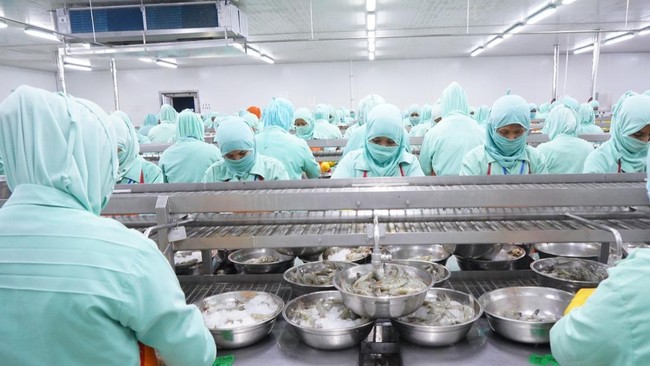
Jakarta, CNBC Indonesia – In the two years since President Prabowo Subianto and Vice-President Gibran Rakabuming Raka took office, the marine and fisheries sector has recorded a number of achievements and areas of growth. According to an official statement from the Ministry of Marine Affairs and Fisheries (KKP), these include increases in non-tax state revenue (PNBP), production volumes, the sector’s contribution to gross domestic product (GDP) and fisheries export value.
PNBP rose from Rp2.208 trillion in 2024 to Rp2.405 trillion in 2025. Provisional data for 2026 show that, as of September, PNBP had reached Rp1.65 trillion, up 5.52% year on year.
The rise in state revenue has coincided with an increase in national fisheries production, which grew from 23.56 million tonnes in 2024 to 26.25 million tonnes in 2025. By the third quarter of 2026, production had reached 19.89 million tonnes.
Under Marine Affairs and Fisheries Minister Sakti Wahyu Trenggono, the sector’s contribution to national GDP also rose sharply. Fisheries’ share of GDP increased from 0.68% in 2024 to 4.95% in 2025, then climbed to 6.86% in the second quarter of 2026.
In international trade, export value rose from US$5.95 billion in 2024 to US$6.27 billion in 2025. From January to August 2026, exports were worth US$4.23 billion.
Fishers’ purchasing power has also strengthened, with the Fishermen’s Terms of Trade (NTN) rising 4.6% year on year to 108.3 in January–September 2026. The positive trend indicates that fishers’ income exceeded their expenditure.
Domestic fish consumption is also being promoted. In 2025, national fish consumption rose by 3.04 to 26.08kg per person per year.
The government is pursuing national salt self-sufficiency through the K-SIGN programme, which includes a 616-hectare salt-farming project in Rote Ndao, East Nusa Tenggara (NTT), as well as salt-pond intensification at four sites: Indramayu, Cirebon, Pati and Sabu Raijua.
Trenggono is also promoting thematic fish farming at 2,000 locations, with projects under construction in Java and Lampung.
“Following President Prabowo’s instructions, we are working to manage this sector as productively as possible, without neglecting the sustainability of existing fisheries ecosystems,” Trenggono said, according to a statement cited on Friday (30 October 2026).
“We continue to strive to raise productivity while improving people’s welfare. Our current focus is on implementing the President’s six priority programmes: the Red and White Fishermen’s Village (KNMP), thematic inland aquaculture, a national salt industrial zone, the revitalisation of north-coast Java fish ponds, integrated shrimp farming, and the modernisation of fishing vessels. These programmes are intended to create more jobs and improve the competitiveness of our fisheries products in domestic and global markets,” he added.
The ministry said 100 KNMP sites are now operating, with a further 1,269 units under construction. With support from these facilities, 719 tonnes of fish have been shipped, worth Rp18.77 billion.
The KNMP programme has also boosted fishers’ incomes. At the Tongke-Tongke KNMP in Sinjai regency, South Sulawesi, for example, monthly income per fisher rose from Rp4 million to Rp7 million. Fish prices increased by 50% to Rp45,000 per kilogramme.
KNMP construction is helping to distribute development more evenly towards eastern Indonesia. A total of 427 sites are planned for NTT, Papua and Maluku.
Development in eastern Indonesia also includes a 2,000-hectare integrated shrimp-farming project in Waingapu, East Sumba, NTT, as well as the large-scale salt project in Rote Ndao.
Protecting the sea
Trenggono is also stepping up efforts to safeguard marine ecosystems. By October 2026, Indonesia’s marine protected areas covered 31.6 million hectares, while enforcement against illegal, unreported and unregulated (IUU) fishing was intensified.
The 31.6 million hectares of protected waters recorded in October 2026 exceeded the target of 30 million hectares. These areas are important for sustaining marine and fisheries resources: they protect habitats and biodiversity while helping maintain fish stocks that support the livelihoods of fishers and coastal communities.
In its enforcement work, the KKP said it had acted against 502 vessels involved in illegal fishing, rescued 3.377 million lobster post-larvae from smuggling, removed 174 illegal fish-aggregating devices and taken action against 137 people for illegal use of marine space. These figures are cumulative for 2025 and 2026 and were updated on 20 October 2026.
The enforcement operations have prevented potential state losses totalling Rp16.03 trillion.
“These achievements demonstrate the government’s commitment under President Prabowo’s leadership to protecting our seas, both in terms of ecosystem conservation and the sovereignty of fisheries resources,” Trenggono said.
“A healthy sea, protected from fish theft, will benefit fishers and future generations in the long term. The KKP will therefore continue to strengthen enforcement and protect marine conservation areas,” he said.
Source: jawawa.id (https://jawawa.id/newsitem/from-fish-to-salt-minister-trenggonos-achievements-1793321458)
Originally published by CNBC Indonesia (https://www.cnbcindonesia.com/news/20261029210337-4-780769/dari-ikan-sampai-garam-ini-deretan-capaian-menteri-trenggono), translated from Indonesian