
From Fiscal Policy to Digitalisation: APEKSI National Meeting Produces 10 Strategic Recommendations
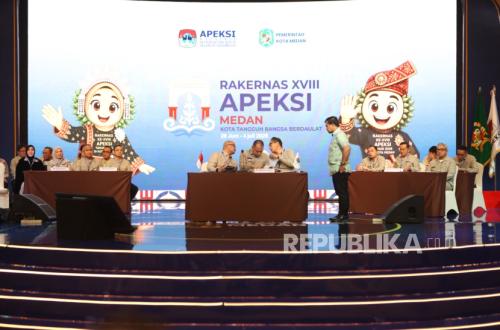
The XVIII National Working Meeting (Rakernas) of the Association of Indonesian City Governments (APEKSI) has produced ten strategic recommendations to be used as advocacy material for the central government. The recommendations cover strengthening regional fiscal capacity to involving the younger generation in city development. The Rakernas XVIII APEKSI, which carried the theme ‘Resilient Cities, Sovereign Nation’, officially closed in Medan on Thursday (3/7/2026). The forum, which took place from 28 June to 4 July 2026, served as a platform for city governments to formulate solutions to various urban development challenges. APEKSI Executive Director Alwis Rustam stated that the resulting recommendations were a consolidation of various discussion forums during the Rakernas. ‘The experience of city governments in dealing with various issues on the ground is expected to provide input for the formulation of national policy,’ Alwis said in a press release on Friday (3/7/2026). The Rakernas discussed a number of strategic issues, ranging from strengthening regional fiscal resilience, structuring civil service (ASN) policies, accelerating infrastructure development, digital government transformation, environmental and waste management, food security, strengthening the local economy, spatial planning, inter-regional cooperation, to legal certainty. Through a plenary session, Rakernas participants agreed on ten recommendations: strengthening fiscal capacity and reforming central-regional financial relations; structuring ASN policies, government employees with work agreements (PPPK), and regional spending flexibility; strengthening the governance of national strategic programmes in the regions; accelerating infrastructure development and regional connectivity; transforming government governance and digitalising public services; strengthening environmental resilience and sustainable cities; strengthening the local economy and inclusive development; strengthening spatial planning, regional cooperation, and regional development; strengthening legal advocacy and regulatory certainty; and involving the younger generation in sustainable city development. The Rakernas also affirmed that city resilience is not only related to disaster preparedness but also encompasses fiscal resilience, public service quality, economic development, digital transformation, environmental management, and strengthening intergovernmental collaboration. The XVIII APEKSI Rakernas was attended by 88 mayors, four deputy mayors, two regional secretaries, and one head of Bappeda representing 98 APEKSI member cities. The series of activities also included Youth City Changers, the Bappeda Heads Forum, the Environmental Forum, the Digital Communication Forum, the Food Forum, the Business and Investment Forum, the Nusantara Cultural Carnival, and the Indonesia City Expo. The Medan City Government estimated that the Rakernas generated an economic turnover of approximately Rp72 billion. Meanwhile, the Indonesia City Expo and bazaar were attended by 375 MSMEs, while the Nusantara Cultural Carnival involved around 2,800 participants. The ten recommendations produced will form APEKSI’s advocacy agenda to the central government as an effort to strengthen resilient, inclusive, and competitive city development.