
From Farmers to Modern Markets: Co-operatives Drive Agricultural Products into Retail Markets
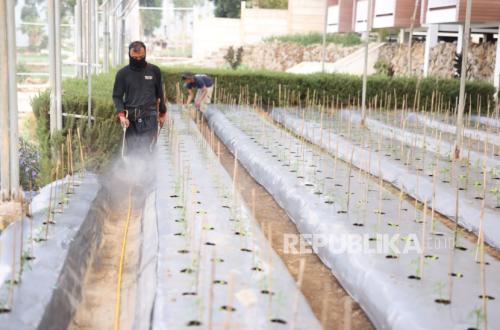
The Al-Ittifaq Islamic Boarding School Co-operative in Bandung Regency, West Java, is developing an agricultural business model and ecosystem that connects farmers to the market in a more structured manner. Through the co-operative, members’ agricultural yields are consolidated to meet the needs of modern retail markets, while simultaneously providing certainty regarding product absorption and payments to farmers.
Setia Irawan, Chairman of the Al-Ittifaq Islamic Boarding School Co-operative, explained that long before its current expansion, the co-operative was initially formed to provide independence for the boarding school. As the Al-Ittifaq school provides free educational facilities for its students, the institution was encouraged to become operationally self-sufficient.
As the school and the co-operative grew, Irawan explained that the strengthening of the agricultural ecosystem was built by ensuring market access needs serve as the benchmark for the production process. The co-operative first obtains information regarding commodity needs and market volumes, then organises planting patterns alongside the farmers.
“Thus, the upstream and downstream processes are clear. We know what the market needs and the required volume, then we arrange with the farmers what should be planted. This way, farmers do not plant without market certainty,” said Setia.
This model allows the co-operative to function not only as a collection and sales point for agricultural products but also as an off-taker that absorbs farmers’ produce. Setia noted that one of the principles maintained by Al-Ittifaq is that payments for agricultural produce are made directly to farmers, ensuring they do not have to wait for extended periods.
“Our farmers are paid immediately, not on credit. If the co-operative receives payment from the market and then the farmers have to wait, it would disrupt the farmers’ cash flow,” he said.
As the business expands, Al-Ittifaq now supplies various agricultural commodities to several market segments, ranging from modern retail, hotels, restaurants, and catering to central kitchen needs. The managed products have also become more diverse, covering vegetables, fruits, and various spices.
Setia mentioned that this development has occurred alongside an increase in the number of farmers connected to the co-operative. From an initial group of approximately 120 farmers, the number of farmers supplying through the Al-Ittifaq ecosystem has reached around 280–300. Production volume, which previously ranged from 1.7–2 tonnes per day, has also increased to approximately 7–8 tonnes per day.
According to Setia, strengthening the co-operative’s capacity is inseparable from the need for working capital to maintain supply chain continuity. In this context, LPDB Koperasi has been one of the partners supporting Al-Ittifaq’s capital strengthening.
“We have known LPDB since 2014, and our first financing with LPDB occurred in 2020. At that time, we were in the midst of the pandemic, but it actually became a momentum for us to strengthen the co-operative,” said Setia.
He continued that the revolving fund support helped strengthen the co-operative’s financial capacity to carry out business activities. The availability of working capital is vital because the co-operative must maintain its ability to absorb farmers’ production while meeting market needs sustainably.
“With the additional capital, the co-operative’s assets and business capabilities have become stronger. We can also purchase farmers’ needs in larger quantities, such as fertiliser, so that the prices can be more competitive,” he said.
Setia believes that the relationship between the co-operative and farmers should not be built solely through buying and selling transactions. The co-operative needs to understand farmers’ needs from the production process onwards while ensuring the resulting products meet market demands.
Consequently, Al-Ittifaq continues to encourage increased productivity and quality through the development of agricultural technology, including the use of greenhouses. This development is aimed at helping farmers increase productivity while producing products that meet market standards.
In its business journey, Al-Ittifaq has also strengthened access to modern retail markets. The co-operative has supplied agricultural products to networks such as Super Indo and Yogya, in addition to meeting the needs of various customers in the hotel, restaurant, and catering sectors.
For Setia, entering the modern market brings consequences in the form of demands for quality, supply continuity, food safety, and standard compliance. This is a crucial part of building market trust while simultaneously increasing the capacity of both farmers and the co-operative.
Moving forward, Al-Ittimaf hopes that the partnership with LPDB Koperasi can continue to grow, not only through financing support but also through strengthening market access, business matching, and opening business networks for the co-operative.
“We hope LPDB is not just a financing institution, but can also serve as a bridge to bring co-operatives to the market. Because the needs of a co-operative are not just capital, but also how our products can be absorbed and grow,” said Setia.
The Al-Ittifaq experience shows that strengthening co-operatives can go hand-in-hand with empowering farmers when production, financing, and markets are built within a single ecosystem. In this model, the co-operative acts as the link between market needs and farmers’ production capabilities, while financing support serves as an instrument to maintain supply chain sustainability.
For LPDB Koperasi, strengthening ecosystems like the one developed by Al-Ittifaq is part of the effort to expand the utilisation of revolving funds to provide an impact on the development of co-operatives and the real sector. With stronger co-operatives, it is expected that market access and the business capacity of members will continue to develop sustainably.
Source: jawawa.id (https://jawawa.id/newsitem/from-farmers-to-modern-markets-co-operatives-drive-agricultural-products-into-retail-markets-1790693658)
Originally published by Republika (https://rejabar.republika.co.id/berita/tm4pqe456/dari-petani-ke-pasar-modern-koperasi-dorong-produk-pertanian-menembus-pasar-ritel), translated from Indonesian