
From Dollar at Rp8,300 to Rp18,000, TransJakarta Fare Remains Rp3,500
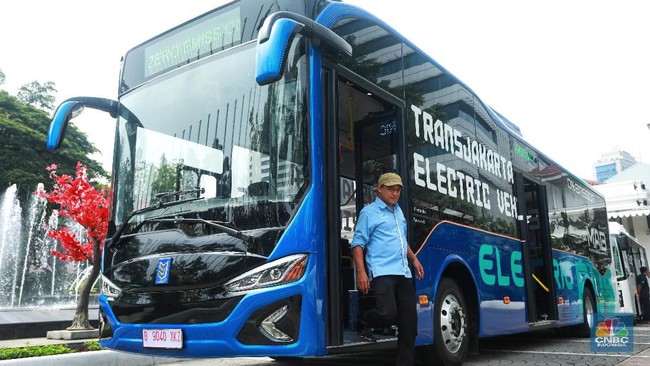
For more than two decades, TransJakarta fares have remained almost unchanged. The fare has persisted through three presidencies and through the Rupiah’s journey from Rp8,600 to over Rp18,000 per US dollar.
When the busway first began operations on 15 January 2004, fares were in the range of Rp1,500 to Rp2,500. By the end of 2005, the regular fare was set at Rp3,500. Twenty years later, the figure remains the same, even though many things have changed. The exchange rate of the Rupiah against the US dollar, which was around Rp8,340 per dollar in early 2004, has reached Rp18,170 as of Tuesday.
After 22 years, discussions regarding fare adjustments have resurfaced. Jakarta Governor Pramono Anung stated that Trans-Jabodetabek fares cannot continue to remain at the Rp3,500 level, especially for long-distance routes such as Blok M to Soekarno-Hatta Airport. “I also conveyed that it is impossible for the Blok M-Soekarno-Hatta route to be Rp3,500, because taking the Damri or other modes already averages above Rp100,000,” said Pramono.
In nominal terms, TransJakarta fares have not changed much, but the value of the money has. In January 2004, one US dollar was equivalent to approximately Rp8,340. In 2026, the value reached Rp18,170. The Rupiah has weakened nearly twofold against the dollar. While this comparison is not a direct measure of transport operational costs, it demonstrates a simple fact: Rp3,500 today is no longer equivalent to Rp3,500 two decades ago. Another comparison is the Jakarta Provincial Minimum Wage (UMP), which was set at Rp671,550 per month in 2004, whereas in 2026, it stands at Rp5,729,876 per month—an 8.5-fold increase.
Interestingly, TransJakarta is not the only mode of transport maintaining relatively low fares. In fact, some services are showing an unusual trend. Amidst rising prices, some Jakarta public transport fares are moving very slowly; some remain stagnant, while others have actually decreased.
The most interesting example comes from the Commuter Line (KRL). In the mid-2000s, air-conditioned KRL fares for certain routes could reach Rp10,000, such as the Tangerang-Manggarai route. Today, many KRL trips range between Rp4,000 and Rp8,000, despite the service being far superior to two decades ago. The number of train sets has increased, frequency has risen, and passenger capacity has surged. These changes were made possible by government subsidies through the Public Service Obligation (PSO) scheme and the implementation of distance-based fares.
Consequently, TransJakarta’s position has become a point of interest. After years of maintaining the Rp3,500 fare, the Jakarta Provincial Government is beginning to open the door for adjustments, particularly for services with much longer distances. The Blok M-Soekarno-Hatta Airport route is the most frequently cited example. The Provincial Government is preparing a fare scheme that considers travel distance and service characteristics. For airport routes, a range of Rp10,000 to Rp15,000 has been mentioned.
No final decision has been made, but one thing is becoming clear: a flat fare for all journeys may become increasingly difficult to maintain. This debate is not just about TransJakarta. For years, Jakarta’s public transport has been built on the philosophy of keeping fares affordable to encourage citizens to switch from private vehicles. This is why the KRL receives subsidies, TransJakarta maintains low fares, Jakarta LRT uses a flat fare, and the MRT has not yet fully implemented a full cost recovery scheme. This approach has helped expand access to public transport.
However, as networks expand, fleets grow, and operational costs rise, the same question always arises: to what limit can fares be held? Jakarta today is not Jakarta of 2004. The network is wider, the passenger numbers are higher, and the services are far more complex. Therefore, the debate regarding public transport fares is ultimately not just about whether Rp3,500 is too cheap or too expensive, but how to keep services affordable when the costs of running them continue to change.
Source: jawawa.id (https://jawawa.id/newsitem/from-dollar-at-rp8-300-to-rp18-000-transjakarta-fare-remains-rp3-500-1781009712)
Originally published by CNBC Indonesia (https://www.cnbcindonesia.com/research/20260609175000-128-741502/dari-dolar-rp8300-sampai-rp18000-tarif-transjakarta-masih-rp3500), translated from Indonesian