
From Campuses to the Streets: Why Is Education Sparking Mass Demonstrations?
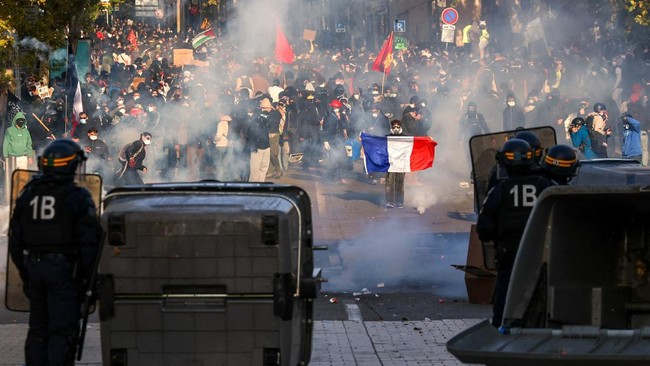
Jakarta, CNBC Indonesia — Waves of student and university protests took place in countries around the world throughout 2026. From Europe and Asia to Africa and the Americas, young people took to the streets to voice a range of concerns about education.
Their demands varied, from opposing increases in school and university fees and scholarship cuts to calling on governments to recruit more teachers and improve educational facilities.
Education-related demonstrations took place in France, Greece, Argentina, Belgium, the United Kingdom, Ireland, Portugal, Romania, Canada, New Zealand, India, Pakistan, Nigeria and South Africa.
In some countries, the protests came to address more than problems at schools or universities. Their demands expanded to include economic concerns such as the high cost of living, low wages and poor public services.
France was one example. An action initially triggered by complaints about teacher shortages and school facilities developed into demonstrations involving workers and other members of the public.
In Greece, students not only called for more education funding but also protested against high housing costs. In Argentina, student protests were linked to cuts in university funding amid the government’s austerity policies.
This raises the question of why education can be such a sensitive issue that it prompts young people to take to the streets.
When Education Becomes Harder to Access
For many families, education is one route to improving their standard of living. A higher level of education is expected to give people a better chance of finding work and earning more.
There is evidence to support that expectation. The Organisation for Economic Co-operation and Development’s (OECD) Education at a Glance 2026 report shows that workers with higher education earn, on average, 54% more than those whose highest qualification is equivalent to upper secondary school.
The benefits of education help explain why more people are seeking to continue their studies at university.
The OECD reports that the share of people aged 25 to 34 who had completed higher education rose from 42% in 2015 to 49% in 2025.
However, students and their families must spend a considerable amount to obtain higher education.
Not all countries provide higher education free of charge. Some impose substantial tuition fees, while others offer subsidies or assistance subject to certain conditions.
In England, for example, the maximum tuition fee for a full-time undergraduate course at eligible universities will be £9,790 per academic year in 2026/27.
In Belgium, students at Université libre de Bruxelles protested against an increase in the full tuition fee from €835 to €1,194 a year, a rise of about 43%. Some students can still qualify for lower rates or fee waivers.
Differences in fees also reflect the extent of government support for education.
The OECD says that in 2023, the governments of its member countries covered an average of 68% of higher education expenditure, from undergraduate to doctoral level. The remainder came from private and international sources.
However, the government-funded share differs considerably from one country to another.
In the United Kingdom, for example, the government financed just 21% of higher education expenditure at those levels. By contrast, governments in Belgium and Romania covered more than 80%.
This means education costs are not always borne entirely by the state. Some are paid by the public, including through tuition fees and other charges.
The OECD also reports that households directly cover an average of 19% of total higher education expenditure.
This can be a particular problem for families on limited incomes. As the cost of education rises, the opportunity to continue on to university can become harder to access.
It Is Not Just Tuition: Living Costs Are Also a Problem
The challenges facing students do not end with high tuition fees.
While studying, they must also pay for accommodation, food, transport and a range of everyday study-related expenses.
These costs can be a significant burden, particularly for students who have to live away from their families.
This is evident in Ireland.
Technological University Dublin’s (TU Dublin) guidance for the 2026/27 academic year estimates that students living away from home will need between €11,878 and €19,928 over the nine-month academic year.
That amount includes the student contribution and various living costs.
Accommodation is one of the largest expenses. TU Dublin estimates that students will need between €5,031 and €13,081 for nine months of accommodation alone, depending on their choice of housing.
Such high expenditure can create difficulties, especially if education assistance and family support are not enough.
Cian McGrath, president of the students’ union at Munster Technological University, said that costs had become one of the biggest barriers to education.
“The biggest barrier for students accessing education is no longer their school-leaving exams, but the costs they have to pay,” McGrath was quoted as saying by the Irish Examiner on 24 September 2026.
A similar problem can be seen in Greece.
Although undergraduate education at public universities is generally free in the country, students still face high housing costs.
According to Le Monde, rents have risen by more than 115% in Athens and 93% in Thessaloniki over the past decade.
It is therefore unsurprising that high housing costs have featured among the demands of students taking to the streets in Greece.
The situation shows that free education does not necessarily free students from financial difficulties.
Without enough money for accommodation, food and everyday needs, students can still struggle to continue their education.
Dissatisfaction Is About Quality as Well as Cost
High costs are not the only issue causing concern among school and university students. The quality of the education they receive is another source of frustration.
Students naturally expect suitable facilities, enough teachers and adequate educational services.
That is not always what they get.
In France, for example, student demonstrations began with complaints about teacher shortages, inadequate school facilities and learning conditions that were seen as falling short of students’ needs.
These problems are linked to the government’s ability to provide funding for education.
Yet while the need to improve education continues to grow, government spending on education as a share of the economy has not increased.
The OECD reports that average government expenditure on education in its member countries fell from 4.4% of gross domestic product (GDP) in 2015 to 4.2% in 2023.
The decline was only 0.2 percentage points. Nevertheless, it shows that over eight years, the share of the economy devoted to education became smaller.
A similar trend is apparent globally. UNESCO says that of 159 countries with comparable data, 54% saw education spending fall as a share of GDP between 2015 and 2023.
A lower percentage of GDP does not necessarily mean that education budgets were cut in absolute terms. Spending may still have risen, but more slowly than the economy grew.
Meanwhile, government spending per student or university student varies widely between countries.
In 2023, for example, the Greek government spent about US$4,499 per student at undergraduate to doctoral level. This was only around 27% of the OECD average of US$16,405.
In Belgium, government spending at the same levels reached US$22,333 per student, almost five times the amount in Greece.
Higher spending does not necessarily lead directly to better education.
However, limited budgets can make it difficult for schools and universities to provide adequate facilities and enough teaching staff.
Staffing levels are also a concern in Ireland.
OECD data show that Ireland had 19 university students per academic staff member in 2024, higher than the OECD average of 15 to one.
Frank Jones, general secretary of the Irish Federation of University Teachers (IFUT), warned that this could put pressure on both students and academic staff.
“When the number of teaching staff cannot keep pace with the number of students, both sides feel the pressure,” Jones said in a statement on 29 September 2026.
Students’ concerns, then, are not only about how much they have to pay, but also whether the education they receive meets their needs.
Why Does Discontent Turn into Demonstrations?
These problems help explain why education can become a source of discontent among school and university students.
When tuition fees rise, students have to find extra money. When scholarships are cut, those who depend on them may struggle to cover their education costs.
Likewise, when schools lack teachers or have inadequate facilities, students and parents worry that the quality of education will suffer.
The problem grows because its effects are not limited to one or two people; large numbers of students can experience them at the same time.
Schools and universities are also places where students meet, exchange information and raise concerns through student organisations and unions.
When the same problems persist and solutions are judged inadequate, discontent can develop into shared demands expressed through demonstrations.
Source: jawawa.id (https://jawawa.id/newsitem/from-campuses-to-the-streets-why-is-education-sparking-mass-demonstrations-1793026276)
Originally published by CNBC Indonesia (https://www.cnbcindonesia.com/research/20261026115159-128-779444/dari-kampus-ke-jalanan-kenapa-isu-pendidikan-picu-demonstrasi-massal), translated from Indonesian