
From Bandung to Dakar: Building Global South Strength through Economic Partnerships
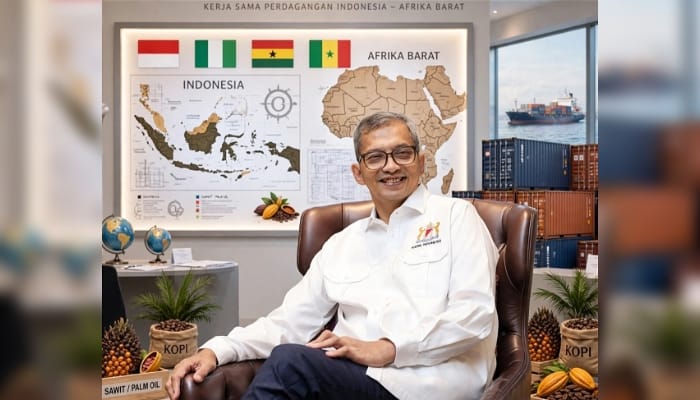
Indonesia’s strength in the Global South will be more firmly established when its presence delivers tangible benefits to partner countries: growing industries, jobs, affordable technology and wider economic opportunities.
It is in this context that the Indonesia–West Africa Business Meeting and B-to-B Networking event on 16 October 2026 should be viewed.
Bringing together Indonesian businesspeople and around 70 business representatives from 44 West African companies, the forum creates an opportunity to turn diplomatic ties into productive economic partnerships.
Senegal holds an important position in this effort. The signing of a partnership agreement between the Indonesian Chamber of Commerce and Industry (KADIN) and Senegal’s National Union of Chambers of Commerce, Industry and Agriculture (UNCCIAS) provides an institutional foundation for business relations between the two countries. Its strategic value, however, will depend on whether the agreement can be translated into transactions, investment and lasting joint ventures.
Indonesia–Senegal relations could be developed as one of Indonesia’s economic links with West Africa, while recognising that the region comprises countries with differing needs, regulations and market characteristics.
Foreign Ministry data show that trade between Indonesia and Senegal reached US$110.1 million in 2024, with Indonesia recording a surplus of US$108.6 million. Palm oil was Indonesia’s leading export, while aluminium was Senegal’s principal export to Indonesia.
These figures indicate that trade is already under way, while also revealing a substantial imbalance in trade flows.
The next challenge is to diversify the range of products and build economic ties that create more room for Senegal’s productive capacity. For Indonesia, the partnership offers market diversification, investment opportunities and a chance to extend the reach of national companies.
For Senegal, the benefits to be developed include local processing, skills development, access to technology, and the involvement of domestic suppliers and workers. Sustainable relations require interests that align.
Indonesia’s export success will be stronger when it goes hand in hand with its partner’s ability to generate income and added value.
Food and agro-industry are sensible starting points. Indonesian companies could explore partnerships in food processing and packaging, medium-scale production machinery, and distribution.
Senegalese partners can contribute market knowledge, supplier networks and an understanding of local consumer needs. Business models should evolve beyond product sales towards commercially viable joint production.
Processing plants or packaging facilities that employ local workers can create deeper economic ties than standalone import transactions.
Fisheries also offer concrete opportunities for cooperation, including cold storage, seafood processing, quality control and product traceability.
For businesses in both countries, such cooperation could help reduce losses, improve quality and widen market access. Sustainability must be built into business plans from the outset, so that increased economic value goes hand in hand with protecting marine resources and safeguarding fishers’ interests.
In technology and digital transformation, Indonesia can offer partnerships addressing practical business needs: transaction records, inventory management, access to finance and logistics efficiency.
Technology companies from both countries could develop solutions together, with training for local workers and a clear division of responsibilities. In public services, the approach should respect partner countries’ policy choices and data sovereignty.
Indonesia’s credibility will grow if the technology it brings can be managed, maintained and further developed jointly by local users.
These opportunities are increasingly relevant to Africa’s economic integration agenda. In an August 2026 report, the World Bank stressed the need to link production across borders and improve customs systems, standards, payments, transport, energy and digital networks.
The implication for Indonesia is clear: market-entry strategies need to take account of the need to develop regional production networks.
Senegal could be considered as one base for such partnerships, but access to wider African markets must be assessed against trade rules, logistics readiness and the viability of each product.
Business diplomacy must therefore be complemented by technical work that often determines whether investment succeeds. Businesses need information on prospective partners, shipping costs, product standards, payment security, taxation and dispute-resolution mechanisms.
Agreements between chambers of commerce can help open networks and facilitate communication, while legal certainty still requires contract reviews and an understanding of applicable regulations.
Every project must also be assessed for its ability to generate cash flow and measurable economic benefits.
KADIN and UNCCIAS could propose a 12-month follow-up programme, selecting several projects that are ready to develop. Priorities could include food processing, fisheries cold chains and digital services for small businesses.
Each project should have a lead party, prospective buyers, financing requirements and an implementation timetable. Measures of success should include repeat transactions, investment actually realised, workers trained and local suppliers involved.
In this way, the business forum would become the starting point for an implementation process that can be evaluated.
This is where Indonesia–Senegal relations acquire their geopolitical significance.
The Global South has diverse needs, but many countries share an interest in broadening development options and strengthening their bargaining power.
Indonesia can expand its influence by bringing together capital, technology, markets and development experience on an equal footing.
Such partnerships should remain open to cooperation with a range of other parties, provided that partner countries retain the benefits and decision-making space.
The legacy of Bandung gives Indonesia valuable capital in the form of trust. The current generation needs to translate it into economic capacity: joint ventures, skilled workers, two-way trade and technology that strengthens self-reliance. Dakar could be one place to demonstrate that Asia–Africa solidarity can deliver tangible prosperity.
Indonesia will earn greater respect as a Global South power when its growing influence goes hand in hand with progress among its partners.
Relations with Senegal and West Africa offer an opportunity to build this kind of leadership—one founded on trust, strengthened through practical work and sustained by shared benefits.
Source: jawawa.id (https://jawawa.id/newsitem/from-bandung-to-dakar-building-global-south-strength-through-economic-partnerships-1792281019)
Originally published by kakinews.id (https://kakinews.id/dari-bandung-ke-dakar-membangun-kekuatan-global-south-melalui-kemitraan-ekonomi/), translated from Indonesian