
From Arafat to Indonesia: Weaving the Fabric of Economic Equality
By: Oman Sukmana, MM, MIkom, MIPR, Deputy Director of OJK
Notes from Mecca
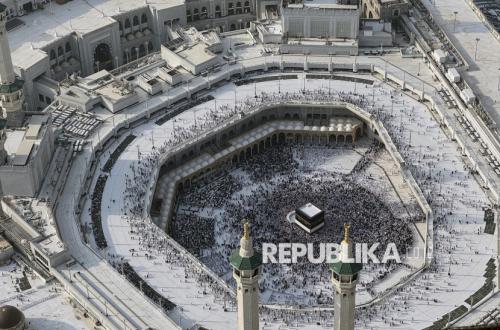
REPUBLIKA.CO.ID, MECCA – This May, two major historical currents converge in a single moment of reflection. In Indonesia, the echoes of National Awakening resonate everywhere. In the holy land of Mecca, the same echoes can be felt and will reach their peak in about a week when millions will move towards the pinnacle of devotion during the Hajj season.
There is a subtle but strong thread connecting the philosophical peak of Hajj in Arafat and the National Awakening movement of 1908. Both speak of transition – from division to unity, from resignation to sovereignty, and from darkness to light.
Hajj is a ritual of stripping away identity. Wrapped in simple white ihram cloth, there is no rank, no separation. All humans return to zero, becoming equal servants before the Creator.
This spirit also gave birth to the National Awakening. When Boedi Oetomo lit the candle of awareness, it invited us to shed the narrow “clothing” of regionalism and move towards a single body called Indonesia.
Hajj is a collective worship, just as the National Awakening is a collective movement. Both teach about equality as a key principle.
Equality: A Right That Flows in the Veins of the Economy
Realizing equality is an ongoing civilizational endeavor. It is a commitment to continuously erode the stones of prejudice and plant seeds of empathy.
In a broader context, there are many forms of equality: equality in education, gender equality, legal equality, health equality, and also economic equality.
The world today is in turmoil. Prices continue to rise, driven by the winds of conflict in distant lands. However, we should be grateful for the data we have.
The latest Statistics Indonesia (BPS) release on February 5, 2026, shows that the number of poor people in Indonesia in September 2025 decreased to 23.36 million (8.25 percent). This figure is down almost half a million people compared to March 2025, which was 23.85 million.
However, this unstable geopolitical situation still needs to be watched out for. In addition to the geopolitical situation, efforts to realize economic equality also face challenges at home.
If in Mina we throw stones as a symbol of resistance against the pillars of evil, then at home the forms of modern evil manifest in the form of corrupt behavior, illegal online loans that strangle the people, and bogus investments that steal the hope of the future.
The Financial Services Authority (OJK) together with 16 other institutions that are members of the task force for combating illegal financial activities (Satgas PASTI) released that from January 1, 2026 to March 31, 2026, Satgas PASTI has found and stopped 951 illegal online loan entities and 2 illegal investment offers on a number of websites and applications that potentially harm the public.
In addition, in terms of handling fraud, during the period from November 22, 2024 to March 31, 2026, the Indonesia Anti-Scam Centre (IASC) has received 515,345 reports from the public. In handling these reports, 872,395 accounts have been reported and verified, and 460,270 accounts have been blocked. From these efforts, the total amount of victim funds that has been successfully blocked reaches around IDR 585.4 billion. IASC has returned IDR 169 billion of victim funds from accounts in 19 banks used by fraud perpetrators. (Source: OJK Press Release, SP 03/STPASTI/IV/2026)
These notes are clearly achievements worth being grateful for. This is a manifestation of the state’s promise to protect all consumers and the people of Indonesia. However, to become the ihram for the economy, there is still a lot of homework to be done. Whether we like it or not, we must admit that there is still a Financial Paradox. Many people already have access to accounts and online loans, but they lack or may not yet understand the risks and how to manage them. This seems to be the reason why the phenomenon of “illegal online loan traps” is still a challenge and homework that needs to be resolved today. The presence of financial literacy and inclusion is like “Basirah” – financial intuition – so that people can distinguish between what brings blessings and what brings disaster. Ultimately, realizing economic equality is not about making everyone have the same amount of money, but about ensuring that every child of the nation has the same opportunity to achieve prosperity. A healthy economy should be like Tawaf – circulating fairly and evenly. Financial literacy and inclusion are the main narratives to realize all of this. Because inclusion without literacy and education is like giving a weapon without guidance.