
From Annual Ritual to a National Kurban Economic Ecosystem
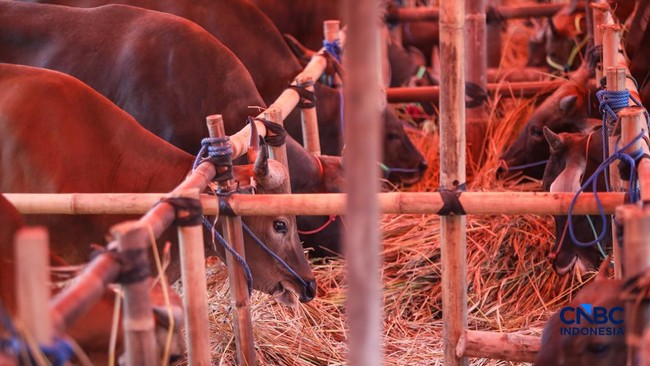
Eid al-Adha consistently generates substantial economic activity. However, the kurban economy has traditionally been viewed as a seasonal activity: bustling for a few days before concluding without leaving significant structural impacts on community economic strengthening, national livestock farming, or food security. Yet, if managed seriously, the kurban economy could become one of the most strategic national economic development instruments based on Islamic philanthropy.
The National ZISWAF Behaviour Survey 2026 revealed that Indonesia’s kurban economy has reached approximately Rp52.3 trillion annually. This figure positions kurban as the second-largest Islamic philanthropy after infak and sedekah. Meanwhile, IDEAS projections estimate the 2026 kurban economy to reach around Rp26.89 trillion, with potential for nearly 1.59 million national sacrificial animals.
Such figures should not remain a cyclical annual economy. It must be transformed into a structured, systematic, and sustainable value chain for the kurban economy from upstream to downstream.
The fundamental issue with Indonesia’s kurban economy is fragmentation. Activities operate independently, locally, short-term, and lack integration within a national ecosystem. Consequently, economic impacts remain suboptimal.
However, the kurban value chain is extensive, encompassing community savings, livestock financing, animal fattening, digital marketing, logistics distribution, food processing, and strengthening the national halal industry. A new approach is needed: integrating kurban into a multi-stakeholder national economic development strategy.
First, strengthening national kurban savings. We must shift from impulsive kurban patterns to annual financial planning. Sharia banks, Sharia fintech, Sharia cooperatives, BMTs, and digital platforms can build an automatic monthly auto-debit kurban savings ecosystem. This allows middle-class communities to plan kurban more systematically while bolstering Sharia social-financial fund collection.
This model can expand into a kurban-based social investment ecosystem, where community funds are not merely idle but actively support small-scale livestock financing.
Second, empowering livestock farmers as the core of the upstream ecosystem. Currently, small-scale farmers often act as passive participants with minimal margins, while the largest profits are captured by the distribution chain. The national kurban economy should seize this momentum to build a cooperative and Sharia partnership-based livestock industrialisation.
Farmers must gain access to affordable financing, livestock insurance, animal health technology, digital livestock monitoring, and market certainty through long-term purchase contracts with zakat agencies, digital platforms, state-owned food enterprises, and local governments.
When managed seriously, the kurban economy can serve as a tool for rural poverty alleviation while strengthening national protein food security.
Third, digitalising and integrating the national kurban platform. Currently, almost all kurban transactions are offline and local. Surveys indicate around 95.9% of kurban transactions still rely on traditional local committee mechanisms.
Digitalisation can fundamentally transform the kurban economic landscape. Digital platforms should not merely serve as payment systems but also integrate livestock data, track distribution, ensure quality, conduct Sharia audits, and provide real-time transparency in kurban utilisation.
Blockchain technology is particularly relevant here. A kurban blockchain can record the entire process transparently and immutably, from livestock origin and animal health to slaughter, beneficiary distribution, and managing agency financial reporting.
Trust is key. National ZISWAF surveys show the primary factor for the public in selecting philanthropic institutions is trust and transparency. Thus, technology must be positioned not just as a digital tool but as a governance instrument to enhance public legitimacy.
Fourth, reforming national kurban distribution. The biggest issue is regional disparity. Nearly 80% of the national kurban value is concentrated in Java, while regions like Papua and Maluku face severe deficits.
Consequently, some areas experience excessive meat surpluses for days, while others barely benefit from kurban.
Thus, kurban distribution must shift from local to national supply chain management approaches. Building cold storage, refrigerated logistics, and modern halal slaughterhouses is urgent. Without cold chain infrastructure, cross-regional kurban distribution will remain limited.
Fifth, downstream processing of kurban meat. Currently, kurban meat is mostly distributed fresh and consumed quickly, failing to create long-term economic value.
However, industrial management could transform it into high-value products: canned meat, corned beef, ready-to-eat rendang, beef floss, halal frozen foods, and emergency disaster relief meals.
This downstream processing would generate significant multiplier effects: creating jobs, strengthening halal SMEs, enhancing national food resilience, and extending kurban benefits year-round.
Imagine if Java’s meat surplus could be processed in halal industrial hubs and then