
From AI-Enabled to AI-First: Indonesian Companies Urged to Prepare for the Agentic Enterprise Era
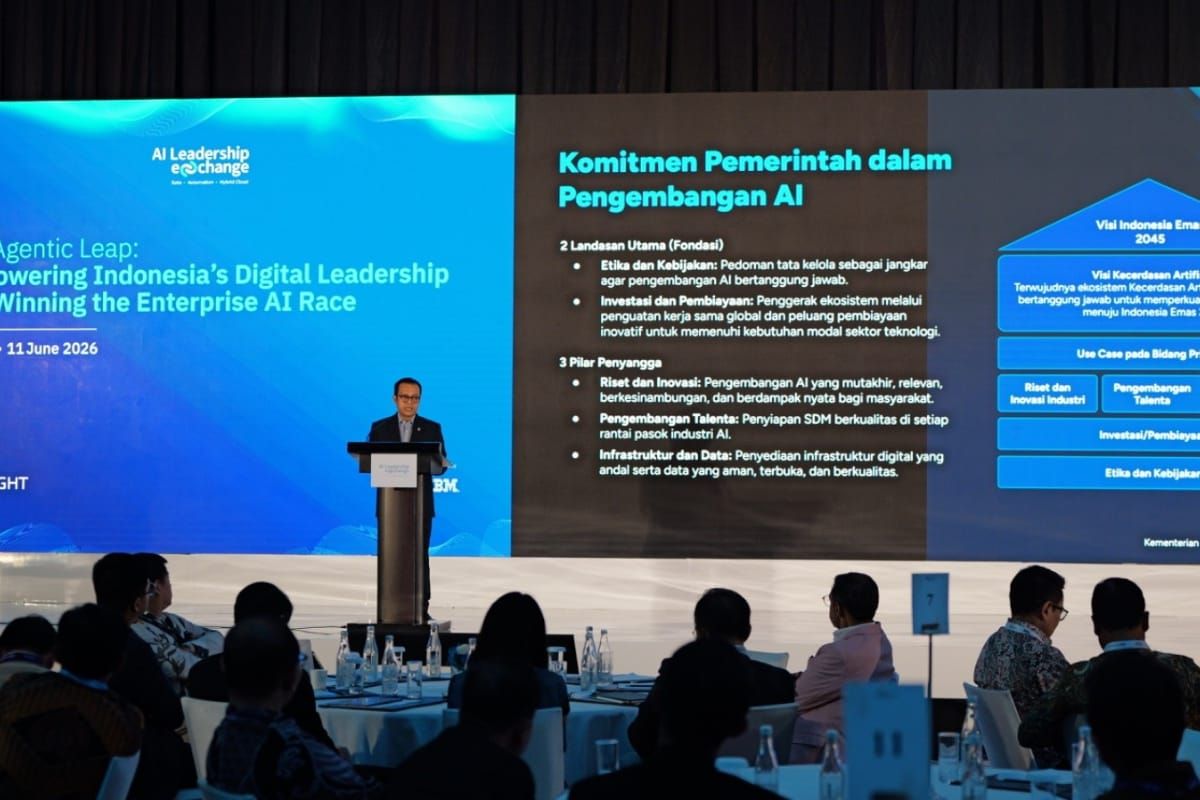
Indonesian companies are being urged to immediately transform from being merely AI-enabled to becoming AI-first, where artificial intelligence forms the core of business operations. This step is considered crucial to face a new era known as Agentic AI, where AI agents are capable of executing tasks, making decisions, and actively collaborating with humans. The idea emerged at the AI Leadership Exchange 2026 with the theme ‘The Agentic Leap: Empowering Indonesia’s Digital Leadership and Winning the Enterprise AI Race’ in Jakarta on Thursday. The event, a collaboration between IBM Indonesia and CIO Insight Indonesia, brought together Indonesian corporate technology leaders, industry players, and regulators to discuss strategies for optimising AI utilisation to boost organisational competitiveness and win the business race in the digital era. Deputy Minister of Communication and Digital Affairs, Nezar Patria, said Indonesia must build national capacity to develop AI technology independently. According to him, the government is currently promoting the strengthening of the AI ecosystem through the 5A framework, which includes Availability, Affordability, Awareness, Ability, and Agency. ‘The goal is for organisations in Indonesia to gain maximum benefit from the utilisation of AI,’ he stated. At the same event, Hans A.T. Dekkers assessed that a gap is beginning to appear between companies that use AI as a support tool and those that make AI the main foundation of business operations. According to Hans, the first group generally uses AI to improve work efficiency. Meanwhile, the second group uses AI to redesign business processes, accelerate decision-making, and build new, more adaptive operational models. ‘These two approaches produce very different impacts. Companies that make AI the core of their operations will have a much greater competitive advantage,’ he said. Hans explained that the world is now entering the Agentic AI era. While the Generative AI wave introduced new machine capabilities to humans, Agentic AI presents digital agents capable of working more independently and proactively. This view was reinforced by Jerry Zhu, who assessed that the future of business is no longer just about using AI as a support activity. ‘The winning companies are those that prioritise AI, or are AI-first, not just AI-enabled,’ he said. Despite optimism about AI technology development, the speakers cautioned that successful AI implementation does not solely depend on technological sophistication. Hans and Jerry assessed that the biggest obstacle many organisations still face is data issues. In various companies, data remains scattered across many unintegrated systems, making it difficult for AI to obtain the context needed to produce accurate decisions. Therefore, corporate attention needs to be directed towards building a strong data foundation and governance so that AI implementation can run sustainably and on a large scale. In a panel session titled ‘From AI Investment to ROI: Building the Foundations for Agentic AI’, Setiaji reminded companies not to adopt AI merely because of trends or the fear of missing out phenomenon. According to him, AI investment must have a clear business purpose to deliver measurable added value. Meanwhile, Toto Prasetio emphasised that AI transformation is not merely a technology issue. Implementation success is also significantly determined by human resource readiness and organisational culture. On the other hand, Patrick Bruinsma encouraged companies to stop partial or project-based AI implementation approaches. He suggested organisations build a single, robust operational foundation so that various future AI initiatives can be deployed more quickly, safely, and efficiently. The discussion also touched on aspects of national technological sovereignty. Ricardo Irwan Rei stated that Indonesia needs to start thinking about developing its own AI models, as several other countries have done. According to him, this step is important to strengthen national competitiveness while supporting long-term technological independence. ‘Ultimately, our goal is to move towards sovereignty or technological sovereignty,’ he said. The banking sector was cited as one of the industries that will undergo significant transformation through AI utilisation. In a discussion, industry players assessed that AI will drive the birth of increasingly autonomous operations in the future. Both Rico Usthavia Frans and Jayaprawirya Diah assessed that AI will become a strategic capability determining the banking industry’s future competitiveness. However, AI adoption in the financial industry must still consider aspects of data security, regulatory compliance, and operational resilience, meaning its implementation cannot be rushed. Throughout the forum, the speakers agreed that access to the latest AI technology is no longer the main factor determining victory in business competition. The advantage will instead be determined by an organisation’s ability to integrate AI into business processes, work culture, governance, and daily decision-making. In other words, the biggest challenge today is no longer building AI, but rather building organisations that are ready to work side by side with AI.