
From a Rp2 Million Loan to Empowering Women and the Disabled
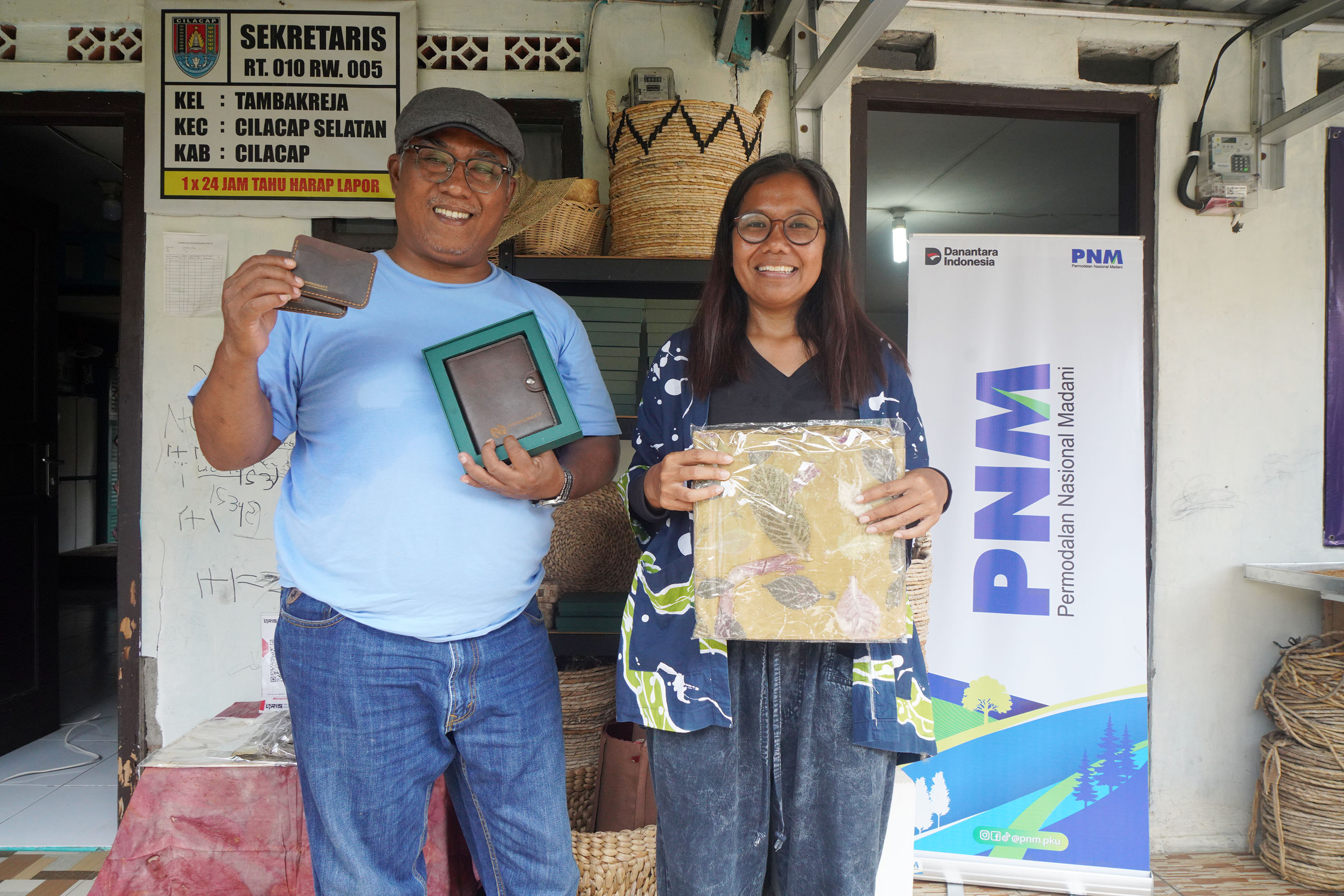
After marrying Khania Kendarsah, Sugeng Paijo, affectionately known as Jojo, decided to rent a 4x5 metre dwelling for around Rp500,000 per month in Cilacap, Central Java.
Khania, who came from Sukabumi, West Java, had to give up her job as a Human Resources Development (HRD) officer at a company to become a housewife. At the time, Jojo, who has a physical disability, was still working as a broadcaster for a well-known radio station in Cilacap.
Finding the dwelling too cramped, Jojo and his wife moved into a rental house belonging to Jojo’s mother in Tambakreja subdistrict, South Cilacap district.
“There is no need to imagine its size, because it was just as cramped. Even the kitchen was only about three square metres. Very small indeed. Every night, once the children were asleep, my wife and I would produce manggleng snacks. It was actually my mother’s business, started in 2016, which my wife and I then developed,” he said recently.
As the business got going, the family wanted to expand and needed capital. They then came across PNM Mekaar.
“There was an offer from PNM to grow the business. But because my mother was already elderly, it was suggested that my wife be the borrower. So Khania took the loan. The first loan was worth Rp2 million. It may look small, but for us it was extremely useful. There was no other institution besides PNM willing to lend without collateral — apart from loan sharks, which we obviously refused. We had no certificates, because the land of the house we lived on belonged to a company. We only had usage rights. So in truth we really had no collateral,” he explained.
From that Rp2 million loan, the business got back on its feet. Khania even began rebranding the manggleng snacks under the Jajan Mamake label.
“With that capital, from 2018 onwards we tried to build the brand with attractive packaging. We also started selling through Instagram and marketplaces. We sold on marketplaces to build public trust,” he said.
At the start of 2019, Jojo left his radio job because he and his wife were confident about growing the business. Moreover, he had already identified another source of capital.
“I dared to step down because at the time I had a job as an event organiser for several major events in Cilacap. My thinking was that once the job was done, I would have capital to develop the business my wife was pursuing under the Jajanan Mamake brand,” he explained.
The script changed. From late 2019 into 2020, Covid-19 spread, including in Indonesia. The capital from the events work never materialised. Every event was cancelled. It was clearly a heavy blow that brought them back to rock bottom. Yet Jojo and Khania did not give up. They intensified their marketing through social media and marketplaces.
“It turned out there was a silver lining when Covid-19 struck. Almost everyone was looking for food online. That was the turning point — our goods sold like hot cakes,” he said.
Despite all the limitations, social media proved capable of boosting sales.
“The funny thing is, because our Instagram looked neat and professional, many people assumed our business was already big. In reality it was very modest. We did not even have a display rack. Products were simply kept in cardboard boxes. Looking back now, the story is laughable, but back then it was a genuinely difficult period,” he said.
At one point, two tour buses from Teluk Penyu wanted to stop by Jajan Mamake after seeing the promotions on Instagram.
“They thought we already had a big shop, when in fact we were still selling from a small rented house. All we could do was say the premises were being renovated and offer to deliver orders directly to the customers,” he explained.
From there they gradually gained customers, especially from the upper-middle class, such as hotel guests and tourists looking for Cilacap specialities through the internet.
“At a time when many MSMEs were only just learning to sell online, we were already accustomed to using social media and marketplaces. Because we had no production capital, we asked customers to transfer payment in advance before goods were produced. So in effect, the buyers themselves were the initial capital for our business. At this point, PNM’s role was extraordinary, because it was the only financing institution channelling funds to us,” he said.
After manggleng, the couple moved on to other snacks: breadfruit crisps, potato products, and wet goods such as brownies and frozen food. The best-selling product proved to be breadfruit crisps.
“Throughout our journey developing the business, PNM has always been by our side. From financing, to facilitating training, to marketing. Essentially from upstream to downstream,” he said.
According to him, the business gained greater exposure when Jojo took part in a competition programme called Juragan Jaman Now organised by a private television station. “The programme, broadcast in 2023, had an extraordinary impact. We received orders for breadfruit sticks as finished products totalling between 1.5 and 2 tonnes. Most of the buyers were sellers on marketplaces. Our product went viral at the time,” he said.
In fact, he added, demand for breadfruit sticks had already come from Malaysia, Australia and Taiwan. “But we were overwhelmed meeting that demand. The main problem lies in the supply chain. Breadfruit is not a cultivated crop, and it is seasonal besides. So in the off-season, the raw material simply is not available. From there we began to think that this product actually has export potential. But the problem remains the same: supply,” he said.
Not stopping at the small-scale food industry, Jojo and Khania spread their wings into craft production. Their focus was crafts made from gedebok, or banana trunks. For Jojo, banana trunk bark is not waste, but can become a craft raw material.
“This idea came from our experience with Jajan Mamake. When demand was high but the raw material supply was insufficient. Well, banana trunk bark could be an alternative because it is available everywhere and does not depend on the season. What is more, the products are guaranteed environmentally friendly. I started learning to process banana trunks from various sources, including YouTube and Instagram. The research and development are still ongoing,” he said.
The banana trunk fibre is processed until it resembles synthetic leather. Some parties have even shown interest in using the material for hotel slippers. When export orders come, they will be ready in terms of raw material and production quality, because the aim is indeed to enter export markets.
The products are quite varied, ranging from card holders to decorative wallpaper, laundry baskets, waste bins and hats. Several products are also produced in collaboration with other artisans.
“For marketing these environmentally friendly products, we are also targeting the corporate market. Besides Instagram and marketplaces, we actively build relationships with companies,” he said.
Meanwhile, Khania manages a joint business group (KUB) called Wijayapura. The group empowers women in coastal areas around the Cilacap sea.
“We were given ecoprint training facilitated by PNM. The cluster is still running today, and its members are also served by PNM financing. I myself have received financing of up to Rp14 million,” added Khania.
Based on Jojo and Khania’s calculations, the business built from scratch is now gaining momentum, with monthly turnover reaching tens of millions of rupiah.
“Jajan Mamake’s current turnover is around Rp30 million per month with six workers, all of them women. From the start we wanted to empower women, especially those who are the breadwinners of their families or single parents,” he said.
For ecoprint, around 15 members are involved in the KUB, mostly women, and some are friends with disabilities. “Most of them are PNM customers, because the group was originally formed as a PNM-supported cluster. The ecoprint turnover currently stands at around Rp15 million per month. The products are frequently showcased at various exhibitions and promotional events, including through collaboration networks,” he said.
As for the banana trunk crafts, current monthly turnover is around Rp25 million.
“Our market direction is mostly towards corporations, so sales are not routine daily, but when a purchase comes it is usually in large volumes. For example, we recently received an order from Baznas worth Rp21 million for event souvenirs and training needs,” he said.
As a person with a disability, Jojo was also moved to pay attention to fellow disabled people in Cilacap. He then founded the Dipa Mandiri Nusantara Foundation and its business unit, Dipa Craft. Although the foundation was only established in 2025, the movement’s embryo actually began in 2022.
Drawing on his personal experience as a disabled person and his role as Head of the Inclusive Disability Services Unit for Disaster Management, Jojo frequently held discussions with fellow disabled people about the challenges they face daily.
“When I often gathered and talked with friends with disabilities, I saw that there was actually plenty of assistance. But it was often unevenly distributed, poorly targeted, and purely charitable in nature,” said Jojo.
In his view, assistance that is merely charitable often breeds dependency. In the long run it can even create a mental block that hampers the creativity and productivity of people with disabilities.
“Sometimes feelings of low self-confidence emerge, a sense of being incapable, and in the end it is hard to progress. Yet they have real potential,” he said.
Drawing on his experience in entrepreneurship, Jojo then sought to share his knowledge and experience with the disabled community in Cilacap. He wants people with disabilities to have the opportunity to be economically independent.
“The Dipa Mandiri Nusantara Foundation focuses on the strategic issues of empowering women and people with disabilities. The foundation not only provides skills training but also builds a mentoring system so that participants can genuinely run businesses,” he explained.
Jojo said one of the biggest problems facing disabled MSME actors is marketing and capital. Many people with disabilities actually have skills, but struggle to grow their businesses due to limited capital and market access.
To answer these problems, the foundation formed Dipa Craft as a business unit and shared production space. In this system, the foundation acts as facilitator.
“We provide them with materials to work on, then we help market the resulting products. So friends with disabilities can focus on creating,” he said.
Currently, around 20 to 25 people with disabilities are actively involved in various production and empowerment activities at Dipa Craft. However, during the mentoring process, Jojo realised that the problems faced by people with disabilities are far more complex than economics alone.
“There are social problems, violence, even the need for legal assistance. That is why we have started working with various other parties to help with advocacy,” he said.
According to Jojo, the foundation, officially established in June 2025, continues to grow through new collaborations almost every month. One active supporting partner is PNM, which has helped absorb products as well as provide business training.
“PNM not only distributes credit but also provides mentoring from upstream to downstream. That is what friends with disabilities truly need,” he said.
Through Dipa Craft, Jojo and his wife are trying to build a blueprint for an inclusive community development model in Cilacap. They want to prove that a business should not only be profit-oriented but must also deliver social and environmental impact.
“The entrepreneurial mindset remains that of a business, but there must be social and environmental impact. Hopefully there will be successors and it can be sustainable,” he said.
Besides building the joint enterprise, the foundation has also begun developing a data collection system for people with disabilities at the district level. Each area has a representative tasked with recording the number of people with disabilities, the types of disability, and the needs they face.
The data collection is accompanied by a verification process so that the data held is genuinely real and more accurate. Because to this day, according to Jojo, one of the main problems in disability issues is the scarcity of valid and evenly distributed data.
“The foundation does not want to work exclusively on its own. We want to be a bridge or facilitator so that assistance from various parties can be better targeted and have a real impact,” he said.
He gave the example of much assistance given with good intentions but unsustainable due to lack of mentoring. For instance, donations of sewing machines that ended up idle and unused.
“It does not mean they do not care. Perhaps they simply do not yet know the right way to help,” he said.
For that reason, he hopes the inclusivity movement will not stop at short-term handouts. For Jojo, people with disabilities need room to grow, opportunities to work, and a sustainable mentoring system so they can live independently within society.