
From a Cup of Coffee, Difabel Coffee Builds Economic Independence
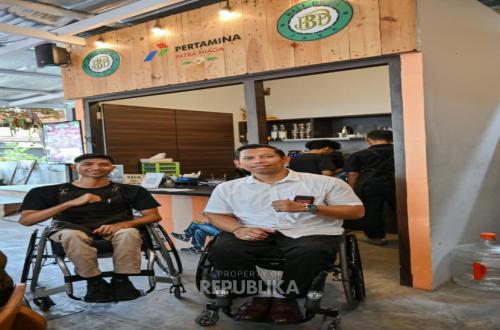
DENPASAR — The aroma of coffee prepared by a barista, the sound of an espresso machine and the warmth of a cup of coffee are all part of Difel Café’s effort to build economic independence for people with disabilities. What began as barista training supported by Pertamina has grown into an inclusive coffee business and a place where 15 members with disabilities can develop skills, serve customers and earn income from a business they run together. The benefits have since expanded through integration with seven members of Skizopreneur from Rumah Berdaya, bringing the total involved in the inclusive social-enterprise ecosystem to 22.
For Nyoman Juniarta, known as Jigo, coffee is more than a drink. Behind every blend lies an opportunity to show that people with disabilities can work creatively and achieve economic independence. Through Difel Café, Jigo hopes to change public perceptions that physical limitations are an obstacle to working and producing something of value.
“I want to prove that, despite the limitations we have, we are still capable. Our friends have skills and abilities, and they can show their work to the public,” he said.
That determination grew out of Jigo’s personal experience. An accident in 2012 left him with a spinal injury and a disability. The change in his life initially caused him to lose confidence.
He also had to confront the stigma that people with disabilities can no longer do many things. That experience, however, became a turning point, prompting him to build a space to empower people in similar circumstances. Jigo wanted his peers to have the chance to learn, work and build more independent lives.
His empowerment work began to take shape when he became involved in Denpasar’s disability community. He saw the need for a place that would not only bring people together, but also create business opportunities and help develop skills.
Conversations within the community gave rise to the idea of a coffee business. The choice drew on Jigo’s background in hospitality management and his interest in preparing drinks. Coffee has a broad market and appeals to many people, he said, making it a potential entry point for people with disabilities to take part directly in economic activity.
Pertamina strengthened Difel Café’s development by supporting barista training and providing productive equipment. The first training programme began on 2 July 2023 and ran for three months, before being extended for a further three months.
Participants were taught how to prepare coffee, use equipment and serve customers. Pertamina also provided two espresso machines, four grinders, barista equipment and a vehicle to support marketing and mobility. The support laid the groundwork for participants to apply their new skills in a real business.
The programme went beyond technical training. For Jigo, having the confidence to interact with customers and appear in public is an important part of empowerment. He understands that shyness and low self-confidence can be particular challenges for some people with disabilities, especially when they first work in public-facing roles. He therefore continues to encourage members of the group to demonstrate what they can do.
“I always tell my friends: you have been trained and you have skills. Don’t lose heart. Show the public that you are capable,” Jigo said.
The approach has gradually produced results. Members who were previously hesitant have begun preparing coffee, serving customers and taking part in activities outside the business without always needing a companion.
In 2026, Pertamina supported a second round of barista training, with nine participants taking part over three months. Including those from the first round, 15 people are now involved in Difel Café’s business activities. They have a range of disabilities, so the training also needs to take account of each person’s abilities and needs.
Jigo’s ultimate goal is not to make members dependent on support, but to build their confidence so they can work independently. After training, he therefore gives them increasing opportunities to carry out their duties on their own.
The impact of the support is beginning to show in the business’s performance. According to bookkeeping figures included in programme materials, Difel Café recorded sales turnover of Rp94.11 million, a surplus of Rp22.89 million and group cash holdings of Rp49.08 million.
The figures reflect a business developed through a combination of skills training, equipment provision and expanded sales opportunities. But for Jigo, success is not measured solely by sales. He also points to members becoming more confident in dealing with customers and recognising that their skills have economic value.
The change in the business’s economic benefits is also reflected in members’ income. Programme materials show that the average economic benefit per member rose from around Rp100,000–Rp200,000 a month before the programme to about Rp500,000 a month in 2024.
The figure increased to around Rp1 million a month in 2025 and is estimated to reach Rp1.5 million a month in 2026. These are estimates of average economic benefits based on business activity and members’ participation in operations and sales, not fixed income received by every member. Jigo hopes that as sales and the customer base grow, the business will provide more regular income for all members.
To achieve that, Difel Café is continuing to improve product quality and build a distinctive coffee identity. As well as serving coffee drinks, the group is developing ground coffee by blending roasted Arabica and Robusta beans. Jigo wants to create a blend with an aroma that customers will recognise.
Iced coffee is priced at about Rp25,000 a glass. At this stage of developing the business, he is focusing on maintaining product quality and building a customer base that will return. For him, repeat purchases are one indication that the product is beginning to find a place in the market.
Expanding market access is another important part of Difel Café’s development. The group aims to serve not only customers at its premises, but also to find opportunities at events, community gatherings, offices, government agencies and hotels. Taking part in these activities allows members to practise their skills, introduce their products and earn additional income.
Jigo hopes that, in future, work outside the café will not require the shop to close, allowing members to continue serving customers while pursuing marketing opportunities.
Coffee grounds turned into a product with economic value
The drive to innovate has also led Difel Café to extend the benefits of its work through collaboration with Skizopreneur, a group from Rumah Berdaya. Under an initiative developed by Jigo, used coffee grounds from Difel Café are turned into coffee-scented incense called Arusaji (Alumni Rumah Sakit Jiwa), produced by seven members of Skizopreneur.
The partnership brings together the empowerment work of Difapreneur and Skizopreneur, linking 15 Difel Café members with seven members of Rumah Berdaya in one social-enterprise ecosystem. The Difapreneur group develops the coffee business and serves its drinks, while Skizopreneur members turn the grounds into a creative product with commercial value, creating connected economic opportunities for both groups.
Coffee grounds, previously a by-product of making espresso, now have added value as an ingredient in Arusaji incense. The innovation supports circular-economy principles by reusing waste material, while also creating income opportunities for people with schizophrenia who are part of the Rumah Berdaya group.
Beyond product innovation, the partnership has a social mission: to challenge negative stereotypes that people with schizophrenia are unable to work or contribute productively. By taking part in producing Arusaji incense, Skizopreneur members can develop skills, build confidence and demonstrate that they can make products with economic value.
The integration of Difapreneur and Skizopreneur shows how a single business can deliver wider benefits to other vulnerable groups. With Pertamina’s support, the partnership between Difel Café and Rumah Berdaya has not only introduced an innovative use for coffee grounds, but also strengthened an inclusive social-enterprise ecosystem, encouraged business sustainability and created opportunities for both groups to become economically independent.
Throughout the business’s development, Jigo has placed members’ independence and confidence at the centre of his goals. He does not want Difel Café to be a support programme that ends when training is over. Equipment, training and guidance should provide members with the foundation to keep learning and developing the business.
“For me, happiness means helping others become more independent and successful. I want my friends to rise again, believe in their abilities and not give up because of their circumstances,” he said.
Difel Café shows how a cup of coffee can be the beginning of a much bigger change. With Pertamina’s support, the empowerment programme has developed into a social-enterprise ecosystem involving 22 people: 15 Difapreneur members from Difel Café and seven Skizopreneur members from Rumah Berdaya. From coffee-making skills to the innovative use of grounds to produce Arusaji incense, the partnership creates income opportunities and economic value while giving vulnerable groups space to work, build confidence and challenge social stigma. It is an example of inclusive empowerment delivering benefits that extend well beyond a cup of coffee and help foster sustainable economic independence.
Source: jawawa.id (https://jawawa.id/newsitem/from-a-cup-of-coffee-difabel-coffee-builds-economic-independence-1793663461)
Originally published by Republika (https://esgnow.republika.co.id/berita/tnweeq522/dari-secangkir-kopi-difabel-coffee-tumbuhkan-kemandirian-ekonomi), translated from Indonesian