
Fresh Wind for Directors: Danantara Brings Legal Shield to Encourage Business Innovation
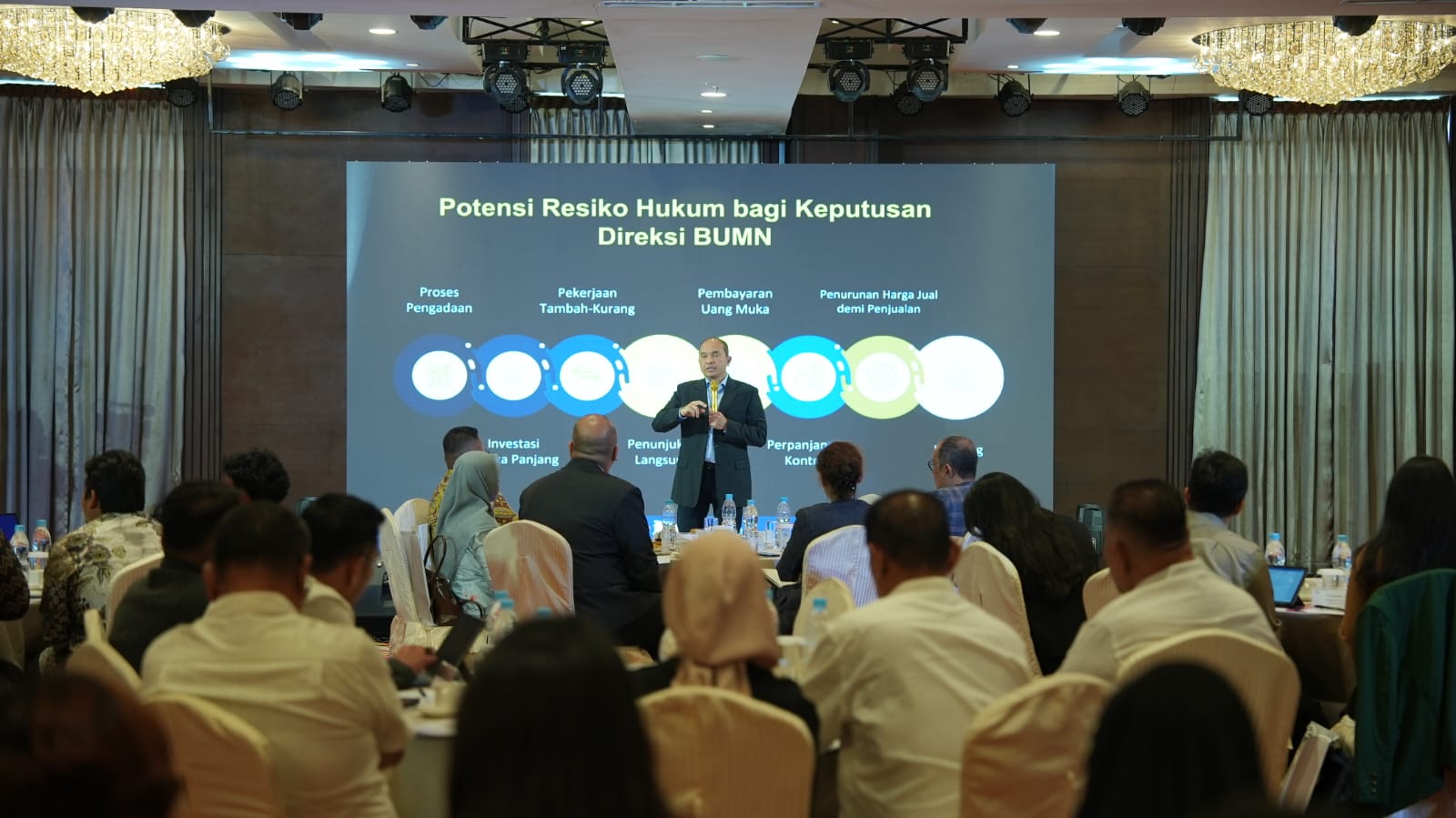
Imagine leading a company with trillions of rupiah in assets, yet every strategic decision you make could potentially land you in prison. This is the dilemma that has haunted the directors of Indonesia’s State-Owned Enterprises (BUMN) for years. Now, the presence of the Daya Anagata Nusantara Investment Management Agency (BPI Danantara) brings a fresh wind through the application of the Business Judgment Rule (BJR) principle, a legal doctrine believed to serve as a shield for SOE managers to innovate without excessive fear. However, can this legal protection truly separate failed business decisions from criminal acts of corruption? This crucial question emerged during a Round Table Discussion (RTD) held by the Nagara Institute, Akbar Faizal Uncensored (AFU), titled ‘Re-designing BUMN Via Danantara and Legal Traps: The Responsibility of Directors and Commissioners?’ Nagara Institute researcher Satya Arinanto explained that protection for SOE directors currently has a solid legal foundation through three main regulations. First, Law Number 16 of 2025 on the Fourth Amendment to Law Number 19 of 2003 concerning SOEs. Second, Law Number 40 of 2007 concerning Limited Liability Companies (PT). Third, Law Number 21 of 2021 on the Amendment to Law Number 31 of 1999 concerning the Eradication of Corruption Crimes (Tipikor). ‘Essentially, the main purpose of the Business Judgment Rule concept is to protect directors from liability for business decisions taken. Directors cannot be blamed as long as their decisions do not involve elements of fraud, conflict of interest, or unlawful acts,’ Satya asserted. The latest regulation in Law Number 16 of 2025 even reinforces the paradigm of asset management based on pure limited liability company principles, affirming that company assets are officially separate from the state’s financial domain. ‘Although assets are separated, supervision and inspection of the company are still carried out as part of state asset management. However, directors proven to have committed legal violations must of course be processed according to the provisions,’ he added. A strong statement was delivered by former President Director of PT Merpati Nusantara Airlines, Hotasi Nababan. He highlighted the real clash between two different legal regimes that have so far shackled SOE managers. ‘We live in two different regimes that cannot mix, like oil and water in one container. Even a single rupiah of state budget money entering automatically becomes part of the state financial domain, which the Supreme Audit Agency (BPK) has the right to audit,’ he said. Hotasi stressed that as long as the legal construction remains as it is, SOE directors are in a very vulnerable position. ‘As long as the legal construction is still like this, half a foot of a state company manager is already in prison. So, differentiate between acts of corruption and non-performance so that directors are willing to take risks to drive the real economy,’ he explained. Therefore, he urged BPI Danantara to provide a stronger legal umbrella to support the achievement of the 8% national economic growth target. This protection is urgently needed so that professionals have high courage in optimally executing various strategic investment plans. Amid the euphoria of SOE transformation, Lalola Easter Kaban, Program Manager of Indonesia Corruption Watch (ICW), reminded that the establishment of BPI Danantara as a new superholding institution must prioritise the principle of public accountability. ‘We are talking about a new entity, a superholding that wants to emulate Temasek Holding from neighbouring Singapore. We must be careful and strictly oversee this process so that the new institution does not turn into a case like Malaysia’s 1MDB,’ she said. Lalola emphasised that the implementation of the Business Judgment Rule can only run effectively if all potential conflicts of interest are managed transparently. Regulatory synchronisation is absolutely necessary so that legal instruments are not misused to criminalise pure corporate management decisions. ‘We all must clearly understand that a state loss is not the same as an act of corruption. The Business Judgment Rule is certainly the best way to minimise the aggressiveness of the application of the Corruption Eradication Law in the field,’ she said.