
Frequently Rocked by Protests: France’s 10 Biggest Demonstrations Since 1944
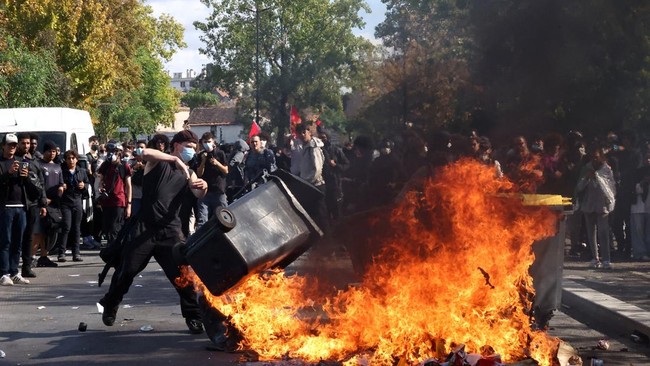
Jakarta, CNBC Indonesia — France has two sharply contrasting faces: a country that enchants tourists and is considered romantic, but also a stage for mass demonstrations that have repeatedly involved millions of people and often ended in unrest.
A demonstration or protest is a collective action by a group of people to express demands, opposition, support or a position on an issue. The streets of the French capital have repeatedly filled with large crowds.
Most recently, Paris was rocked by a major student protest.
The student demonstrations in France were initially prompted by calls for increased funding for state schools and improvements in education quality. However, the actions, which began in late September 2026, escalated into clashes with the authorities.
Tensions rose in Lens after police broke up a student blockade, leaving a 15-year-old student with a severe hand injury caused by crowd-control equipment. The incident has prompted an investigation and renewed debate over the use of force by police when dealing with student protests.
This is not a new phenomenon. Since the end of the Second World War, Paris has witnessed a number of demonstrations attended by hundreds of thousands or even millions of people.
The size of the crowds also shows that protests in France are not always related to employment issues. Demonstrations have also been triggered by education, social policy, political issues, national tragedies and sporting events.
One of the largest took place on 11 January 2015, when around three million people took to the streets for the Marche Républicaine, or Republican March, to pay tribute to the 17 victims of a series of terrorist attacks in France. The turnout made it one of the largest demonstrations in modern French history.
Meanwhile, a demonstration on 24 March 2013 over a bill on same-sex marriage drew between 300,000 participants, according to police, and 1.4 million, according to organisers.
However, large gatherings are not always protests against the government. On 12 July 1998, more than 1.5 million people filled the Champs-Élysées to celebrate France’s victory in the World Cup.
This range of events shows that mass gatherings have become part of public life in France.
The streets can become a venue for putting pressure on the government, voicing the demands of particular groups, expressing solidarity or celebrating a national event.
Why Do the French Protest So Often?
The roots of France’s culture of mass action can be traced back well before modern demonstrations in Paris. One landmark was the 1831 revolt by silk workers, or canuts, in Lyon.
Thousands of workers demanded a minimum price for their silk after prices fell. They then stopped work, built barricades and briefly took control of parts of the city for three days. The event is remembered as one of the milestones in the emergence of modern strikes in France.
Changes in the structure of the economy also made collective action increasingly effective.
The scale of demonstrations in France cannot be explained solely by the number of trade union members. Data from the Organisation for Economic Co-operation and Development (OECD) show that trade union density in France was relatively low, at around 10.8% of workers in 2016.
However, collective bargaining coverage reached 98% of workers in 2018. This system means that agreements between unions and employers can cover far more workers than the number who belong to unions themselves.
History has also given collective action a special place in French civic life. Offbeat France notes that workers’ demands over time have concerned not only wages, but also working hours, conditions and social protection. The labour movement in 1936, for example, helped bring about paid holidays and collective bargaining.
For that reason, demonstrations in France do not necessarily mean that its people are more inclined to protest than those in other countries.
Taking to the streets has long been one of the ways people collectively express their demands, from the 19th-century silk workers’ revolt in Lyon to demonstrations involving millions in Paris.
The issues change with the times, but the principle of turning them into collective action remains.