
French Protests End in Arson and Looting, with Provocateurs Suspected
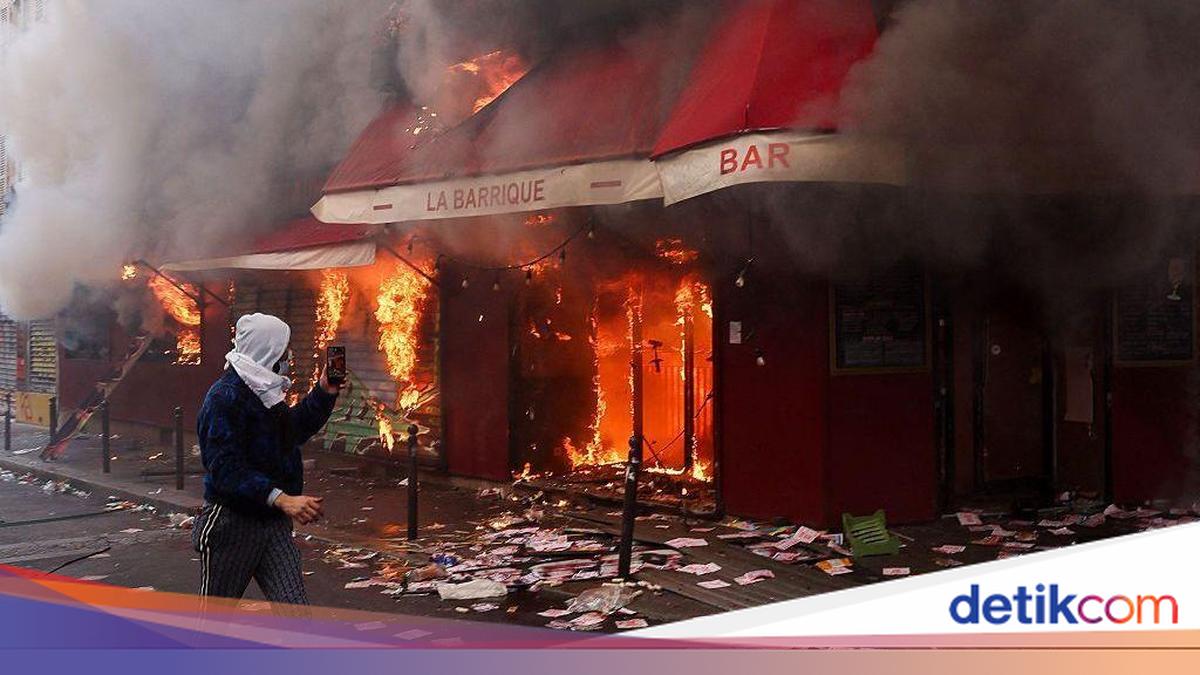
Violence broke out in various parts of France on Saturday (17 October) during the latest wave of demonstrations protesting difficult conditions in schools and the high cost of living.
At least 1,200 people were arrested in what the French government called an “escalation of violence”, while an estimated 550,000 people took to the streets.
In Paris, major clashes between demonstrators and police continued into the evening. Police used tear gas and water cannon to disperse the crowds.
Buildings were set on fire in the French capital and elsewhere. In Limoges, a major fire at the town hall caused part of the roof to collapse.
Looting was also reported in several cities, alongside reports of widespread vandalism targeting town halls and commercial buildings.
French Prime Minister Sébastien Lecornu said 150 police officers were injured in the rioting.
In response, French President Emmanuel Macron insisted that “there is no place for violence” in the country.
In Paris, demonstrations during the day appeared relatively peaceful. A group of young people told the BBC they were “pacifists” who “just want to push for change, but nothing is moving”.
As the day went on, however, some groups began lighting fires in the streets and setting vehicles alight, including at iconic locations in the city centre such as Place de la République.
Several shops were looted, at least one restaurant was gutted by fire, and the BBC witnessed clashes break out between groups of demonstrators.
Police were also seen charging a crowd in central Paris and striking several people with batons.
In Lyon, Mayor Grégory Doucet called the burning of the city’s tourist office a “tragedy” for Lyon.
Speaking to BFMTV, he said: “This breaks our hearts because this is a very iconic historic building, widely known.”
Local police said some “hostile individuals” prevented firefighters from tackling the blaze safely.
Firefighters also struggled to put out a fire at Limoges town hall. The local prefecture said the blaze caused part of the building to collapse.
During the unrest, a young person’s hand was also reportedly “blown off by a grenade explosion” in Saint-Étienne, said the city’s mayor, Régis Juanico, on social media.
He added that the tragedy “should never have happened”.
France’s Interior Ministry said the protests were marked by “deliberate acts of violence” by “hooded individuals” in several locations, including parts of Paris and cities such as Marseille, Rennes, Toulouse and Angers.
Damage to buildings was also reported across France, including in Grenoble, Avignon, Pau, Montpellier and Valence.
In Paris, several clothing and grocery shops were looted. An Apple-branded shop in Lille was also broken into and stripped of its contents.
Video footage verified by BBC Verify showed a tourist train in Grenoble being driven by masked men along a narrow street in the city centre and towards at least three police officers.
Hundreds of thousands of pupils have protested in recent weeks against staff shortages and poor facilities at lycées, secondary schools for pupils aged 15 to 18.
They were later joined by trade union members and other protest groups.
These included the Gilets Jaunes, or Yellow Vests, a movement that has protested against rising living costs for more than a year since 2018 and became one of the longest-running protest movements in French history.
Although France is no stranger to waves of protest and rioting, the latest demonstrations come as the country enters a period of deep political uncertainty.
French President Emmanuel Macron is due to leave office next year. Opinion polls suggest that April’s presidential election could become a contest between National Rally leader Marine Le Pen and radical left-wing figure Jean-Luc Mélenchon of La France Insoumise.
Mélenchon took part in demonstrations in France and later accused police of “attacking” protesters.
At the same time, however, he condemned the looting and arson during the demonstrations.
Prime Minister Sébastien Lecornu called Mélenchon’s remarks “dangerous and cynical”.
Earlier, Lecornu said police were facing “violence of very high intensity” and accused some groups of using the protests as a “warm-up” ahead of the presidential election.
“No one will impose their political agenda through violence,” he added.
Marine Le Pen said the demonstrators’ “legitimate demands” had been “held hostage by the radical left”. She accused Mélenchon of helping to fuel the violence.
The government has sought to ease public anger by offering concessions. In a television interview on 8 October, Education Minister Édouard Geffray promised 3,000 additional substitute teachers to help address staffing shortages in schools.
The protests have nevertheless continued.
In a social media post, President Emmanuel Macron said those who had “damaged and attacked” prefecture offices and shops, and “looted” town halls, would be “prosecuted and punished”.
“We will all stand united against those spreading chaos, who are only seeking to undermine our institutions and prevent those making their demands peacefully from doing so,” he added.
Interior Minister Laurent Nuñez said in a televised address that police had helped ensure demonstrations remained peaceful by arresting protesters who resorted to violence.
Nuñez criticised “far-left” figures who, he said, were “openly calling for insurrection”. He said they must be held responsible for the disorder on French streets on Saturday.
The French General Confederation of Labour (CGT) described the latest wave of demonstrations as “a new stage in the mobilisation” and said the government “must respond immediately to public demands”, without delay.
Among the demands put to the Emmanuel Macron government by the CGT are higher wages and pensions, as well as the reintroduction of a wealth tax for affluent citizens.
The CGT also “called for peaceful mobilisation with young people to continue” in the coming days. The actions are planned to culminate in a “major inter-union strike day” on 5 November.
BBC Paris correspondent Hugh Schofield said there was a clear distinction between the official demonstration from Place de la République to Place de Clichy and the incidents at various other locations in the French capital.
He said the main march “appeared peaceful”. But across Paris, small groups of demonstrators were moving around, some of whom were clearly intent on provoking unrest.
That was the situation at least in the early hours of the demonstrations. As time went on, however, conditions became increasingly chaotic and violent.
“It is reminiscent of the early days of the Yellow Vest movement eight years ago, when violence by small, uncontrolled groups proved too difficult for the police to contain,” Schofield said.
The pattern, he said, was a largely peaceful mass demonstration overshadowed by smaller groups operating separately and engaging in vandalism, looting and clashes with security forces.
In Toulon, in southern France, local authorities said “several acts of violence” occurred at the front of the march.
Two police officers were injured by objects thrown at them. Authorities also said some “violent individuals” dismantled barriers at a Christmas market and used them to attack police.
Violence was also reported on the sidelines of demonstrations in Caen, in Normandy. Local authorities said several groups were involved in “looting and acts of vandalism”.
They threw stones and spray-painted public buildings in the city. Authorities also said the perpetrators used a road roller to break through police barricades and damage two police vehicles.
Is this an ordinary protest or something more serious?
Analysis by Hugh Schofield, BBC Paris correspondent
The question to ask about the wave of protests in France is whether this is simply the latest version of the country’s familiar tradition of street demonstrations, or whether something deeper and more significant is happening.
In many respects, the movement looks much like those seen repeatedly before: a source of anger, marches, vandalism, tear gas, arrests and allegations of police violence.
It is like a performance with familiar scenes and an ending that arrives when everyone has had enough. Almost every autumn in France, an issue emerges that produces a similar pattern.
But is there something different this time? Could the period of 2026–27 become a defining moment in history, like May 1968, the Paris Commune of 1870 or the social revolutions across Europe in 1848, when waves of protest brought about major change?
There are arguments in favour of that view.
The centrist French government has been unable to act effectively. The radical experiment in Macronism that has lasted a decade has failed. There is widespread disillusionment with politics as it has been practised.
There is a debt crisis which, some serious observers say, could push France into default. Inflation has made people poorer.
Political groups at the extremes are growing stronger. There is war in Europe. There is Donald Trump. And there is the French presidential election in April and May.
The world is in a highly unstable state.
Everything is changing.