
French archaeologists invited to test Leang Metanduno dating methodology – permission required
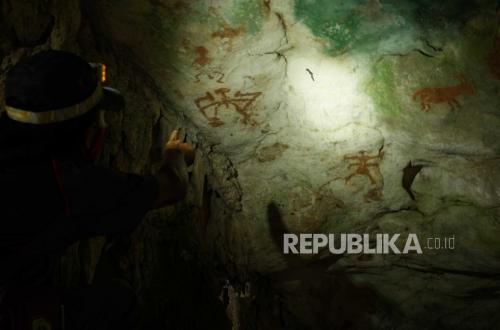
Researchers at Leang Metanduno Cave Site have invited other studies to test the age of the world’s oldest cave paintings. Dr Adhi Agus Oktaviana, an archaeologist from the National Research and Innovation Agency (BRIN), stated that their research is open to competing studies and methodological critiques.
This was communicated by Adhi Agus to Republika on Saturday, 30 May 2026, following the publication of a scientific response from French archaeologist Georges Sauvet, who expressed disbelief in the method used to analyse the oldest cave paintings. Sauvet argued that due to methodological issues, the claim of being the world’s oldest must be re-verified using alternative methods.
Sauvet’s statement was published in a scientific article titled ‘Uranium-thorium dating: the race towards the earliest rock art’, released on 20 May in Aplomb Publication’s AOJ of Historarchaeology & Anthropological Exploration, Volume 2, Issue 1, 2026.
Sauvet accused the U/Th method of containing bias. This bias could stem from at least two factors: theoretical closed and open models in assessing uranium/thorium decay within calcite formed over the cave paintings, and researchers’ reluctance to use alternative dating methods after U/Th analysis.
Closed theoretical models assume perfect uranium/thorium decay within calcite without isotope leakage from environmental factors, while open models consider chemical exchange with the surrounding environment. An open system implies changes in the calcite due to the cave’s exposed environment.
Sauvet argued, “This is the core issue. Research shows that in some cases, the system is not fully closed or ‘open’. This occurs when water seeping through the calcite layer causes uranium to dissolve and exit the sample, altering the elemental composition and potentially leading to inaccurate age estimates based on thorium-uranium ratios.”