
Freeport Projects State Contributions of Rp120 Trillion Annually After Full Smelter Operation
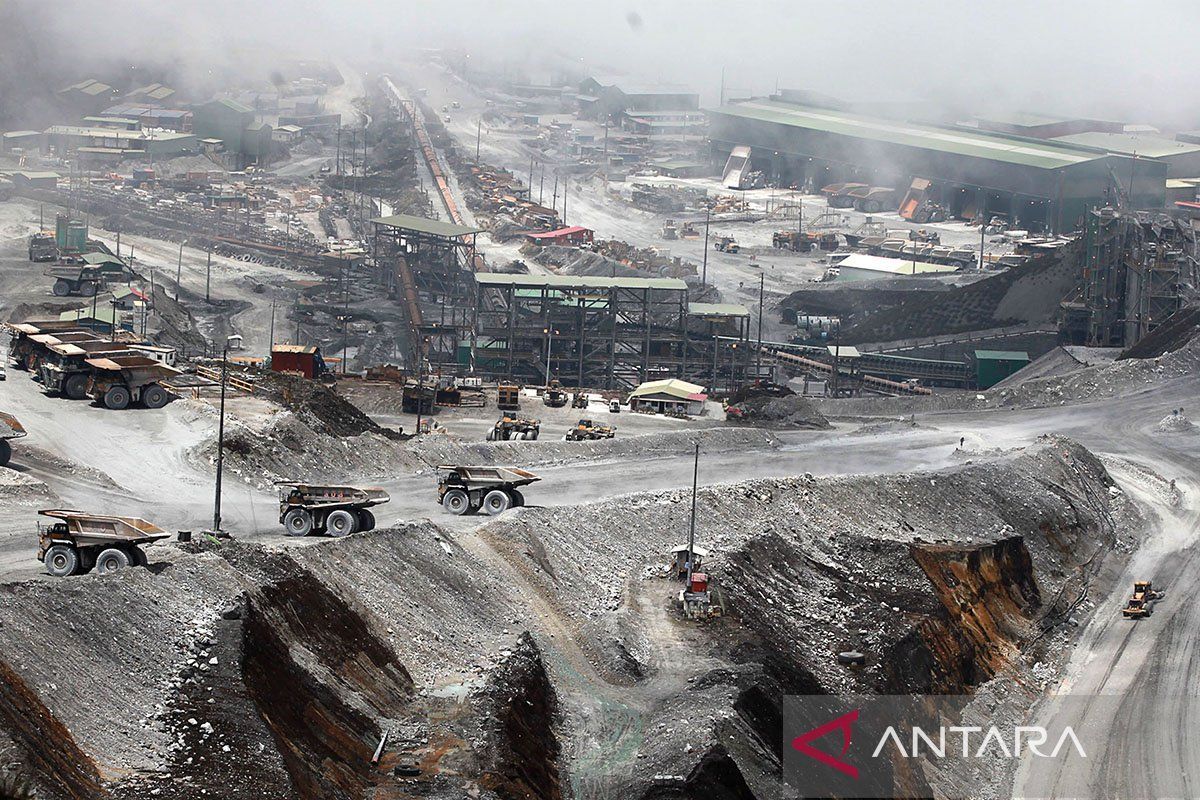
PT Freeport Indonesia projects its contribution to the state will exceed US$7 billion, or around Rp120 trillion per year, once mine production returns to normal and all copper downstream processing facilities in Gresik, East Java, operate at full capacity.
President Director of Freeport Indonesia Tony Wenas said the milestone would be supported by the operation of the smelter and precious metal refinery (PMR) in the Gresik Special Economic Zone (KEK), which enables the entire copper value chain to be processed domestically.
“With the smelter and precious metal refinery operating in Gresik, the entire copper value chain—from concentrate and copper cathode to precious metals such as gold and silver—can now be processed domestically. This is a major leap for Indonesia’s mineral downstreaming,” Tony said during a hearing with Commission XII of the House of Representatives (DPR RI) in Jakarta on Tuesday (14/7/2026), as quoted from his press statement in Jakarta on Wednesday.
The new smelter has a processing capacity of 1.7 million tonnes of copper concentrate per year.
Together with the 300,000-tonne capacity expansion of PT Smelting Gresik and PT Smelting’s existing capacity of 1 million tonnes, Freeport now has a domestic refining capacity of around 3 million tonnes of copper concentrate per year.
In addition, the PMR, with a capacity of 6,000 tonnes of anode slime per year, is able to refine gold, silver and platinum-group metals.
The facility produces around 600,000 tonnes of copper cathode per year.
Together with PT Smelting’s output, total copper cathode production reaches around 800,000 tonnes per year.
The PMR also produces approximately 50 tonnes of gold, 200 tonnes of silver, 30 kilogrammes of platinum, 375 kilogrammes of palladium, 285 tonnes of selenium, 220 tonnes of bismuth and 2,200 tonnes of lead each year. All gold production is planned to be off-taken by PT Aneka Tambang Tbk (Antam).
Nevertheless, Tony explained that smelter operations faced challenges following a fire at the gas cleaning plant facility in October 2024. Repairs were completed and the smelter resumed operations in May 2025.
However, operations were disrupted again by a landslide at the Grasberg Block Cave, which halted concentrate supply.
The company is currently using the operational halt to carry out a thorough inspection and upgrades to the facilities before the smelter resumes receiving concentrate supplies from Papua starting this September.
“Our current focus is to ensure the mine recovery process proceeds safely so that concentrate supply returns to normal. Once the upstream side recovers and the smelter operates at full capacity, the benefits of downstreaming will be increasingly optimal, whether in the form of higher metal production, a stronger domestic industry or greater state revenue,” Tony said.
According to him, mine production in 2026 is expected to remain at around 65 per cent of capacity due to the post-landslide recovery process.
Capacity is targeted to increase to around 75 per cent in the first half of 2027 before returning to 100 per cent by the end of that year.
In line with the recovery, metal production is also expected to rise gradually.
In 2026, Freeport targets production of around 800 million pounds of copper and 700,000 ounces of gold, equivalent to about 21 tonnes of gold.
Production is projected to increase to 1.2 billion pounds of copper and 1 million ounces of gold, or about 31 tonnes, in 2027, and then reach 1.6 billion pounds of copper and 1.4 million ounces of gold, or about 43 tonnes, in 2028.
Alongside the production recovery, state revenue is expected to increase from around US$2.6 billion in 2026 to US$4.7 billion in 2027, before exceeding US$7 billion, or around Rp120 trillion per year, once production capacity returns to normal.
During the hearing, Commission XII of the DPR RI commended the steps taken by Holding Industri Pertambahan Indonesia MIND ID and PT Freeport Indonesia to strengthen copper downstreaming through the construction of the smelter and PMR in Gresik, which were assessed as increasing the added value of minerals, strengthening the domestic processing industry and raising their contribution to the national economy.