
Freeport Mining Permit Extension Draws Global Attention
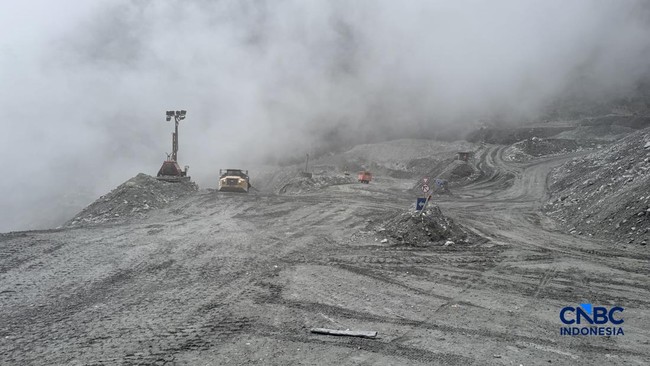
The operations of PT Freeport Indonesia (PTFI) have become a focal point for the international mining industry amid discussions on extending its Special Mining Business Permit (IUPK) beyond 2041.
Operational certainty at the Grasberg mine in Papua is considered vital for the stability of global copper and gold supply, given the rising demand for strategic minerals.
PTFI President Director Tony Wenas stated that the company’s current position serves as a barometer for the global minerals market due to its enormous production scale. PTFI operates the world’s second-largest open-pit mine and is the world’s largest gold producer.
“Grasberg, or Freeport Indonesia, is viewed by the international community as one of the barometers of copper mining. When it was an open-pit mine, it was the world’s second-largest copper mine and the second-largest open-pit mine. We are also the world’s second-largest copper producer and the largest gold producer,” Tony said in Tembagapura, Central Papua, during CNBC Indonesia’s Mining Zone programme, as quoted on Monday (24/8/2026).
With such substantial production, any operational development in Papua immediately triggers price volatility in international markets. Tony explained that market turbulence occurred when the company temporarily halted operations to focus on evacuating victims of last year’s wet material landslide incident.
“Many parties also believe that Grasberg’s future remains long. This creates hope internationally, not only for investors interested in investing directly in PTFI or through Freeport-McMoRan by purchasing its shares, but also for others,” he explained.
According to him, the current underground block caving mining method does not allow for prolonged operational pauses. If the permit is not granted promptly and activities cease, the underground rock structure risks collapsing on its own, making it extremely difficult and costly for any future operator to restore.
“The hope, of course, is for certainty, because mining conservation dictates that if resources still exist underground, operations should continue. Moreover, this is block caving—it cannot simply be stopped and later handed over to someone else. Within one or two years, the mine would have already collapsed on its own,” he added.
Progress on the IUPK extension beyond 2041
Previously, Tony stated that the company had submitted an application for the IUPK extension beyond 2041 to the government through the Ministry of Energy and Mineral Resources (ESDM).
Tony explained that the application follows up on a memorandum of understanding (MoU) signed in February 2026. The IUPK extension application was submitted in June 2026.
One of the reasons, he stressed, is the importance of operational certainty so that the company can maximise the potential of mineral reserves deemed still abundant, particularly in the Grasberg district, Tembagapura, Mimika Regency, Central Papua.
“This step is crucial to ensure mining conservation, long-term investment sustainability, safeguarding jobs for around 30,000 workers, maintaining contributions to the state amounting to tens of trillions—potentially reaching hundreds of trillions—each year, and of course continuing our community development programmes in the future,” he explained in his address at PTFI’s 81st Indonesian Independence Day ceremony in Tembagapura, Mimika Regency, Central Papua, on Monday (17/8/2026).
According to him, the extension of PTFI’s IUPK beyond 2041 will also contribute to the state. By the end of 2026 alone, PTFI has set a target of at least Rp 47 trillion in payments to the state.
If the IUPK is extended beyond 2041, Tony previously stated that PTFI would contribute approximately US$6 billion, or around Rp 90 trillion, per year to the state, assuming current commodity prices. If prices rise, the contribution to the state is expected to be even larger.
“The bottom line is that if the mine stops in 2041, no one benefits. The government also loses out—there would be no more revenue from Freeport, the 30,000 employees would be gone, and our community development programmes would cease. If it is extended, all parties benefit,” he added.
Certainty over the IUPK extension until 2041 also aligns with the development of the Kucing Liar underground mining project, which requires a total investment of Rp 72 trillion.
This substantial investment is deemed unlikely to yield optimal returns for all parties if operations cease in 2041, just as production is reaching peak levels.
Under the company’s extension application, the Indonesian government is scheduled to receive additional shares through a 12% divestment effective after 2041, or starting from 2042.
The increase in the state’s shareholding will be carried out without a commercial sale-and-purchase mechanism, but rather through a proportional reimbursement scheme for operational costs.
“There will be an additional 12% divestment signed now to take effect in 2041. There is no buying and selling involved. Whoever holds the additional 12% will proportionally reimburse the costs incurred for mining after 2041. That is only fair,” he said on the sidelines of the event.