
Free University Tuition Funded by Corruption Recoveries
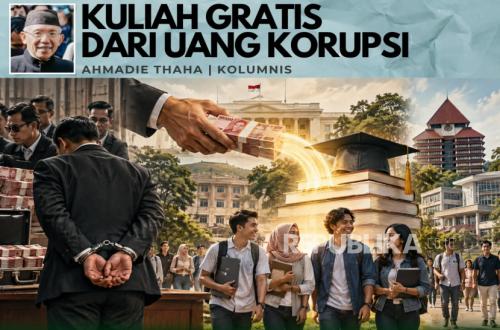
This news may bring relief to parents’ wallets. The government has begun calculating the costs required to make tuition free at state universities (PTN).
What has previously forced parents to balance Single Tuition Fees (UKT) against mortgage instalments may soon become a mere memory. During a meeting with Commission X of the House of Representatives (DPR), the Minister of Higher Education, Science, and Technology, Brian Yuliarto, stated that the budget required to make state universities free reaches approximately Rp93.7 trillion.
The precise figure of Rp93,742,969,840,000 is intended for 2,833,169 students in vocational and academic state universities at the D3, D4, and S1 levels, excluding postgraduate (S2 and S3) studies. If divided equally, this amounts to roughly Rp33.1 million per student per year. This is not money to be distributed directly to students, but rather the financing requirement that the state must bear. This figure will be subject to further discussion, including the possibility of a phased implementation.
Looking at the State Budget (APBN), the 2027 Draft State Budget allocates Rp820.9 trillion for education, in accordance with the constitutional mandate of at least 20 per cent. This includes the Program Indonesia Pintar (PIP), KIP Kuliah, school renovations, and various other educational programmes. The KIP Kuliah programme alone is allocated Rp17 trillion for approximately 1.1 million students. Therefore, Rp93.7 trillion is not a small figure, but it is not an impossible one. The issue is not merely whether the money exists, but how the allocated educational funds are structured to avoid competing for the same resources.
During the 28th anniversary of the PAN party in Jakarta on 18 September 2026, President Prabowo Subianto stated that the cost of state education—from primary school through to state universities—must be free. When asked where the funding would come from, he pointed to money from corruption, theft, and embezzlement that has been successfully returned to the state. The logic is simple: if the people’s money is stolen, return it to the people.
While that sentiment is pleasant to hear, corruption recoveries should not be the primary pillar of educational financing. Education has recurring bills: salaries for teachers and lecturers, electricity, laboratories, libraries, internet, building maintenance, and research. All of these occur annually. Meanwhile, funds from corruption recovery arrive case-by-case, depending on court rulings and the state’s ability to reclaim assets. Education requires a flowing river; seized assets are more like heavy rainfall that comes occasionally.
Regarding the practice of free education, we already have a laboratory in state schools. For primary and secondary education, the state has long borne various educational needs through the education budget, including the School Operational Assistance (BOSP). Consequently, students in state schools are not burdened with the primary tuition fees typical of private schools. The state pays for the operation of the system. This does not mean all student needs are automatically free; shoes, additional books, transport, and meals still follow their own economic laws.
Private schools will not disappear; they persist by offering alternatives such as religious education, specific curricula, school culture, discipline, or particular learning methods. Legally, the boundary between public and private is no longer as simple as it once was. In Decision Number 3/PUU-XXII/2024, the Constitutional Court affirmed that the government and local governments are obliged to guarantee compulsory education at the primary level without charging fees, whether in government-run or community-run institutions. Assistance to private schools can be provided under certain conditions to ensure standards, governance, and accountability are maintained.
This provides an important lesson for higher education. State universities (PTN) could be relieved of student tuition fees, while the state funds the campuses based on student numbers and educational needs. However, the state must not apply a uniform standard to all study programmes. Medicine, for instance, naturally costs more than the social sciences. Engineering laboratories are more expensive than standard lecture halls, and vocational education requires practical equipment. Campuses in remote areas also face different cost structures.
The formula is relatively simple: students do not pay tuition fees; the state pays a reasonable educational cost to the campus. The formula is simple, but the implementation is complex.
Source: jawawa.id (https://jawawa.id/newsitem/free-university-tuition-funded-by-corruption-recoveries-1790222295)
Originally published by Republika (https://analisis.republika.co.id/berita/tlum5o415/kuliah-gratis-dari-uang-korupsi), translated from Indonesian