
Free Nutritious Meals Encourage School Attendance, but Wealthy Pupils Still Among Recipients
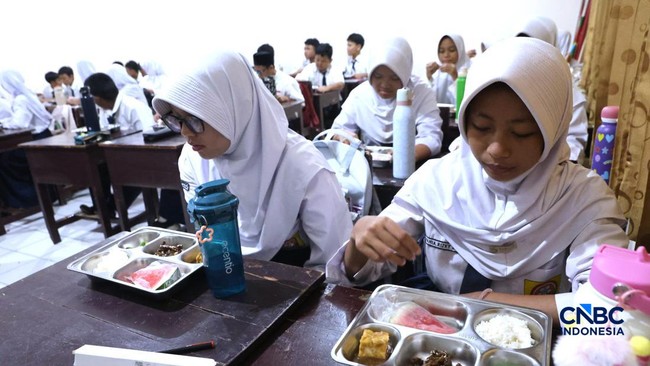
Jakarta, CNBC Indonesia — Indonesia’s National Economic Council (DEN) has found that the Free Nutritious Meals (MBG) programme could help reduce school absenteeism, particularly among children from the poorest households.
However, the programme’s distribution remains uneven: recipients are concentrated in urban areas, and pupils from wealthy families still outnumber those from poor households.
The findings were presented by DEN member Mochammad Firman Hidayat, based on a study conducted with Statistics Indonesia (BPS) and several other institutions. The research used a dedicated module in the National Socio-Economic Survey (Susenas), which has been carried out since September 2025 and covers the whole of Indonesia.
Firman said the study measured the programme’s effects on several indicators of pupils’ education and welfare, including school attendance, enthusiasm for learning and hunger during lessons.
“When we look at pupil absenteeism, MBG recipients are absent less often than non-recipients. The gap is actually quite large, particularly in decile one, the poorest group,” Firman said while presenting the DEN study’s findings at Merdeka Palace on Tuesday evening (20 October 2026).
He said pupils in the poorest group who did not receive MBG tended to miss school more often. By contrast, pupils who received the meals were relatively less likely to be absent.
The DEN also found that absenteeism fell further as the intensity of MBG provision at schools increased. The finding points to the programme’s potential to improve attendance, especially among those most in need.
Menu quality affects enthusiasm for learning
Alongside attendance, the DEN study found that receiving MBG was associated with greater enthusiasm for learning. However, the benefit depended on the quality of the food served.
Firman said 95% of pupils receiving MBG reported being more enthusiastic about learning when the meals they received were of very good quality.
By contrast, the proportion reporting greater enthusiasm fell considerably when the food was rated as poor.
“This means one of the recommendations we made to the President is that the quality of MBG menus needs attention, because it is correlated with children’s hunger and enthusiasm for learning at school,” Firman said.
The findings identify food quality as an aspect that needs attention in the programme’s implementation.
Recipients still concentrated in cities and among wealthy pupils
While noting the apparent benefits for attendance and enthusiasm for learning, the DEN also highlighted concerns about the equitable distribution of MBG recipients.
According to data for September, Firman said recipients remained more concentrated in urban areas than in rural ones. In addition, more pupils from wealthy families received the programme than pupils from poor families.
“This means there needs to be better prioritisation, particularly for disadvantaged, frontier, outermost and remote (3T) areas, rural communities and poor households,” he said.
According to Firman, the DEN believes delivery priorities need to be improved so that the communities most in need have greater access to the programme.
Source: jawawa.id (https://jawawa.id/newsitem/free-nutritious-meals-encourage-school-attendance-but-wealthy-pupils-still-among-recipients-1792551044)
Originally published by CNBC Indonesia (https://www.cnbcindonesia.com/news/20261021073049-4-778030/mbg-bikin-siswa-rajin-sekolah-tapi-penerimanya-masih-ada-siswa-kaya), translated from Indonesian