
Free Nutritious Meal System Overhauled, Beneficiaries Re-registered Using Biometrics
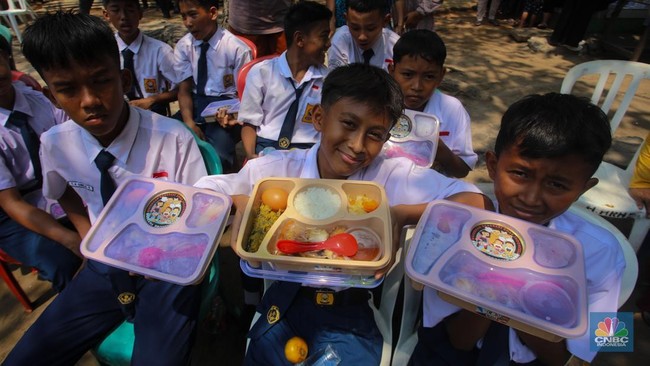
The government is strengthening the data collection system for the Free Nutritious Meal (MBG) programme using biometric technology. The National Nutrition Agency (BGN) is collaborating with the Ministry of Home Affairs (Kemendagri) through the Directorate General of Population and Civil Registration (Dukcapil) to ensure MBG beneficiaries are accurately recorded and not registered more than once.
Minister of Home Affairs Tito Karnavian stated that the population data held by Dukcapil will be used to help BGN identify MBG beneficiaries individually, including children and pregnant women. “We have just signed a cooperation agreement between BGN and Dukcapil Kemendagri. The essence is that the data of 98.7% of Indonesia’s population resides on Dukcapil Kemendagri’s servers, complete with biometrics, facial recognition, fingerprints, and iris scans,” Tito said during a press conference at his office in Jakarta on Thursday (13/8/2026).
With this system, MBG recipients will no longer be recorded merely by number or beneficiary group. Each recipient’s identity can be verified using the biometric data stored at Dukcapil. “This can also help BGN to register beneficiaries, both children and pregnant women, directly as individuals. So it is not just quantitative data on the number of beneficiaries, but exactly who the beneficiaries are can be recorded,” he said.
Tito noted that similar technology was previously used with the Ministry of Social Affairs to identify beneficiaries directly through facial recognition. “This was already done with the Ministry of Social Affairs recently; we could directly register who the beneficiaries are using facial recognition in just 5-10 seconds,” he added.
The cooperation is also expected to prevent the emergence of beneficiary data recorded more than once. Tito explained that the use of biometric data allows a person’s identity to be distinguished based on their physical characteristics. “We also agreed with the Head of BGN that with this Dukcapil and BGN cooperation programme, using accurate per-person data, it will automatically avoid instances of, for example, three, four, or five identical names among beneficiaries,” Tito said. “Because it is impossible; it can be detected. Every person has different facial characteristics, it is very easy. So one person, one beneficiary, and their progress can be tracked,” he explained.
Looking ahead, Tito said the MBG beneficiary data could potentially go beyond identity validation. The data could be integrated with the health system to monitor the development of beneficiaries, particularly children. “Later, it might be possible to integrate it with the Ministry of Health’s data, called Satu Sehat. That could register and track the child’s progress, for instance, their height, health, whether their weight has increased or not; that can be monitored through that data integration,” he elaborated.
Meanwhile, Head of BGN Sudaryono stated that updating data is a crucial part of improving the governance of the MBG programme. During a coordination meeting with local governments, he revealed that issues with duplicate data were still found in the programme’s implementation. “Dukcapil, indeed we just signed an MoU with the Ministry of Home Affairs for data updating. Also, we recently held a limited coordination meeting at the Coordinating Ministry for Food, and we found old practices, duplicate data, specifically around six million duplicates,” Sudaryono said on the same occasion.
According to Sudaryono, the duplicate data occurred partly because one recipient was registered in more than one location. For example, someone studying at an Islamic boarding school might be registered there and also at their formal school, resulting in a double entry. “But it does not mean six million multiplied by billions of rupiah, no,” he clarified.
Beyond duplicate data, BGN also discovered that some kitchens that were not yet operational already had virtual accounts that had been credited with funds. “So part of these six million are also kitchens that were not yet built, but their names had been inputted, and they had not actually provided meals. There were 414 kitchens we indicated where the kitchen did not yet exist, but the virtual account had already been filled with money,” he said. “That is the Rp311 billion we returned. That is part of the data updating process,” he continued.
With the integration of Dukcapil and BGN data, the government hopes the distribution of MBG can be more accurately targeted while facilitating the monitoring of individual beneficiaries over time.