
Free Nutritious Meal Programme absorbs Rp139.77 trillion budget until September 2026
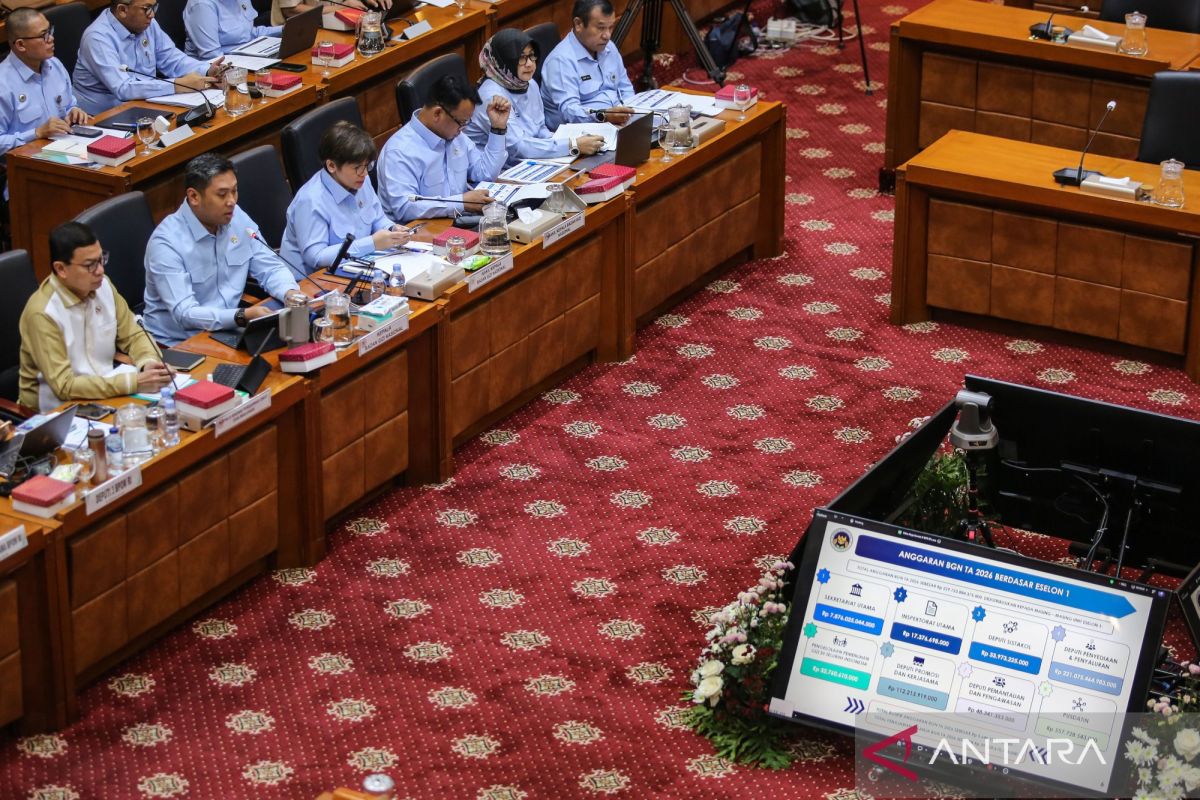
Jakarta (ANTARA) - The National Nutrition Agency (BGN) has recorded that the budget realisation for the Free Nutritious Meal (MBG) Programme for the 2026 Fiscal Year reached Rp139.77 trillion, or 63.89 per cent of the available ceiling of Rp218.77 trillion, as of 16 September 2026.
The Head of the National Nutrition Agency, Sudaryono, explained that from this ceiling, Rp79 trillion remains unutilised to support the distribution of the MBG programme until the end of the year.
“The budget realisation for the MBG Programme as of 16 September 2026 has reached Rp139.77 trillion, or 63.89 per cent of the Rp218.77 trillion ceiling. At the same time, we are continuing to improve governance to ensure the programme implementation is increasingly targeted and the quality of service is maintained,” said the Head of BGN during a working meeting with Commission IX of the Indonesian House of Representatives (DPR RI) at the Parliament Complex, Jakarta, on Thursday.
Sudaryroono explained that the MBG budget is part of the BGN’s 2026 budget ceiling, which has undergone a spending refinement process. Prior to this refinement, the total BGN budget ceiling was Rp268 trillion, consisting of the National Nutrition Fulfilment Programme at Rp255.83 trillion and Management Support at Rp12.17 trillion.
Following the spending refinement, the total BGN ceiling became Rp229.75 trillion, with an allocation of Rp221.30 trillion for the National Nutrition Fulfilment Programme and Rp8.45 trillion for Management Support.
From the total National Nutrition Fulfilment Programme budget of Rp221.30 trillion, Rp218.77 trillion, or 98.86 per cent, is allocated for the MBG budget, while Rp2.53 trillion, or 1.14 per cent, is allocated for non-MBG technical nutrition fulfilment activities.
Meanwhile, Sudaryono stated that the Management Support budget of Rp8.45 trillion, or 3.68 per cent, consists of salaries and allowances of Rp7.19 trillion, office operations and maintenance of Rp494.48 billion, and non-operational management support of Rp762.86 billion.
Overall, the BGN budget realisation as of 16 September 2026 reached 63.83 per cent, or Rp143.04 trillion of the total ceiling of Rp229.75 trillion. From that figure, the National Nutrition Fulfilment Programme realisation reached 6lar 63.89 per cent, while the Management Support Programme reached 60.71 per cent.
Based on expenditure type, Personnel Expenditure reached 64.33 per cent, Goods Expenditure reached 63.82 per cent, and Capital Expenditure reached 71.03 per cent. Based on function, Economic Function realisation was 61.28 per cent, Health Function was 65.80 per cent, and Education Function was 63.68 per cent.
According to beneficiary data as of 31 August 2026, the implementation of the MBG programme has reached 56.99 million beneficiaries, or 76.45 per cent of the target of 74.56 million beneficiaries, leaving a difference of 17.56 million beneficiaries.
The Head of BGN explained that the budget realisation and beneficiary data use different cut-off dates due to the alignment of the monthly synchronisation cycle of beneficiary data. This separation is conducted to maintain accuracy and accountability in the presentation of programme data.
According to him, the achievement of beneficiaries is still temporary as the process of improving MBG governance continues. Regarding beneficiaries, the BGN is performing a refocusing effort to ensure the programme is increasingly targeted.
A total of 1,653 educational units have been removed from the MBG recipient list, and services will be increasingly directed towards groups in need, including frontier, outermost, and least developed (3T) regions and areas with higher nutritional intervention needs.
“We are conducting this refocusing so that the programme becomes more targeted. Therefore, the difference from the target number of beneficiaries does not mean the programme has stopped. This is part of the improvement process to ensure the expansion of the MBG is more targeted, safe, accountable, and sustainable. Once service readiness is met, we will continue to expand the number of beneficiaries gradually,” said Sudaryono.